

If asset issuance on Bitcoin becomes a new narrative, will we have a more feasible and friendly way while minimizing the burden on the Bitcoin mainnet?
Therefore, a protocol that has been silent for many years has recently sparked discussion again - "RGB", a protocol that can create and manage digital assets on the Bitcoin network, which often appears together with Bitcoin second-layer concepts such as the Lightning Network.


What exactly is the RGB protocol? Can it truly bring about a Renaissance in BTC asset issuance?
Ancient RGB, focusing on BTC asset issuance
In fact, the idea of issuing assets on the Bitcoin network has been on people’s minds for a long time.
The origins of the RGB protocol can be traced back to 2018, when Bitcoin community members such as Giacomo Zucco, Peter Todd, and Alekos Filini began to explore a new way to create and manage assets on the Bitcoin network. Their goal was to design a protocol that would leverage the security and decentralization of Bitcoin while supporting more complex features such as asset issuance and smart contracts.
To achieve this goal, they began to study how to combine asset and status information with Bitcoin's UTXO model and proposed a new protocol called RGB. The core idea is to combine asset issuance, ownership, and status updates with Bitcoin's UTXO model through client verification, rather than relying on full nodes of the Bitcoin network like the current BRC-20.
As for why it is called "RGB", you can easily associate it with the three primary colors of red, green and blue. In fact, the initial research direction of the RGB protocol was "dyed coins", so the concept related to color was used. Although the current work of the RGB protocol has little to do with dyed coins, the name has been retained.

As can be seen in its Github directory, RGB's explanation is to provide scalable private smart contracts for Bitcoin and Lightning Network, creating the possibility of issuing assets in the Bitcoin network.
It’s just that due to the subsequent rise of Ethereum and Bitcoin being more considered as a store of value and a bellwether of the cryptocurrency world, the practice of issuing asset creation contracts on Bitcoin has been lukewarm.
Until recently, the popularity of BRC-20 has brought up the old tune of Bitcoin asset issuance again. Compared with the former’s direct on-chain inscription system, RGB uses more off-chain processing logic that is somewhat similar to the Lightning Network.
With UTXO, bind asset status
The implementation of the RGB protocol is actually not difficult to understand. The core lies in Bitcoin’s own accounting method - UTXO.
Due to space limitations, the author does not intend to popularize the concept of UTXO, but only briefly defines it as: it does not record the final status of Bitcoin transactions, but only records transaction events and processes.
A simple example: A has 10 bitcoins, sends 5 to B, and has 5 left. A simple description using UTXO is as follows:

UTXO 1: A has 10 BTC
UTXO 2: A has 5 BTC left
UTXO 3: B has 5 more BTC
It can be seen that UTXO is recording the transaction status changes on the Bitcoin chain. After the transaction is completed, A still has 5 BTC left, which is different from the previous state of 10 BTC. Correspondingly, UTXO1 is actually split into 2 new states: 5 BTC is given to himself as change (UTXO2), and 5 BTC is transferred to others (UTXO3).
After understanding this principle, RGB actually binds the issuance of off-chain assets with the UTXO changes on the chain:
Since UTXO can confirm Bitcoin transaction events at a certain point in time, we can make the changes in such transaction events correspond to the changes in the status of some other things;
For example, if I issue an asset in another place, it corresponds to UTXO1 on the Bitcoin network. If I transfer this asset to someone else, then this "transfer" behavior can be mapped to UTXO2 on the Bitcoin network....
Because UTXO itself is fixed and agreed upon, as long as I can prove that this binding is reliable, then the changes in UTXO on the Bitcoin mainnet and the corresponding changes in the status of other assets should also be agreed upon.
Furthermore, the RGB protocol uses the security of Bitcoin mainnet UTXO to endorse the security of its off-chain asset issuance or contract logic.
If this is hard to understand, here’s an example from Twitter user @trustmachinesco:
Matt issued 100 $MATT coins to himself on the RGB network;
On the Bitcoin network, Matt’s issuance of coins corresponds to UTXO A, which is the Bitcoin he currently holds.
Matt transferred 50 $MATT coins to Pam;
On the Bitcoin network, Matt's transfer of coins corresponds to a new UTXO B, and UTXO A in step 2 is destroyed;
On the Bitcoin network, Pam’s acquisition of coins corresponds to a new UTXO C, indicating that Pam currently holds Bitcoin UTXO;
Similarly, when Pam transfers coins, his original UTXO C will also be destroyed, thus forming a new UTXO D....

If this $Matt coin keeps transferring among different people, eventually the UTXO corresponding to these transfers will be marked on the Bitcoin mainnet, and each transfer will cause the original UTXO to be destroyed and a new UTXO to be generated. If this $Matt coin keeps transferring among different people, eventually the UTXO corresponding to these transfers will be marked on the Bitcoin mainnet, and each transfer will cause the original UTXO to be destroyed and a new UTXO to be generated.

Through this process, we can see how the creation, transfer, and verification of assets in the RGB protocol are linked to Bitcoin's UTXO. This connection enables RGB assets to be transferred securely, decentralized, and privately on the Bitcoin network.
One-time stamp and commitment
The above is a very simple technical detail of RGB implementation. In fact, to ensure that the assets issued by RGB off-chain can indeed match the UTXO on the chain, some other technologies are needed to achieve it.
Client-side verification: In the RGB protocol, transaction verification and data storage are done on the client (such as wallet software) rather than on the blockchain. This keeps transaction data from being made public on the chain, thereby improving privacy. Client verification can also reduce on-chain data storage requirements and improve network scalability.
This is also a big difference between RGB and BRC20. Since the transaction data is on the client rather than on the chain, it can theoretically greatly reduce the current network congestion and high transaction fees.
Single-Use-Seals: A technology that ensures that asset ownership cannot be tampered with. A one-time seal is a cryptographic signature that is used to lock the state of an asset. When an asset is transferred, the old seal is destroyed and a new seal is created. This way, any attempt to tamper with the asset ownership will be discovered because the state of the seal will not match.
This also corresponds to the destruction and generation of UTXO described in the previous section. The old seal represents the old UTXO, and the new seal points to the new UTXO.
Commitments: To associate assets with the Bitcoin network, the RGB protocol uses a technology called commitments. A commitment is a cryptographic proof that an asset is associated with a specific Bitcoin transaction. Commitments are embedded in the output of a Bitcoin transaction (UTXO), which allows assets to be transferred on the Bitcoin network.
Anchoring: In order to connect client verification and the Bitcoin network, the RGB protocol uses anchoring technology. Anchoring is the process of combining a one-time seal and a commitment. When assets are transferred, new one-time seals, commitments, and transaction data are anchored to the Bitcoin network, ensuring the security and consistency of the entire system.
Here, the author gives a more practical RGB protocol workflow:
The asset issuer creates a new asset on the client side and generates a one-time seal and commitment.
Asset issuers anchor new assets to the Bitcoin network by embedding commitments into Bitcoin transaction outputs (UTXOs).
The recipient of the asset verifies the validity of the asset by viewing the commitment and verifying the one-time stamp.
When assets are transferred, the old one-time seal is destroyed and the new one-time seal, commitment, and transaction data are anchored to the Bitcoin network.
In this way, the RGB protocol enables asset issuance, transfer, and verification on the Bitcoin network while maintaining privacy, scalability, and decentralization.
At the same time, RGB can also be well integrated with the Lightning Network. In its official documentation, RGB describes itself as an L2 or L3; when the Lightning Network exists, RGB can be used as an L3 to quickly exchange Bitcoin and RGB tokens off-chain, thereby achieving more efficient transactions and asset management.
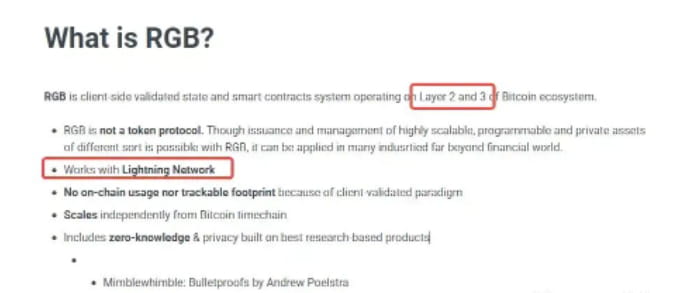
In my opinion, both the RGB protocol and the Lightning Network are second-layer protocols on Bitcoin, focusing on digital asset issuance and management and rapid value transfer respectively. They can support and complement each other to achieve a more efficient and scalable Bitcoin ecosystem.
future
RGB has been dormant for a long time, but has been dug up again. In fact, it is still due to the trend of BRC-20 issuing assets.
Without making value judgments or discussing significance, what we can discover more is that after the first wave of speculation, more opportunities will quietly emerge and push the entire ecosystem forward one step further amid the noise.
At present, we can see that RGB has also unlocked the last remaining functions required to implement smart contracts in the recently released V0.1 version. In the context of BRC-20 burdening the network, RGB's paving at the infrastructure layer may give rise to other BTC-based protocols and applications.

At the same time, RGB has actually launched a wallet that can send and receive BTC-based network assets and supports NFT-related functions. During the author’s research, it was found that the RGB-related Telegram discussion group is still active, and developers are keen to discuss and answer technical-related questions.

Leading the revival narrative of BTC, BRC-20 may be the first, but unlikely to be the last.
Some people benefit from the hype, and it brings new technical problems; solving these problems often generates new narratives, awakening old protocols like RGB, which may trigger the next wave of hype.