

Key Insights
PEPE has become the fastest growing ERC-20 token in cryptocurrency history, gaining a $1 billion market cap and 107,000 holders in just 23 days;
PEPE triggered the revival of Meme coins. As a result, both Ethereum and Bitcoin networks experienced congestion and increased transaction fees;
Although PEPE has seen record growth, its valuation is still only a fraction of DOGE and SHIB.
A common complaint about the current state of cryptocurrency is that it lacks adoption for the average person. This is a fair criticism, but there is one product that has consistently proven to be able to attract new users to the chain: meme coins. Recently, speculators have seen a resurgence in interest in meme coins thanks to the parabolic growth of PEPE, an Ethereum ERC-20 token that attracted 107,000 holders and reached a market cap of over $1 billion in just 23 days. To better understand the role of meme coins in cryptocurrency, let’s take a look at their history and progress up until the recent PEPE craze that has sparked a lot of market attention.
origin
Memecoins trace their origins back to Dogecoin (DOGE) in late 2013, peaking during the 2021 bull run. In 2021, DOGE gained mainstream popularity, growing from a market cap of $700 million on January 1 to $88 billion by early May. Following Dogecoin’s run, Shiba Inu (SHIB) reached a market cap of $42 billion at the end of October, having started the year with a market cap of less than $1 million. These dog-themed assets have no intrinsic value, but their association with viral internet memes has fueled their popularity among both cryptocurrency and retail users.
Now, PEPE is the latest meme coin to attract the market’s attention. The popularity of this coin stems from the Pepe the Frog character created by Matt Furie in the 2005 cartoon “Boys Club”. After the original Pepe drawing and later variations achieved virality on Internet platforms such as 4chan and Tumblr in the 2010s, Pepe was adopted by the cryptocurrency community and quickly became part of the cryptocurrency cultural lore.

The PEPE token was released more than three weeks ago on April 14, with a total supply of 420.69 trillion tokens. 93.1% of the tokens were deposited into Uniswap's liquidity pool, and the remaining 6.9% were stored in a multi-signature wallet for future centralized exchange listings. The anonymous team that released PEPE took advantage of Pepe the Frog's existing popularity on Twitter and created a meme campaign to drive early adoption. It can be said that this strategy has achieved unexpected success.
PEPE's growth data
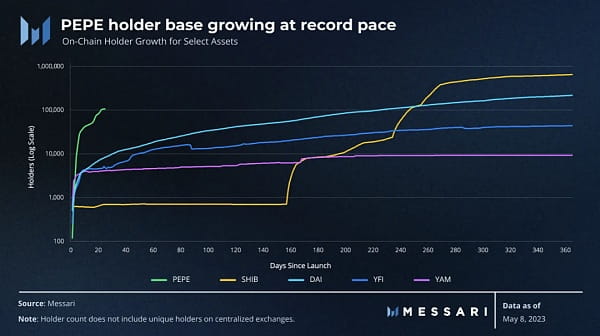
PEPE’s meteoric growth is unprecedented in the history of cryptocurrency. Its first two days were relatively quiet, but by the third day, the number of daily holders grew by the thousands. It took only 22 days for PEPE to have more than 100,000 holders on the chain.
This is even more impressive when compared to the historical growth of other fast-growing Ethereum tokens. When SHIB entered a period of hypergrowth in 2021, it took the token 90 days to reach 100,000 holders. Viral assets from the 2020 DeFi summer, like YFI and YAM, never even reached the 100,000 holder milestone. As a proxy for more organic growth rather than speculative demand, Dai provides a benchmark: it took 225 days to reach 100,000 holders.
Arguably the most important factor driving Pepe’s growth is that crypto players are now familiar with how meme coins have grown rapidly from the initial cycle led by DOGE and SHIB in 2021. There is profit in getting a head start, and this self-reinforcing force attracts more buyers as the popularity of the meme increases. If we look at the average value per holder of PEPE and SHIB, measured by the market value of each holder’s holdings, we see that PEPE shows a similar growth pattern to SHIB, but at a much faster pace.
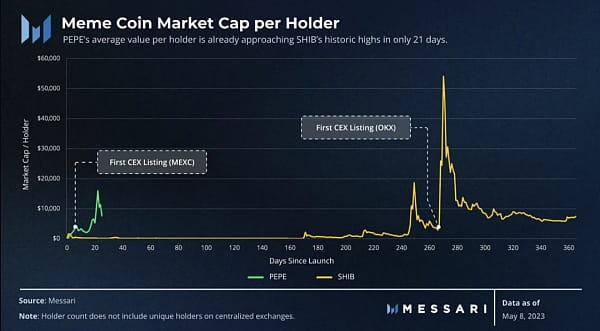
The rapid listing on centralized exchanges added fuel to PEPE's hot start. It took only six days for PEPE to land on MEXC, its first centralized exchange; and 22 days to land on Binance, the world's largest cryptocurrency exchange. These integrations not only lower the threshold for users to speculate, but also enable large capital providers to provide off-chain market making services. In the past week, we have seen most of PEPE's trading volume move from Uniswap to these centralized platforms.
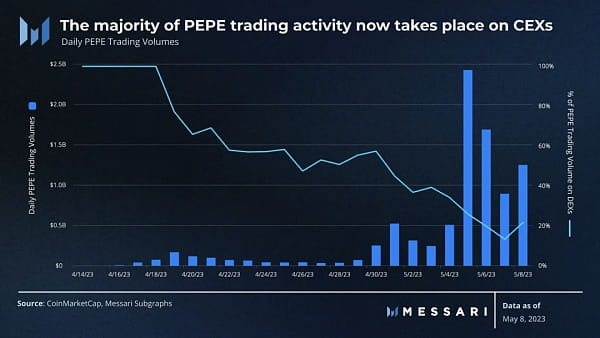
The adoption of PEPE on centralized exchanges has also opened the door to PEPE derivatives trading. Now, exchanges like Binance and Bybit have offered PEPE perpetual futures, enabling users to invest in PEPE's price with 100x leverage. In just a few days, the trading volume of PEPE derivatives has exceeded daily spot trading volume.
Because derivatives create leveraged exposure to the underlying asset, they also introduce greater volatility to the asset. This volatility is now spilling over into Ethereum’s DeFi ecosystem, where a sharp swing in PEPE prices over the weekend pushed Ethereum gas fees to a new yearly high. Users are once again faced with transaction fees of more than $100 to exchange PEPE on-chain.
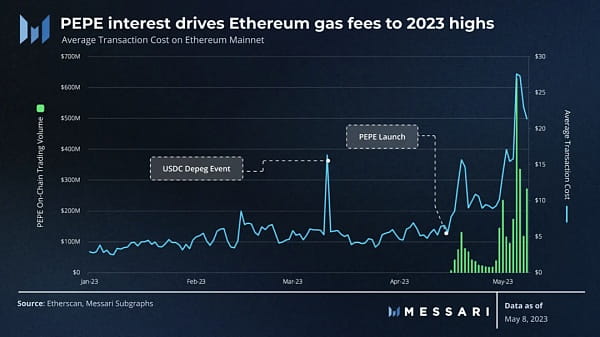
Unlike the meme coin craze of 2021, the Ethereum ecosystem now has fully functional second-layer solutions that can help alleviate mainnet congestion. However, the creators of PEPE chose to launch on the Ethereum mainnet to maximize their exposure to liquidity. While Ethereum, Arbitrum, and Polygon all offer similar numbers of daily active users, Ethereum has a total locked value of $29 billion, Arbitrum has $2.5 billion, and Polygon has $1 billion. Choosing to launch on the Ethereum scaling solution will create greater friction and reduce the likelihood of PEPE breaking out.
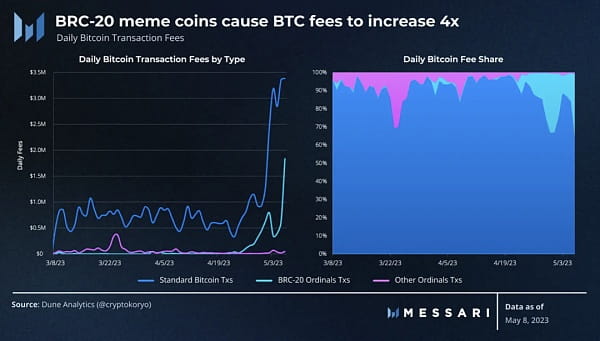
Meme coins may not have made a splash on Ethereum’s scaling solution, but they are scaling to Bitcoin through the novel BRC-20 standard built on the Ordinals protocol. These “tokens” are fungible chunks of metadata inscribed in a single satoshi on the Bitcoin network. Since the release of PEPE, BRC-20 meme coins have exploded in popularity and caused severe congestion on the network — enough to force Binance to suspend BTC withdrawals twice in one day to reconfigure their fee processing.
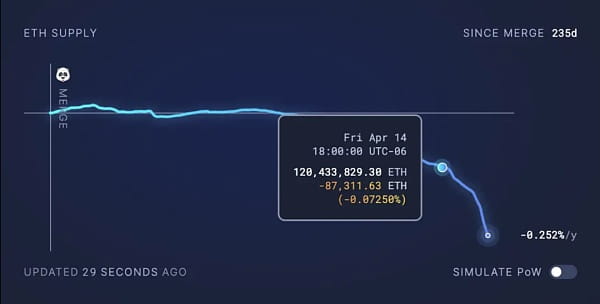
Finally, the resurgence of activity on the Ethereum mainnet has benefited ETH holders. ETH supply is shrinking at the fastest rate since The Merge occurred in September 2022. Although on the surface, PEPE is clearly the clear winner of the recent meme cycle, the "Ultrasound Money" meme has shown its strength on the fundamentals.
Looking ahead
Both SHIB and DOGE experienced a 90% price correction after their parabolic growth in 2021. Will PEPE face the same outcome? The history of speculative markets would say yes. However, this is not to say that PEPE’s rise is over.
At the height of the frenzy in October 2021, SHIB’s market cap briefly surpassed DOGE, peaking at a $45 billion market cap. At $1 billion, PEPE is now one-fifth the size of SHIB and one-tenth the size of DOGE. It wouldn’t be surprising to see it surpass both at some point, even if only briefly.
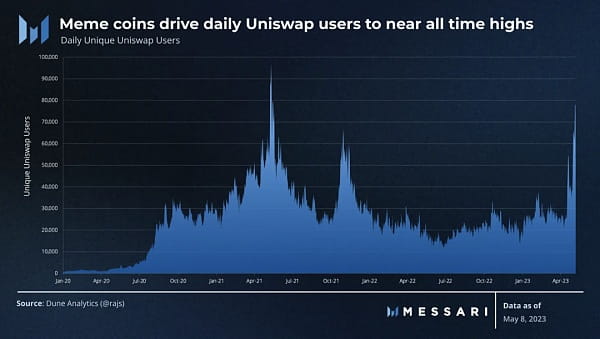
Another data point worth watching is the number of daily active users of Uniswap on Ethereum. This number has more than doubled since the release of PEPE and is now rapidly approaching the all-time high of 90,000 daily users in May 2021. Integrations with Uniswap mobile wallets have improved since 2021 and could set a new daily user record if PEPE continues to gain traction.
Finally, stories are spreading of early PEPE buyers getting rich from a small initial investment. These stories make speculative investments in other newly launched memecoins more attractive to fringe users. In the first two weeks of Pepe’s release, we began to see substantial interest in other memecoins such as WOJAK, TURBO, and AIDOGE. However, the excitement and growth of these alternative memecoins are all characteristics of the final stage of the 2021 memecoin mania.