
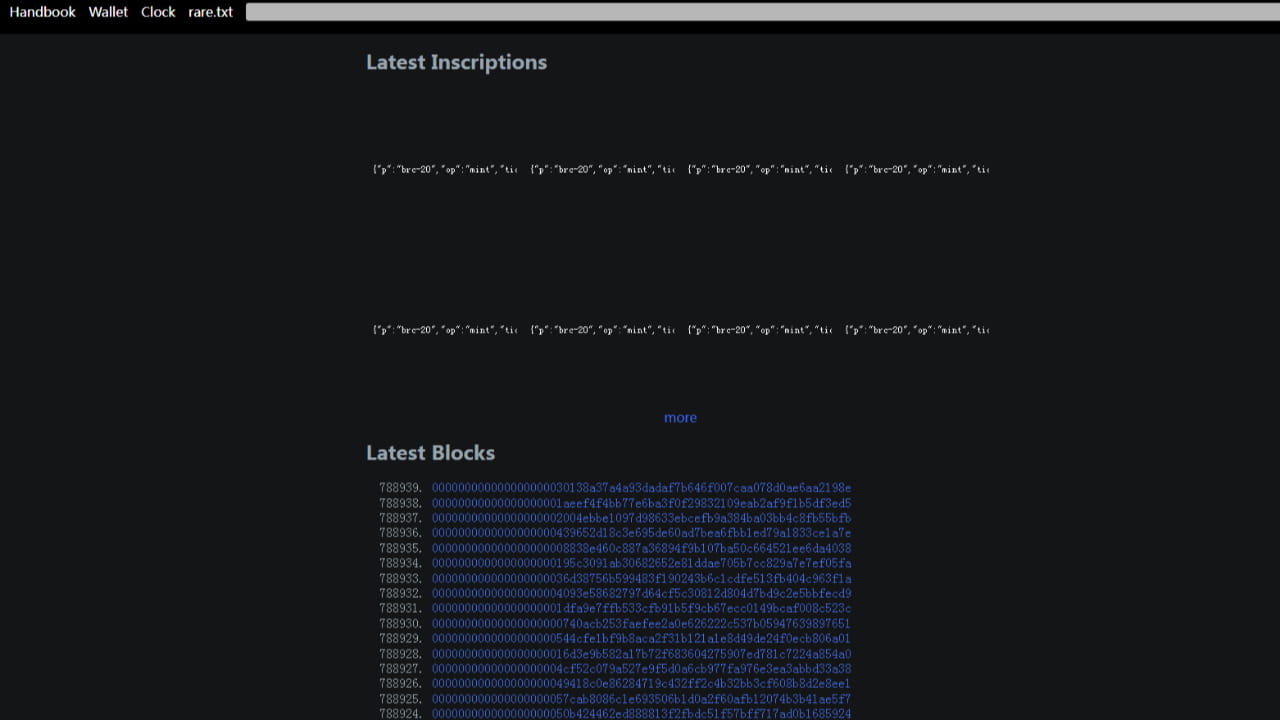

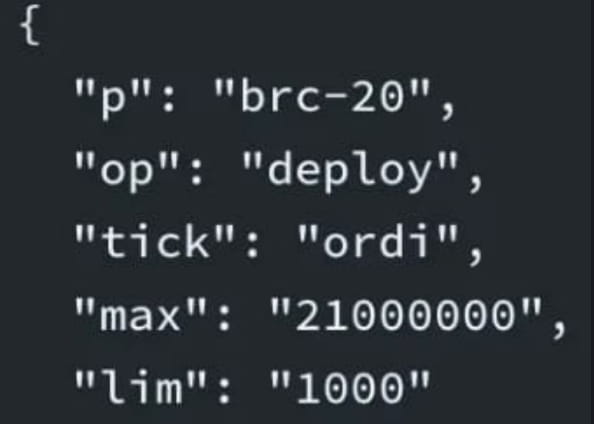
BRC-20 is an experimental Bitcoin network homogeneous token standard, proposed by Twitter user @domodata on March 8, 2023. It leverages JSON data inscribed on the Bitcoin network to deploy token contracts, mint tokens, and transfer tokens. BRC-20 is a Token issuance standard that imitates ERC-20 but is implemented on the Bitcoin network. It leverages data to deploy token contracts, mint tokens, and transfer tokens.
3. Inscription
Inscriptions engrave arbitrary content, creating digital artifacts native to Bitcoin, often referred to as NFTs. Inscription does not require sidechains or separate tokens.
These engraved sats can then be transferred using a Bitcoin transaction, sent to a Bitcoin address, and saved in a Bitcoin UTXO. These transactions, addresses, and UTXOs are in all respects normal Bitcoin transactions, addresses, and UTXOs, except that in order to send individual sats, the transaction must control the order and value of inputs and outputs according to ordinal theory.
The inscription content model is networked. An inscription consists of a content type (also called a MIME type) and the content itself (byte string). This allows inscription content to be returned from a web server and used to create HTML scripts that use and remix other inscription content.
The inscription content is entirely on-chain and stored in the taproot script-path spending script. Taproot scripts have few restrictions on their content and receive additional witness discounts, making inscription content storage relatively economical.
Since taproot script costs can only be generated from existing taproot output, a two-phase commit/reveal process is used for engraving. First, in the commit transaction, create a commit to the taproot output of the script containing the inscription content. Second, in the display transaction, use the output generated by the submission transaction to display the inscription content on the chain.
The inscription content is serialized using data pushes in unexecuted conditions, called "envelopes". The envelope consists of OP_FALSE OP_IF ... OP_ENDIF wrapping any number of data pushes. Because envelopes are effectively no-ops, they do not change the semantics of the script that contains them and can be used in conjunction with any other locking script.
A text inscription containing the string "Hello, world!" is serialized as follows:
OP_FALSEOP_IF OP_PUSH "ord" OP_1 OP_PUSH "text/plain;charset=utf-8" OP_0 OP_PUSH "Hello, world!"OP_ENDIF
The string ord is first pushed to disambiguate inscriptions from other uses of envelopes.
OP_1 indicates the type of content the next push contains, and OP_0 indicates that subsequent data pushes contain the content itself. Large inscriptions must use multiple data pushes because one of the few limitations of taproot is that a single data push cannot be larger than 520 bytes.
The inscription content is contained in the input showing the transaction, and the inscription is made on the first sat of its first output. This sat can then be tracked using familiar ordinal theory rules, allowing it to be transferred, bought, sold, lost and recovered.
4. Frequently Asked Questions
What is ordinal theory?
Ordinal Theory is a protocol for assigning ordinal numbers to satoshis (the smallest subdivisions of Bitcoin) and tracking those satoshis as transactions are spent.
These serial numbers are very large numbers, such as this one 804766073970493. Each Satoshi, the ¹⁄₁₀₀₀₀₀₀₀₀ of Bitcoin, has a serial number.
Does ordinal theory require sidechains, separate tokens, or changes to Bitcoin?
unnecessary! Ordinal theory works now, there are no sidechains, and the only token required is Bitcoin itself.
What is the use of ordinal theory?
Collect, trade and plan. Ordinal theory assigns identity to each satoshis, allowing them to be tracked and traded individually as curios and numismatic value.
Ordinal theory also supports inscriptions, a protocol for attaching arbitrary content to certain satoshis, turning them into digital artifacts native to Bitcoin.
How does ordinal theory work?
Ordinal numbers are assigned to satoshis in the order they are mined. The first Satoshi in the first block has a sequence number of 0, the second Satoshi has a sequence number of 1, and the last Satoshi of the first block has a sequence number of 4,999,999,999.
Satoshis exist in outputs, but transactions destroy outputs and create new outputs, so ordinal theory uses an algorithm to determine how satoshis jump from the inputs of a transaction to the outputs.
Fortunately, the algorithm is very simple.
Cong conducts transfers in first-in, first-out order. Think of the transaction's inputs as a list of satoshis and its outputs as a list of slots waiting to receive satoshis. To assign an input satoshi to a slot, each satoshi in the input is examined in order and each satoshi is assigned to the first available slot in the output.
Let's imagine a transaction with three inputs and two outputs. Inputs are to the left of the arrow and outputs are to the right, both labeled with their values:
[2] [1] [3] → [4] [2]
Now let's mark the same transaction with the ordinal number of the satoshis contained in each input, and mark each output slot with a question mark. Ordinal numbers are large, so let's represent them using letters:
[a b] [c] [d e f] → [? ? ? ?] [? ?]
To figure out which satoshi goes to which output, check the input satoshis in order and assign each satoshi to a question mark:
[a b] [c] [d e f] → [a b c d] [e f]
You may ask what about the cost? good question! Let’s imagine the same transaction, this time with a fee of two satoshis. A fee transaction sends more satoshis in the input than the output receives, so to make our transaction a fee-paying transaction we will remove the second output:
[2] [1] [3] → [4]
satoshis e and f now go nowhere in the output:
[a b] [c] [d e f] → [a b c d]
So they go as a fee to the miner who mined the block. The BIP has details, but in short, fees paid by a transaction are treated as additional inputs to coinbase transactions and are ordered according to how their corresponding transactions are ordered in the block. The coinbase transaction for this block might look like this:
[SUBSIDY] [e f] → [SUBSIDY e f]
Where can I find the details?
BIP!
Why are sat inscriptions called “digital artifacts” instead of “NFTs”?
An inscription is an NFT, but the term “digital artifact” is used instead because it is simple, revealing, and familiar.
The term "digital artifact" is highly suggestive, even to someone who has never heard the term before. In contrast, NFT is an acronym that doesn’t provide any indication of what it means if you haven’t heard it before.
Additionally, “NFT” feels like a financial term, and the word “fungible” and the word “token” used in “NFT” have meanings that are not common outside of a financial context.
How do sat inscriptions compare to other....?
Ethereum NFT?
The inscription never changes.
The creator of the inscription or the owner of the inscription simply cannot modify it after it has been created.
Ethereum NFTs can be immutable, but many are not, and can be changed or deleted by the NFT contract owner.
To ensure that a specific Ethereum NFT is immutable, the contract code must be audited, which requires a detailed understanding of EVM and Solidity semantics.
It is difficult for non-technical users to determine whether a given Ethereum NFT is tamperable or non-tamperable, and the Ethereum NFT platform makes no effort to distinguish whether an NFT is tamperable or non-tamperable, and whether the contract source code is available and audited .
The content of the inscription is always on the chain.
Inscriptions cannot reference off-chain content. This makes the inscription more durable, since the content cannot be lost, and rarer, since the inscription creator must pay a fee proportional to the size of the content.
Some Ethereum NFT content is on-chain, but most is off-chain and stored on platforms like IPFS or Arweave, or on traditional fully centralized web servers. Content on IPFS is not guaranteed to continue to be available, and some NFT content stored on IPFS has been lost. Platforms like Arweave rely on weak economic assumptions, and they can fail catastrophically when these economic assumptions are no longer met. Centralized web servers can disappear at any time.
It can be difficult for non-technical users to determine where the contents of a given Ethereum NFT are stored.
The inscription is much simpler.
Ethereum NFTs rely on the Ethereum network and virtual machine, which are complex, constantly changing, and changes are introduced through backward-incompatible hard forks.
Inscription, on the other hand, relies on the relatively simple and conservative Bitcoin blockchain, which introduces changes via backward-compatible soft forks.
Inscriptions are safer.
Inscriptions inherits Bitcoin’s transaction model, which allows users to see exactly which Inscriptions a transaction is transferring before signing the transaction. Inscriptions can be sold using partially signed transactions, which does not require allowing a third party (such as an exchange or marketplace) to transfer them on behalf of the user.
In contrast, Ethereum NFTs have been plagued by end-user security vulnerabilities. Blind signing of transactions, granting third-party applications unlimited permissions to user NFTs, and interacting with complex and unpredictable smart contracts are commonplace. This creates a dangerous minefield for Ethereum NFT users, and one that ordinal theorists simply don’t care about.
There are fewer inscriptions.
Inscriptions require Bitcoin to mint, transfer and store. On the surface, this may seem like a disadvantage, but the raison d'etre of digital artifacts is scarcity and therefore value.
Ethereum NFTs, on the other hand, can be minted in nearly unlimited quantities via a single transaction, making them inherently less scarce and therefore potentially less valuable.
Inscription doesn’t pretend to support on-chain royalties.
On-chain royalties are a good idea in theory, but not in practice. Royalty payments cannot be enforced on-chain without complex and intrusive restrictions. The Ethereum NFT ecosystem is currently grappling with the confusion surrounding royalties and is collectively facing the reality that on-chain royalties conveyed to artists as a benefit of NFTs are not possible, while platforms race to lower and remove royalty support.
Inscription avoids this scenario entirely by not making false promises to support on-chain royalties, thereby avoiding the confusion, chaos, and negativity of the Ethereum NFT situation.
Inscriptions open new markets.
Bitcoin’s market capitalization and liquidity are both significantly higher than those of Ethereum. Ethereum NFTs don’t have access to much of the liquidity because many Bitcoin holders are reluctant to interact with the Ethereum ecosystem due to concerns about simplicity, security, and decentralization.
Such Bitcoin advocates may be more interested in inscriptions than Ethereum NFTs, unlocking a new class of collectors.
Inscription has a richer data model.
A signature consists of a content type (also known as a MIME type) and the content (an arbitrary byte string). This is the same data model used by the web, allowing signature content to evolve with the web and support any type of content supported by web browsers without changing the underlying protocol.
RGB and Taro assets?
RGB and Taro are both layer-2 asset protocols built on Bitcoin. They are much more complex than the inscriptions, but also more distinctive.
Ordinal Theory is designed for digital artifacts, and the main use case for RGB and Taro is fungible tokens, so the user experience for Inscriptions is likely to be simpler and more refined than that for RGB and Taro NFTs.
Both RGB and Taro store content off-chain, which requires additional infrastructure and can be lost. In contrast, the inscription content is stored on-chain and cannot be lost.
Ordinal theory, RGB, and Taro are all very early, so this is speculation, but the focus of Ordinal theory may give it an advantage in terms of characteristics of digital artifacts, including features such as better content models and globally unique symbols.
Counterparty assets?
Counterparty has its own token, XCP, which is required for certain features, causing most Bitcoin holders to view it as an altcoin rather than an extension or second layer to Bitcoin.
Ordinal Theory was designed from the ground up for digital artifacts, while Counterparty was primarily designed for financial token issuance.
Who can use inscriptions…
artist
*The inscription is on Bitcoin. *Bitcoin is currently the digital currency with the highest status and the greatest chance of long-term survival. If you want to ensure that your artwork lives on into the future, there is no better way to publish than with an inscription.
*Cheaper on-chain storage. *At a minimum relay fee of $20,000 per BTC and 1 satoshi per vbyte, the cost to publish inscribed content is $50 per 1 million bytes.
*It's still early days for Inscription! *Inscription is still under development and has not been released on mainnet yet. This gives you the opportunity to be an early adopter and explore the medium as it evolves.
*The inscription is simple. *Inscription does not require writing or understanding smart contracts.
*Inscriptions unlock new mobility. *Inscriptions are more accessible and more attractive to Bitcoin holders, unlocking a whole new class of collectors.
Inscriptions are designed for digital artifacts*. *Inscription was designed from the ground up to support NFTs and feature a better data model, as well as features such as globally unique symbols and enhanced provenance.
*Inscription does not support on-chain royalties. *This is a negative, but it just depends on how you look at it. On-chain royalties have been a boon to creators, but they’ve also caused massive disruption in the Ethereum NFT ecosystem. The Ethereum ecosystem is now grappling with this issue and there is a race to the bottom to achieve an optional royalty future. Inscription does not support on-chain royalties as they are not technically feasible. If you choose to create an inscription, you can work around this limitation in a number of ways: retain a portion of the inscription for future sale, benefit from future appreciation, or provide perks to users who respect the optional royalties.
collector
*The inscription is concise and clear, with no surprises. *They are always immutable and on-chain, requiring no special due diligence.
Inscription on Bitcoin. You can easily verify the location and properties of the inscription using a Bitcoin full node that you control.
Bitcoin holders
I begin this section with the following statement: “The most important thing the Bitcoin network does is decentralize the currency.” All other use cases are secondary, including ordinal theory. The developers of ordinal theory understand and acknowledge this, and believe that ordinal theory contributes to Bitcoin's primary mission, at least to a small extent.
Unlike many other things in the altcoin space, digital artifacts have their merits. Of course, there are tons of NFTs that are ugly, stupid, and fraudulent. However, there are many very creative things out there, and the art of creating and collecting has been part of the human story from the beginning, even before trade and money, which are also ancient techniques.
Bitcoin provides an amazing platform for creating and collecting digital artifacts in a secure, decentralized way, protecting users and artists in the same way it provides an amazing platform for sending and receiving value, and for the same reasons .
Ordinal numbers and inscriptions increase the demand for Bitcoin block space, which increases Bitcoin’s security budget, which is critical to safeguarding Bitcoin’s transition to a fee-dependent security model, as it becomes infeasible to allow the block reward to be halved. No matter how important it is.
The content of the inscription is stored on the chain, so the block space requirements used by the inscription are unlimited. This creates a buyer of last resort for all Bitcoin block space. This will help support a strong fee market, ensuring Bitcoin remains secure.
The inscription also refutes claims that Bitcoin cannot scale or be used for new use cases. If you follow projects like DLC, Fedimint, Lightning, Taro, and RGB, you know this statement is false, but Inscription provides an easy-to-understand counter-argument that targets a popular and proven use case - NFTs. This makes it very clear.
If the inscriptions become highly sought-after digital artifacts with rich histories, as the authors hope, they will serve as a powerful hook for Bitcoin adoption: come for the fun, rich art, stay for the decentralized digital currency .
Inscriptions are an extremely benign source of block space requirements. For example, stablecoins on Bitcoin (which may give large stablecoin issuers an influence on the future of Bitcoin development), or DeFi (possibly through the introduction of MEV on Bitcoin), digital art and collectibles are unlikely to generate sufficient Individual entities of power undermine Bitcoin. Art is decentralized.
Inscription users and service providers are incentivized to run Bitcoin full nodes, issue and track inscriptions, thereby investing their economic weight into the honest chain.
Ordinal theory and inscriptions will not have a meaningful impact on Bitcoin’s homogeneity. Bitcoin users can ignore both without repercussions.
We hope that ordinal theory will strengthen and enrich Bitcoin and give it another dimension of appeal and functionality, allowing it to more effectively serve its primary use case, which is a decentralized store of value for humanity.