

W Labs Editor’s Note:
Last week, I wrote about some thoughts on SLG games on the blockchain side. Xiaofei also happened to have completed a survey on SLG games. You can just read it. Xiaofei is a core partner of W Labs. He is a practitioner in the WEB3 industry and a senior blockchain game player. At the last Singapore token2049 blockchain game hackathon, Xiaofei was one of the members of the W Labs judging team. He looked at more than a dozen projects in a week and gave very detailed comments. You can follow Xiaofei on Twitter: @daifei520
one
Half a year ago, I thought that the blockchain version of the SLG project would be very difficult to do.
What's the difficulty?
At that time, the judgment was made based on the characteristics of the WEB2 SLG game ecosystem:
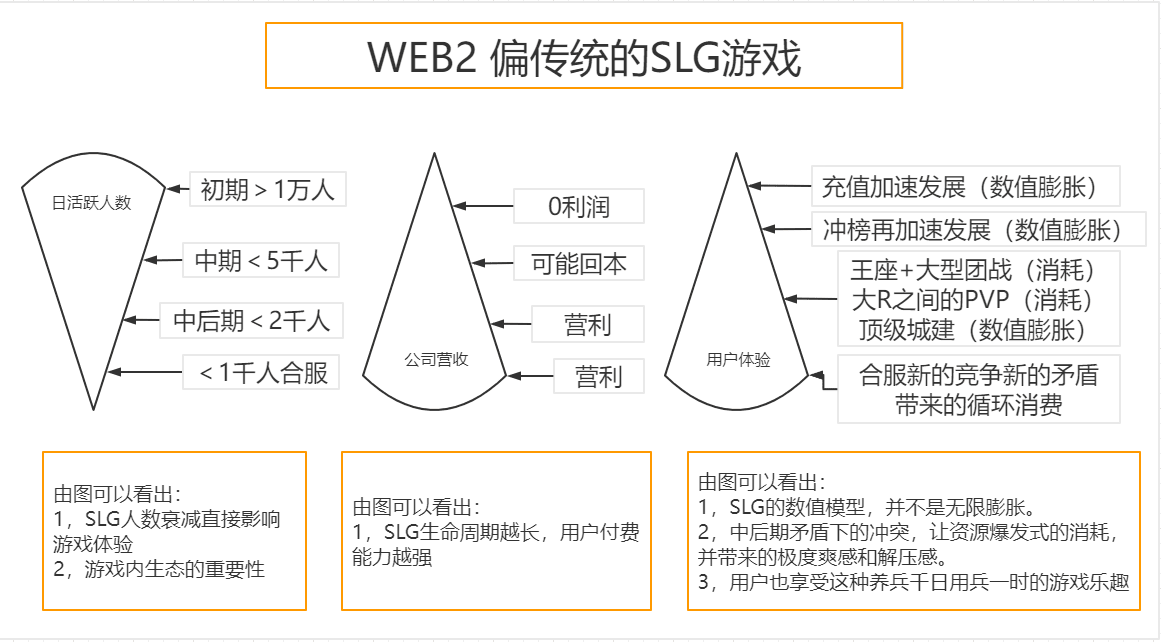
1. SLG needs to establish a game ecosystem first, retain more users in the early stage, have richer user levels, and not have too big a gap between alliances, and gradually establish contradictions and conflict points in the process. In this case, it is not profitable in the early stage.
2. After about half a year, users build social relationships with each other, and various real social relationships are displayed in the game, such as brotherhood, chivalry, intrigue, and deception. The contradictions escalate to the extreme, and people fight for the throne and fight to the death. Specifically, soldiers, resources, acceleration, recovery, etc. are all bought with money. It is a pleasure to spend tens of thousands of dollars.
3. After every large-scale group battle, many alliances will disband and users will leave. The gap in combat power between alliances is too large. After one company dominates, the ecosystem gradually becomes unbalanced. The final result is: there are no fights in the game, no place to vent, and it is boring to play.
4. When 10,000 to 20,000 people initially join a server, it is fun to play. You can always find someone to bully. The big world also looks very lively. When the number of people on a server drops to 2,000 to 3,000, you should consider merging the servers.
so:
1. WEB2 SLG relies heavily on the in-game ecosystem. Can blockchain game SLG create an in-game ecosystem?
2. A server must have at least 1,000 daily active accounts. How many daily active users can a blockchain game SLG have?
3. It will take at least three months and at most more than half a year to see more and more users recharging. Can the life cycle of blockchain game SLG be more than three months and can the payment increase in the future?
All signs indicate that it is too difficult to use WEB2 thinking to create SLG.
Even so, there are still WEB3 game developers exploring the SLG type, which is remarkable.
two
I have played "MOiand Defense" before. It is a TD-style card development game, and it is also a unique blockchain game mode explored by the MOBOX platform.
It can even be said that they are exploring a rapid game chain reform solution based on the platform's mother currency framework.
During the National Day holiday, I had more time, so when the season was about to end, I also played the latest SLG blockchain game "Clash of MOland" on the platform. This game continues the mature blockchain game model of "MOiand Defense". Although not everyone likes this model, I didn't like it at the beginning. But it is still a business model that can be explored and continued. At the same time, I also see places for evolution or innovation, such as:
In the following examples, the payback period calculation brought by the ranking rewards is not considered. The reasons will be explained later.
In the card game "MOiand Defense", users spend the mother currency to buy gold coins to draw cards. The quality of the card has nothing to do with the payback period (yes, the payback period has nothing to do with the quality of the card, pay attention). The payback period was originally designed to be non-fixed. If you spend 100, you can get 20-80 back. It's probably like this, I can't remember it because it's been so long. Now it's a fixed 50 back for every 100 spent. The rest depends on playing the ruins dungeon every day (which can be understood as mining). The dungeon will produce a fixed amount of sub-coins according to the consumption level. In summary: without considering the leaderboard rewards, the payback period is fixed. Payback mode: mine sub-coins in the dungeon + return the mother coin in the lottery.
In the SLG game "Clash of MOland", users directly spend mother coins to draw cards, and the quality of the cards directly affects the payback period, which is different. That is, if you spend 100 to draw several top cards, the mother coins and sub-coins released after the cards are bound will be more and faster, with low consumption and high returns, and the payback period will naturally be faster than those who spend 1,000 to draw the same number of top cards (the release of tokens by the monument can also be understood as mining). In summary: without considering the ranking rewards, the payback period is not fixed. Payback mode: Monument mining mother coins + sub-coins.
More detailed comparisons are shown below:
Card draw comparison
In this way, due to the different mining methods and payback periods, users can clearly understand that these are two games with different money-making models.
That is why we did not consider the ranking list when analyzing. Because the ranking list is similar from the user's perspective, we will not discuss the same design.
The most important difference between the two is probably the one that users have received the most feedback on:
In the card game "MOiand Defense", the price of top cards in the in-game trading market is too low, there is no demand, no liquidity, and the odds of drawing cards are negative. Users will definitely not spend the mother currency to draw cards.
In the SLG game "Clash of MOland", the top cards can release 90 mother coins at the minimum, 2 mother coins for 1 draw, and the odds are 45 times. With the guaranteed price, the game between users will generate demand, and the market is there. No matter how bad it is, after 3-4 seasons, after the mother coins are released, plus the sub-coins released in each season, you can always get your money back, and you can see hope in the payback period. Therefore, in the subsequent payback, users are not afraid of not getting their money back after drawing cards. On the contrary, because there are top cards with high odds, it can stimulate the desire to draw cards and other consumption desires.
After comparison, I would like to make a bold guess that the MOBOX team takes the development and design of blockchain games very seriously and is considered top-notch in the crypto community. The exploration and matching of these different modes and the pitfalls they have encountered are all their precious wealth.
Not investment advice, just enjoy researching.
three
What is SLG playing?
From understanding to playing, SLG is much simpler than MMORPG. Therefore, the early SLGs were mostly for older users because they were simple enough to understand.
SLG is about city building and fighting. Fighting is the core, and fighting alone is fine without city building. (Rate of Land is an SLG that greatly simplifies city building)
So what is SLG all about? It's about resources. It's about the output and consumption of resources. City construction has the output and consumption of resources, the big world has the output and consumption of resources, PVP, neutral cities, and thrones all have the output and consumption of resources.
Output and consumption? Does it sound familiar? What is the economic model about? Isn’t it the output and consumption of tokens?
Are they similar?
At the same time, an ecosystem is also needed. SLG needs a game ecosystem, and the economic model needs a community ecosystem. The foundation is people.
Are they similar?
After rethinking these things, I found that SLG is more suitable for blockchain games.
Four
If you were asked to design a blockchain version of SLG, how would you design it?
In other words, be careful about your fantasies and make a bold guess: is there anything promising in the blockchain version of SLG?
1. Based on the logic of PVP, can we package various tokens, various public chain names, and sectors into camps, and various blue-chip NFTs into camps or heroes, and mix them in to grab BTC together? Can we complete the cold start?
2. SLG relies more on the in-game ecology, and the construction of the ecology consumes more user emotions. The emotional investment of users in the game and the alliance, as well as the community ecology construction we often mention, can be built and taken into account at the same time. That is, when developers design games, they can connect the game ecology and the community ecology to build. If the SLG ecology can be done well, the community ecology can also be done well. How good is it? It will definitely not be bad. In the blue ocean market, not bad means how good it is.
3. The blockchain version of SLG may be expanded into a metaverse project. Elements such as city construction and the big world are naturally related to the concept of the metaverse. The path is clearer, consensus is easy to build, and it is easy to draw a big picture.
Theme packaging can be used for cold start, community ecology has a path to follow, and it is easy to draw a big picture.
Boss, this plan guarantees no loss of money, do you want to invest?
Not investment advice.
Welcome to reprint, originality is not easy, please indicate "Guatian Laboratory W Labs"
Guatian Laboratory website: http://www.wlabsdao.com/
Guatian Lab Discord: https://discord.gg/wggdao
GuaTian Lab Twitter: https://twitter.com/GuaTianGuaTian
GuaTian Lab in-depth research long article Mirror: https://mirror.xyz/iamwgg.eth
Guatian Lab Medium: https://guatianwgg.medium.com/