

Written by: Zuo Ye
Bitcoin and stablecoins are soaring together, and the signs of a bull market or false fire are particularly obvious, attracting funds from both the OTC market and the chain. Let’s first look at three data to see what is happening.
Speaking of stablecoin income alone, USDe gives an annualized rate of 27%. If you have an impression, the rate of return has exceeded UST's 20%, and far exceeded DAI's 8% when the concept of U.S. debt was most popular before August last year. .
Another data is that there are more than 140 billion stablecoins in existence, second only to the $180 billion on the eve of the Luna-UST collapse in May 2022. Taking the stablecoin market as a signal, it has now reached the middle stage of the bull market cycle.
In the entire stablecoin market, USDT is the only dominant player accounting for more than 70%. After Binance collapsed after FTX, someone else reached this proportion again. Among them, Sun Ge’s Tron chain accounts for more than 50% of the USDT issuance. I don’t know whether to cry or laugh.
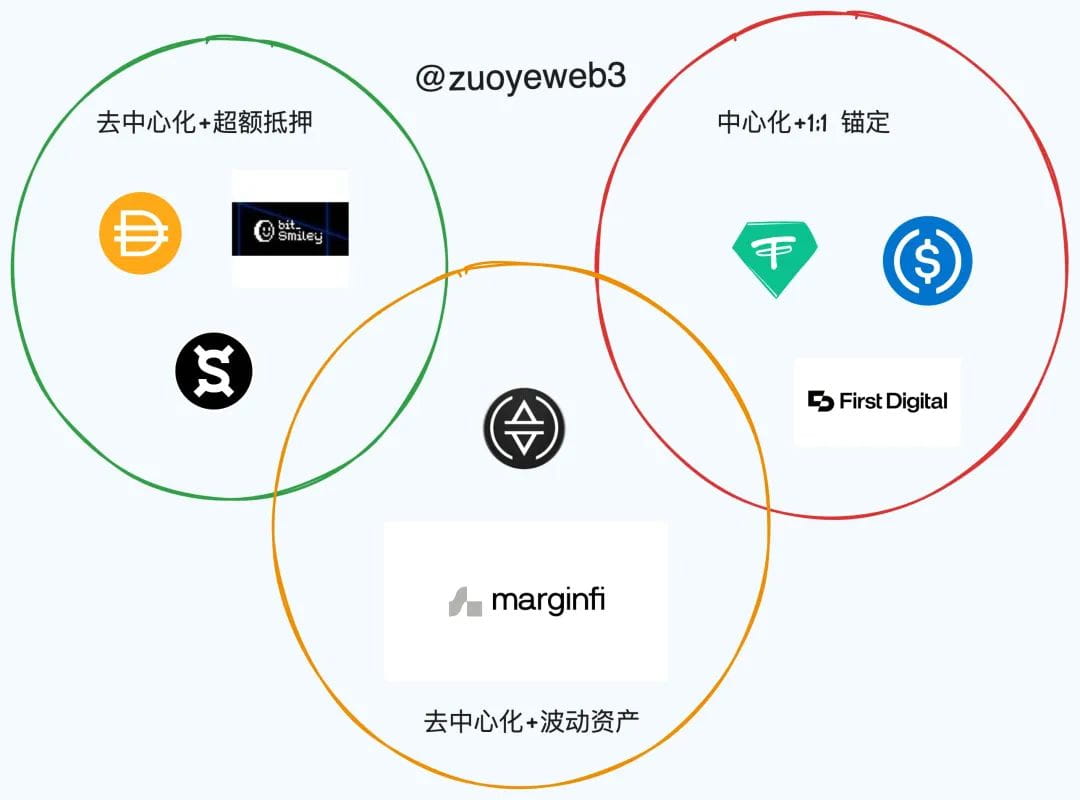
In this round of stablecoin competition, there are only two mainstream models: on-chain stablecoin + over-collateralization mechanism and on-chain stablecoin + US dollar reserve. The occasional algorithmic stablecoins are not pure either. Traditional stablecoin routes such as Rebase are basically extinct. Surprisingly, Solana's YBX built by Marginfi based on LSD has the shadow of a new stablecoin. Then there is USDe issued by Ethena, which takes a mixed route of introducing volatility and ETH collateral to strike a balance between decentralization and value anchoring.
Overall, the innovation is mainly focused on Bitcoin and volatility handling. This does not mean that they have the potential to replace USDT, but in terms of mechanism, in my personal opinion, USDT and USDC have become de facto retail digital dollars, and may very well be potential digital dollars.
Stablecoin situation chart
It can be found that USDT has the largest share, USDC is eager to be listed, FDUSD is backed by Binance to replace BUSD, TUSD has had a bad year, and no one is clear, so we can only sigh that Sun Ge’s ghost is still there.
Question volatility, understand volatility, and use volatility
Let’s first use USDT as a backdrop. The US government is hesitant about the digital dollar. USDT and USDC assume the de facto role of retail digital dollars. USDT has in fact become part of the US dollar and is gradually becoming too big to fail. This does not mean that the market value of 100 billion is important, but that USDT is determined by the three elements of being the de facto pillar of DeFi, the medium of exchange for CEX, and the legal currency of the third world.
The problem of USDT's reserve fund opacity has existed for a long time, but it is not important. Disclosure and auditing can be regarded as a way for everyone to step up. If USDT is really to be cancelled, please refer to the fate of BUSD. The US government definitely has the ability to do so.
The technical feature of USDT is that it uses Tether as a guarantor and issues on-chain assets that are 1:1 anchored to the US dollar. Tether is responsible for both minting and destruction. Its profit comes from using the US dollar to buy assets "equivalent to the US dollar", such as cash and short-term deposits.
However, once the assets are replaced with non-US dollar assets, the volatility of the collateral or the issued stablecoin will face huge volatility. The instability of UST’s value is only superficial. The core is that it encountered a run without rescue. Lido’s stETH also encountered a depegging crisis and finally passed it smoothly. Another negative example is FTX and FTT. Therefore, volatility is not terrible, but we should be afraid that no one will rescue it.
Volatility of collateral: Non-USD, non-Bitcoin and non-Ethereum collateral currently seems to have no real success. UST's minting is based on Luna's burning. Now a dangerous or great experiment is YBX's income based on LSD assets.
Volatility of stablecoins: The failure of the Rebase mechanism does not lie in the mathematical model, but in the lack of means to deal with economies of scale. If a $100 stablecoin is issued and a $50 reserve is reserved, the problem is not big, and bank runs or liquidations are easy to handle. However, a market value of $10 billion cannot be made up simply by borrowing some money.
The volatility of the collateral is no longer deep, and if both the dollar and Bitcoin collapse, it would be much more serious than the problem of making or losing money.
We will mainly discuss how to deal with the volatility of stablecoins. The over-collateralization mechanism can suppress volatility, but it will come at a serious cost - loss of liquidity. A ratio of 150% to 200% means that at least half of the assets in the circulating market value are lying in vain, which is an absolute disaster for capital efficiency.
If volatility cannot be eliminated, then there are two ways to coexist with it: reduce volatility or increase returns.
The current mainstream choice is to increase the rate of return. On Bitcoin, there is bitSmiley's stablecoin BitUSD + BitLending lending route, and on Solana, there is Marginfi's liquidity-based pledge stablecoin YBX. The advantage of this is that you can enjoy the "stability" of the underlying SOL assets while sharing the income of LST to ensure a minimum rate of return. The overall route is similar to the LRT re-staking operation method.
In addition, the pegged assets are also becoming more diverse, especially focusing on links with reality:
For example, Frax has issued three pegged assets, including the most common USD stablecoin FRAX, FPI pegged to CPI, and frxETH, an LSD product pegged to ETH;
BitSmiley also plans to introduce CDS credit default swap products for bitLending, but in general, BTC ecosystem entrepreneurs have to face the problem of how to outperform BTC holding returns. This is also the helplessness of the Bitcoin ecosystem. Most BTC holders are looking at BTC's value storage function rather than derivative returns, so I personally feel that what to do next will not be smooth sailing.
USDe is designed based on the ETH spot and futures hedging mechanism, hoping to provide a global Internet bond with no access for ordinary individuals to share the stable income of savings. The mechanism of USDe is relatively complex. The simple understanding is that the value of ETH is stable and large enough to handle market fluctuations, and the sources of bond income can be summarized into three categories: interest income, capital gains, and possible leverage income. That is, ETH spot pricing and trading will generate income, and leverage income combined with the hedging mechanism is a closed loop with the design mechanism of USDe.
When Stablecoins Are No Longer Stable
USDT was first issued on Bitcoin OmniLayer in 2014. It has been more than ten years since then. USDT has abandoned OmniLayer and turned to RGB, but the overall pattern of Ethereum being responsible for large payments and Tron being responsible for daily use has been formed and is basically difficult to change.