


With the next Bitcoin halving less than a year away, it’s crucial to understand what it is and how it can impact the world’s flagship cryptocurrency.
Bitcoin was invented in 2008 by an unknown person or group of people using the name Satoshi Nakamoto. Bitcoin blockchain’s first block, referred to as “Block 0” or “Genesis Block,” was mined by Satoshi on January 3, 2009. At the start of Bitcoin, the initial block reward was set at 50 BTC, and since Bitcoin did not have any monetary value, Satoshi was the sole miner. However, in March 2010, the first Bitcoin exchange, BitcoinMarket.com, was established, resulting in increased interest in the digital currency. By the spring of 2011, Bitcoin’s value had exceeded $1.
Bitcoin halving is a critical event that happens every four years on the Bitcoin network. The next one is expected to take place in 2024, and it is essential to understand what it is, how it works, and its effects on Bitcoin’s price.
Bitcoin halving is a process in which the reward for mining Bitcoin transactions is cut in half. The reward is the amount of Bitcoin that miners receive for solving complex mathematical problems and adding transactions to the blockchain. Bitcoin was designed to have a limited supply, with only 21 million bitcoins to be mined. As of April 2023, over 18.7 million bitcoins have been mined, and the remaining number of Bitcoins is decreasing with each halving.
The first Bitcoin halving occurred on 28 November 2012, and the reward for mining was cut from 50 Bitcoins per block to 25 Bitcoins per block. The second halving occurred on 9 July 2016, reducing the mining reward to 12.5 Bitcoins per block. The third halving happened on 11 May 2020, when the reward per block was reduced to 6.25 Bitcoins.
Halving is an essential part of Bitcoin’s design as it helps control inflation and ensure the longevity of the Bitcoin network. Reducing mining rewards slows the rate at which new bitcoins enter circulation, making them more scarce and valuable. As the mining reward reduces, the cost of mining Bitcoin increases, making it more challenging to earn bitcoins.
Historically, Bitcoin halving has significantly impacted the price of Bitcoin.
The extraordinary trajectory of #Bitcoin requires a log scale to visualize properlyEach of the following charts are indexed to 100 on the halving, to display performance over each halving epoch$BTC Market Cap growth remains explosive1️⃣: 470x2️⃣: 80x3️⃣: 16x4️⃣: 2.5x (so far) pic.twitter.com/XJlvWPZqyc
— glassnode (@glassnode) April 29, 2023
The first halving in 2012 saw the price of Bitcoin increase from around $11 to over $1,000 in a year. The second halving in 2016 also had a similar effect, with Bitcoin’s price increasing from about $650 to nearly $20,000 in less than two years.
The third halving in May 2020 saw the price of Bitcoin increase from around $8,500 to over $60,000 in less than a year.
Before & after the halving, you will hear a lot of "why didn't the price move (everyday)?"#bitcoin price:1st halving, 2012 Nov: $122nd halving, 2016 Jul: $6583rd halving, 2020 May: $8,8004th 2024: …History does NOT predict the future. But zoom out… https://t.co/979tpNq9kf
— CZ 🔶 Binance (@cz_binance) April 20, 2023
The next Bitcoin halving is expected to occur in 2024, where the mining reward will be reduced to 3.125 Bitcoins per block. The halving event is expected to reduce the supply of newly mined Bitcoins, leading to an increase in Bitcoin’s price.
However, it is important to note that relative to overall circulating supply the halving has a diminishing impact and therefore it is logical to expect diminishing cyclical returns pic.twitter.com/qWwGHui0Gm
— Will Clemente (@WClementeIII) April 25, 2023
As of 8:56 p.m. on April 29, 2023, there are around 364 days left to the next Bitcoin halving.
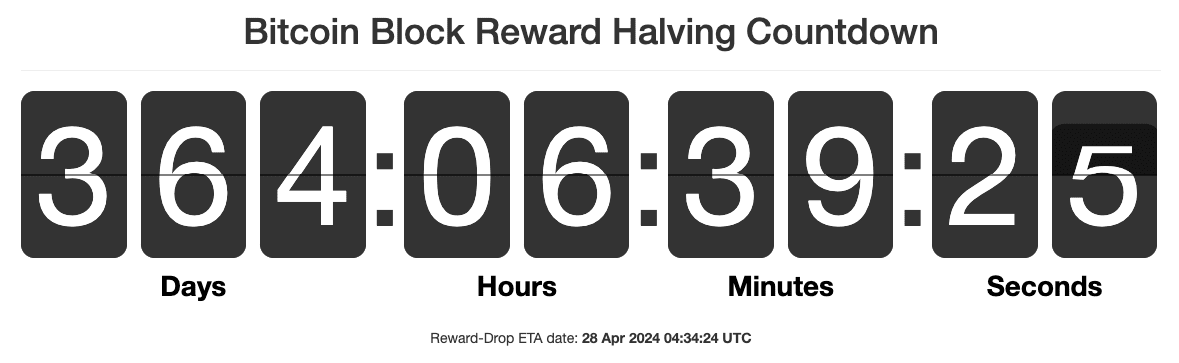 Source: Bitcoin Block Reward Halving Countdown
However, as with previous halving events, the exact impact on the price of Bitcoin is uncertain and can be influenced by various factors.
Below we look at some of these factors:
Market Sentiment: Market sentiment is one of the most significant factors influencing the impact of Bitcoin halving. If investors believe the halving will lead to increased demand for Bitcoin due to the reduced supply, then the price will likely rise. On the other hand, if investors are bearish on Bitcoin, they may sell their holdings, causing the price to fall.
Miners: Miners play a crucial role in the Bitcoin network. They verify transactions and create new blocks by solving complex mathematical problems. After each halving event, the mining rewards are reduced, which means that some miners may find it less profitable to continue mining. This can lead to a decrease in the network’s overall hash rate, which can, in turn, slow down transaction processing times and lead to a decline in the price of Bitcoin.
Competition: Bitcoin is not the only cryptocurrency in the market. If investors believe that other cryptocurrencies are better investments than Bitcoin, then the impact of halving on the price of Bitcoin may be minimal.
Adoption: The adoption of Bitcoin has been growing steadily over the years. However, the adoption rate can vary significantly depending on factors such as government regulations, media coverage, and public perception. If there is a surge in adoption after the halving, it could increase demand for Bitcoin, which can drive up the price.
Economic and Political Events: Bitcoin is often considered a hedge against economic and political instability. If major economic or political events occur around the time of halving, it can influence the price of Bitcoin. For example, during the COVID-19 pandemic, Bitcoin’s price initially fell but later rebounded strongly as investors turned to alternative investments.