


Author: Climber, Golden Finance
The gameplay of the project is simple and old-fashioned, with on-chain mining rewards, but when combined with the most cutting-edge AI grand narrative, it is possible to turn decay into magic.
The recent news of OpenAI founder Sam Altman's departure and return has become the focus of global attention, which shows how much people value AI. The economic benefits brought by AI are huge, and the related concepts in the encryption field have risen significantly. In addition, under the layout of miners, mining coins led by KAS have also ushered in new vitality, so the AI+POW narrative has entered the field of vision of market researchers.
Bittensor (TAO) is a typical representative of this narrative. Its nearly 600% increase in one month has attracted the attention of a large number of investors. Today, Golden Finance will comprehensively analyze the overall picture of this new project and explore whether it has the value of benchmarking OpenAI as experts say.
Introduction to Bittensor (TAO)
Bittensor was founded in 2019 by two AI researchers, Ala Shaabana and Jacob Steeves, who were looking for a way to make AI stackable. They eventually came up with a way to leverage blockchain technology - a way to incentivize and coordinate a global network of machine learning nodes to train and learn together on a specific problem. The incremental resources added to the network increase the overall intelligence, making the work done by previous researchers and models more complex.
According to the official definition, Bittensor creates a peer-to-peer market for trading machine intelligence through decentralized processes, which can change the development process of previous machine learning platforms. By leveraging distributed networks and incentive collaboration mechanisms, it enables the collective wisdom of artificial intelligence models to come together to form a digital hive mind.
In simple terms, the Bittensor protocol has established a market that transforms machine intelligence into tradable commodities. This machine intelligence is what we usually call algorithmic models. Bittensor can be regarded as a platform that builds a trading bridge for the supply and demand sides of algorithmic models.
In essence, Bittensor’s business principle is still the original exchange of goods, but with data on the chain and superimposed financial attributes, its biggest attraction and value-added space lies in the growth of the algorithm market in the future. If AI narratives remain popular in the next few years, then Bittensor will naturally have a huge market demand, and its value will rise accordingly.
But as far as the current increase in Bittensor's project token TAO is concerned, it is very eye-catching.
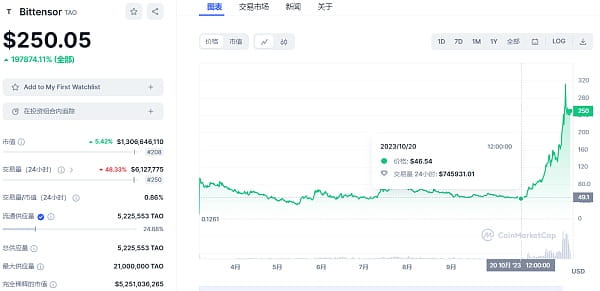
As of writing, the price of TAO was $250. However, on October 20 of this year, the price of TAO was $46.54. In just one month, on November 21, it reached its all-time high of $312, an increase of 573%.
As an AI+POW concept in the Crypto field, this short-term increase of only 6 times has attracted the attention of many investors. Whether it is FET, RNDR, OCEAN of AI concept, or KAS, FREN, ZEPH of POW mining coin concept, they have all seen huge increases.
However, in terms of price positioning, TAO is similar to ETH, so some people regard it as the next Ethereum that will create future innovation narratives.
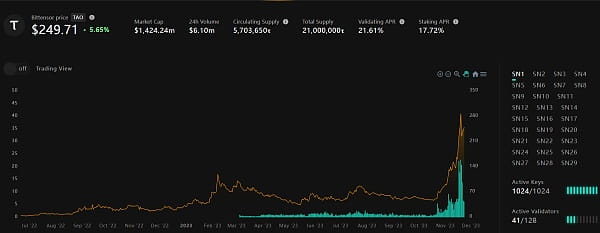
At present, the total market value of TAO is about 1.42 billion US dollars, the trading volume in the past 24 hours is 6.1 million US dollars, and the circulation is about 5.7 million. The verification APY is 21.61% and the staking APY is 17.72%.
How the project works
The Bittensor Protocol is a decentralized machine learning protocol that enables the exchange of machine learning capabilities between network participants. It facilitates the sharing and collaboration of machine learning models and services in a peer-to-peer manner.
At the same time, Bittensor is also a mining network, similar to Bitcoin, which provides censorship-resistant access to a decentralized network of machine learning models. By leveraging digital incentives and directly rewarding participants for their contributions to computing resources, expertise, and innovation, Bittensor has built a comprehensive open source AI capability ecosystem. The native currency TAO constitutes the network's reward and access tokens.
Here is an overview of how the Bittensor protocol works:
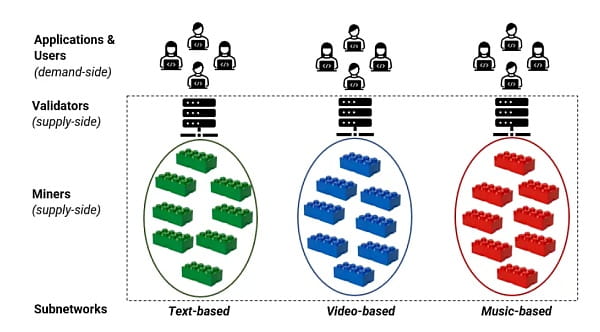
Network Architecture: The Bittensor network consists of a set of nodes (miners) participating in the protocol, each of which runs the Bittensor client software, enabling it to interact with other nodes in the network.
Registration: The Bittensor protocol operates through a registration process that involves hotkey registration. To participate in the Bittensor network and mine Tai tokens, users need to register a hotkey by solving a proof of work (POW) or paying a fee using the recycle_register method.
Subnet: Once registered, a node becomes part of a subnet, which is a specific domain or topic within the Bittensor network. Each subnet has its own set of registered nodes and associated machine learning models.
Validators: Validators play a vital role in the Bittensor network. They verify the responses and predictions provided by miners. Validators ensure the integrity and quality of the data and models exchanged within the network. Validators interrogate miners and evaluate their responses to determine the accuracy and reliability of their predictions.
Validators act as important intermediaries and access points to the Bittensor network, playing a vital role in enabling interactions and providing interfaces for users and applications.
Miners: Miners in the Bittensor network provide machine learning services by hosting and serving their locally hosted machine learning models. When a client application requires a prediction, it sends a request to the Bittensor network, which routes the request to a miner that has registered itself as the provider of the required service. The miner processes the request using its locally hosted machine learning model and returns the prediction to the client via the Bittensor network.
Incentives: One of the most notable features of the Bittensor protocol is its incentive mechanism, which rewards users who contribute valuable data or computing resources with TAO tokens.
The Bittensor Network incentivizes participation and contribution through a token-based economy. Miners and validators are rewarded with tokens for their computing resources, accurate predictions, and other valuable contributions to the network. These incentives encourage active participation and help maintain the stability and efficiency of the network.
Consensus: The Bittensor network uses a consensus algorithm to reach agreement on the state of the network and ensure the integrity of the data being processed. The consensus mechanism helps prevent double spending, ensure data consistency, and maintain the overall security of the network.
The consensus mechanism is designed to reward valuable nodes in the network. This incentive mechanism combines game theory scoring methods, including the application of Shapley values, to evaluate the performance and reliability of models within the Bittensor network. Shapley value is a concept in cooperative game theory that assigns a value to each model based on its marginal contribution to the overall prediction accuracy and collective intelligence of the network.
In the context of Bittensor, the Shapley value is used to determine the contribution of each model in reaching consensus and making accurate predictions. It takes into account the collaborative nature of the network, where models interact and exchange information to improve their collective performance. The Shapley value captures the importance of each model by evaluating how much it enhances the accuracy and insight of the entire ensemble of models.
During the scoring process, models are evaluated based on their individual predictive power, ability to provide valuable insights, and consistency with the consensus reached by other models.
Token Economics
According to the official project documents, Bittensor was launched in November 2021, and the token name is TAO. The total supply is 21 million, imitating BTC. Bittensor also sets a halving cycle every 4 years. Every 10.5 million blocks, the reward of each block is halved. A total of 64 halving events will occur, and the most recent halving cycle will occur on September 20, 25.
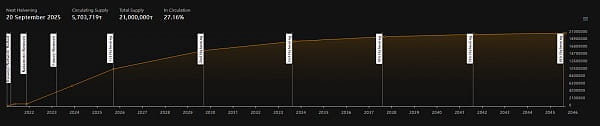
A block is mined approximately every 12 seconds, with miners and validators being rewarded 1 TAO per block. Based on the current inflation schedule, this means that 7,200 new TAO are issued into circulation every 24 hours, which is currently evenly split between miners and validators.
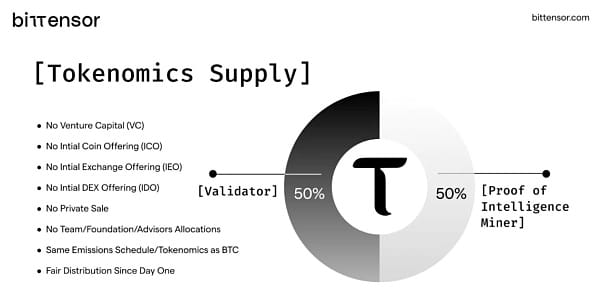
In addition, it can be seen from the token economic model diagram provided by the official project that since TAO is a fair launch, there are no VC rounds, private placement rounds, ICO/IEO/IDO, foundation reserves and other financing stages, and tokens are generated entirely by mining output.
However, several major investors are still listed on its official website, such as Digital Currency Group, Polychain Capital, FirstMark Capital, GSR and other well-known investment institutions and market makers.
Opportunities and risks
Delphi Digital researcher Teng Yan sees Bittensor as a combination of decentralized ChatGPT + Midjourney + artificial intelligence. Bittensor may represent a shift in the AI business paradigm, with technology-driven business model innovation more promising than technological breakthroughs. It provides a way for proprietary data and AI models to be co-developed and used by a wider audience without having to open source them.
Omnichain Capital co-founder DAVID ATTERMANN also said that Bittensor is an artificial intelligence Lego project that explores more possibilities by superimposing algorithm models. It seems to be a reasonable solution to drive the next generation of machine intelligence.
Crypto industry research and investment staff @digitalhk listed several possible problems and risks with Bittensor:
1. In essence, Bittensor is still in its infancy and has no real use cases yet. ChatTensor is still in the early experimental stage and has a long way to go before it can be put into practical use.
2. The Bittensor protocol uses a new dAI algorithm, which may take some time and resources to promote.
3. Bittensor uses STAO as a way to incentivize nodes and pay for the services of dAI applications. This dependence may limit the development of the project.
4. Currently, the Bittensor community is relatively small and needs more community members to support and promote the project.
5. Due to the uncertainty of emerging technologies such as blockchain and cryptocurrency, governments and regulators may formulate relevant regulations and policies, which may have a negative impact on the development of the Bittensor project.
Summarize
Currently, training AI models requires a large amount of data and computing power. Due to the high cost, large companies and research institutions will mostly set up closed fields once they make breakthroughs, which undoubtedly hinders the compound effect of AI development. From this point of view, the emergence of Bittensor provides an interchangeable value conversion platform for the sharing and collaboration of algorithm models, which is conducive to the flow of AI results and alleviates the inefficiency of algorithm innovation.
However, the capital market has never lacked innovative narratives, just like the concept of the metaverse. Whether Bittensor can eventually develop as vigorously as Ethereum depends not only on the continued development of the project, but also on how long the AI trend in the market can last.