

Interviewer: Wu Yue, Geek web3
Guests: Kevin He, former Huobi Group Web3 technical director; Faust, Founder of Geekweb3
Introduction: The beginning of 2024 can be regarded as the Warring States Period of Bitcoin Layer2. In just a few months, at least 60 project teams claiming to be Layer2 have emerged in the Bitcoin ecosystem. Due to the lack of authoritative voices in this field, people have not formed clear and organized judgment criteria for what should be regarded as Layer2 and what should not be regarded as Layer2.
While this ambiguity and disorder provides absolute freedom for developers and entrepreneurial teams, it also allows all kinds of narrative fabrication and concept-ridden phenomena to spread rampantly.

(The Chinese text in the picture is machine translated from the English original of Bitcoin Magazine)
In this chaotic and impetuous time, Bitcoin Magazine, relying on its status as a relatively authoritative media organization in the Bitcoin community, proposed a simple set of Bitcoin Layer2 definition standards. It is not difficult to see that this standard has a strong "Bitcoin feature" and is very different from the mainstream perception of Layer2 in the Ethereum community. Bitcoin Magazine's main views mainly cover three points, including:
1. Use Bitcoin as its native asset: Bitcoin Magazine believes that Layer2 should use Bitcoin as its main token or account unit (Native Token), as well as as a measurement currency for gas fees.
If the Layer2 project issues its own tokens, they should be backed by bitcoin. (This explanation is rather vague, and some people think that Bitcoin Magazine seems to be referring to inscription assets such as BRC-20).

2. Use Bitcoin as the settlement layer: Layer 2 must reserve an exit mechanism for users to withdraw their assets to Layer 1. This withdrawal mechanism can be trustless or have certain trust assumptions.
(It seems to be saying that there must be a bridge relationship between Layer2 and Layer1, or a mapping relationship between assets in L1 and L2. The cross-chain bridge or asset exit method does not have to be Trustless, but they did not clearly state what level of trustlessness should be achieved. And according to this standard, the inscription protocol or the off-chain index protocol, the original RGB protocol, may not be included in the category of Layer2)

3. Dependence on Bitcoin: If Bitcoin fails completely, Layer2 should also be in jeopardy. Assuming that Layer1 is down and the so-called "Layer2" is still running, then such a project must not be Bitcoin Layer2.

In addition to the above-mentioned "three rules", Bitcoin Magazine also mentioned CounterParty and Ordinals, pointing out that this type of asset protocol that is dependent on Bitcoin and does not have an independent blockchain structure does not fall into the category of Layer 2; at the same time, some "parasitic layer" protocols do not meet some of the conditions of Bitcoin Layer 2.
However, Bitcoin Magazine did not provide a clear explanation as to which protocols belong to the so-called “parasitic layer” (which may include the RGB protocol), which also leaves everyone undecided about the point Bitcoin Magazine wants to make.
After Bitcoin Magazine’s standards were released, they quickly attracted many people’s discussions, including the founder of the Stacks sidechain who expressed his views. Onekey’s Chinese official Twitter account observed these influential Western KOLs, and it was clear that everyone had mixed opinions about Bitcoin Magazine’s views, and most even expressed opposition.
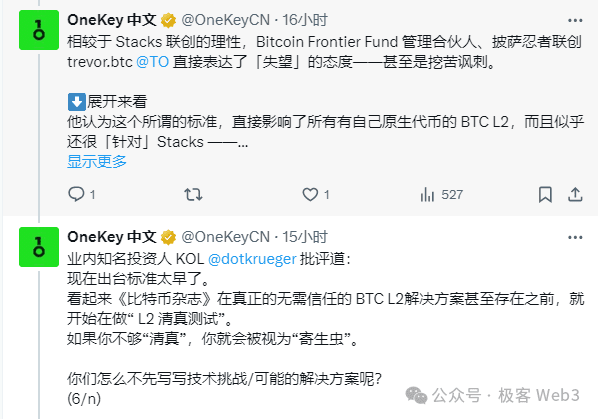
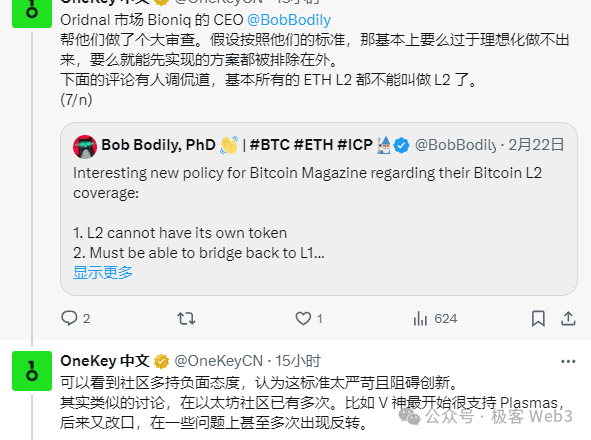
Putting aside the subjective positions of the public and the rationality of the above-mentioned Layer 2 definition standards, Bitcoin Magazine, as a Bitcoin ecological media and research institution with a voice, has taken a historic step - it has triggered a large number of discussions on the Bitcoin Layer 2 definition standards in public, and has triggered support or opposition from people with different positions.
It feels like Dankrad of the Ethereum Foundation made a high-profile statement on Twitter in August 2023 that "if Ethereum is not used as the DA layer, it is not considered Layer 2." If nothing unexpected happens, the public discussion on the definition of Bitcoin Layer 2 will intensify in the future until most professionals reach a staged consensus.
Based on the strong interest in Bitcoin Layer2 and even modular blockchain technology narrative, Geekweb3's Research Lead Wuyue invited Kevin He, former Huobi Group's Web3 technical director, and Faust, the founder of Geekweb3, to have an online closed-door exchange. This article will sort out the results of this online exchange in text format to help everyone dispel the definition standard of Bitcoin Layer2.
one
Text: 1. Wu Yue: In fact, the current Bitcoin ecosystem is very similar to the Wild West of the United States in the 19th century. Many people regard Bitcoin Layer2 as gold. Major entrepreneurial teams are like enthusiastic gold diggers, clinging to Layer2 as a gimmick to make money. In the eyes of the two guests, what is the current status of the Bitcoin Layer2 industry? What do you think of the current Bitcoin ecosystem?
Faust: In my personal opinion, the current Bitcoin Layer2 track has a tendency to be chaotic and disordered. That is to say, there is a lack of consensus on the definition of Layer2 and the objective evaluation criteria of Layer2. Take the overall perception of the Chinese community as an example. The VCs that invest in the Bitcoin ecosystem, the project teams that are engaged in Layer2, and the OGs that have experienced multiple rounds of bull and bear markets have very different views. Some technical geeks believe that only the UTXO programming model can be regarded as inheriting the "fundamentals" of Bitcoin, and EVM is heresy; others believe that if it cannot inherit the high security from Bitcoin, it is not considered Layer2.
Of course, traders who are keen on trading and geeks who focus on technology have very different views on Bitcoin Layer2. Previously, some KOLs believed that exchanges can also be considered Bitcoin Layer2, and Sun Ge even directly shouted: TRON is also Bitcoin Layer2. Some KOLs believe that the evaluation indicators of Bitcoin Layer2 should be different from those of Ethereum Layer2, and even claim that Bitcoin Layer2 will definitely surpass Ethereum Layer2, and then take this opportunity to promote a set of subjective theories.
These phenomena are just the tip of the iceberg of the current Bitcoin ecosystem. The phenomenon of setting up one's own standards and calling for one's own opinions is common among most people. Of course, all so-called "theories" must ultimately be judged by professionals. Currently, many of the statements about Bitcoin Layer 2 are not logically reasonable enough.
In addition, there is a clear gap between the Eastern and Western communities. There has always been direct and frequent communication between practitioners in the Western community, especially in Europe and the United States, and the technical atmosphere is stronger than that in the Eastern circle. Of course, more importantly, professional people or organizations such as Bitcoin community OG, Ethereum Foundation, Celestia Foundation, etc. have a huge influence in the West, much greater than in the East, which has largely created the difference in values between the Eastern and Western communities.
In contrast, the Chinese community as a whole has formed a certain closed loop. Everyone is independent and busy with their own little piece of land. There is no one or several organizations with strong professionalism and propaganda capabilities as the source of radiation of unified values. This has brought both freedom and chaos.
Of course, this kind of thing is inherently mixed, but when it comes to Bitcoin Layer2 technology awareness, we can clearly feel the difference between Eastern and Western communities. However, "technology is valuable, but the price of wealth creation is also high." Technology is one aspect, and wealth creation is another. Since so many people can accept Blast, I think even if some Layer2 technologies are insufficient, we cannot arbitrarily deny it. In the end, it still depends on what value these projects themselves can bring to the market and even the entire industry.
Kevin He: Thank you for the question. Faust has expressed it clearly. Let me add some personal opinions: the current Bitcoin ecosystem can be described as a hundred flowers blooming. As for Bitcoin Layer2, it is a stage where many heroes compete for supremacy and hundreds of boats compete for the current.
Against the backdrop of Bitcoin's continued halving, the Bitcoin ecosystem came into being. Various Bitcoin-based asset protocols have been launched one after another, breaking the inherent concept that Bitcoin cannot easily issue assets, and assets have exploded. The prosperity of assets will inevitably give rise to application needs, and Bitcoin's special technical conditions (expensive and slow) urgently require BTC Layer2 to undertake the application needs of these assets.
From the market perspective, there are already several projects that are running fast and have attracted the attention of Eastern and Western communities. At the same time, technically speaking, the definition of Bitcoin's Layer2 or security standards are in a state of lack, and more people with aspirations are needed to promote the formation of consensus.
two
2. Wu Yue: Thank you for your wonderful sharing. What do you think about the recent widely discussed "Bitcoin Magazine's three rules for Bitcoin Layer2"? Do you think the standards proposed by Bitcoin Magazine are reasonable? At present, many people in the Western community seem to be critical of this matter.
Faust: In fact, the three major standards proposed by Bitcoin Magazine are not very precise, and some key points are based on ideology rather than technology. They have not gained community consensus and can hardly be used as objective conditions for judging Layer 2.
I personally think that they originally wanted to propose some strict standards, but found that different Bitcoin Layer2s are very different, and there is no way to quickly summarize a universal evaluation framework. They want to promote a set of custom standards at this point in time, so they simply "set three rules" (Bitcoin Magazine stated at the beginning of the article that the purpose of promoting standards is to resist some chaos in the Bitcoin ecosystem). However, this simple and crude method may not be able to objectively measure Bitcoin Layer2.
In this regard, the Ethereum Foundation's approach may be more rigorous. They start from a technical perspective, distinguish different technical solutions, and classify specific technical solutions such as state channels, Plasma, Rollup, etc. as Layer 2. Many people in the Ethereum community also classify Validium and Optimium in addition to Rollup into the Layer 2 category.
This method of categorizing from a technical perspective first is clearer and more specific. For example, the working mechanisms of state channels and Rollups are very different, and many features are not interoperable. The Ethereum community first classified both into the Layer2 category, and then proposed a series of evaluation criteria for the Rollup subcategory. This method is more mature.
But if we insist on using a macro, universal indicator to evaluate the entire Layer2 track like Bitcoin Magazine did, we will find it difficult to summarize a set of fine-grained universal methods. So if it were me, I would first state:
Sidechain, sovereign Rollup, independent public chain (ps: there are differences between independent public chain and sidechain), ZK Rollup and OP Rollup, which types of technology are considered Layer2, and then implement them into different sub-concepts. Of course, if a set of evaluation schemes with insufficient granularity and fuzziness is directly given to Bitcoin Layer2, it is not impossible. For example, I would prefer to evaluate from the perspectives of anti-censorship, DA implementation method, and verification method of state transition, which are basically agreed upon by the industry. That is, first examine everything from the perspective of security and function expansion, because the evaluation methods involved have long been mature, and the industry basically has a consensus.
The views put forward by Bitcoin Magazine have not been recognized by the industry and are mixed with strong ideological orientation, especially the first point: Layer 2 must use Bitcoin as its native token. Even if it issues its own token, it must be backed by Bitcoin.
Even the Ethereum Foundation, which has a centralized tendency and aims to maintain the price of ETH, dare not express this standard so bluntly. Bitcoin Magazine may not want to see too many teams rushing to issue coins for quick success, so it raised this point. But in fact, even if Layer2 issues coins, it will not affect what its Native Token is, and the phrase "backed by bitcoin" is even more confusing.
At this point, my personal attitude is very clear: standards should be proposed from a technical perspective as much as possible, with less pure ideology. In this regard, L2BEAT in the Ethereum community has done a good job. They have made scientific assessments from technical aspects such as anti-censorship, DA reliability, verification of state transition results, and control of Rollup contracts. This set of standards can be applied to many modular blockchains in the Celestia ecosystem with only a slight modification. Of course, it can also evaluate the security of Bitcoin Layer2 on a large scale.
But if we define Layer 2 from an ideological perspective like Bitcoin Magazine did, it would be too subjective. It's like evaluating which political system is better, the US or the Soviet Union, which could easily turn into a fight between people with different political views. But if we judge everything from a technical perspective, it would be much easier.
I think we should start with less controversial and easier to reach consensus directions, such as judging the security risks and functional completeness of Layer2, and judging the hidden dangers of different asset protocols. Starting from these perspectives, we should be more objective and rigorous. Trying to define it from an ideological level is not what Bitcoin Magazine or any person or organization should do (except Satoshi Nakamoto).
But what’s interesting is that the CEO of Bitcoin Magazine mentioned that he plans to recruit an employee from L2BEAT to study the evaluation method of Bitcoin Layer 2. It is estimated that they will soon cite some of L2BEAT’s work results.
Kevin He: First of all, I would like to greatly appreciate the courage and responsibility of the editors of Bitcoin Magazine. In such a contentious world, proposing and implementing standards is bound to attract criticism, and implementation also requires a lot of effort. However, a healthy community must have someone to do this, just like we tried to promote the discussion of classification standards and security standards in the community a few months ago.
Secondly, back to the standard itself, I personally think that
1) It is based on the innovations of Ordinals and BitVM (without these two innovations, the Bitcoin ecosystem may still be stagnant)
2) I personally think it is a relatively broad standard (we have tried very hard to unite as many forces as possible)
3) I personally think there is a lack of discussion on more fundamental security standards (that is, the underlying principles of why these three standards are needed)
Considering that we have had a lot of thoughts and discussions in this regard before, mainly focusing on the Chinese-speaking circle, we will promote our draft to a wider audience in the future. We also welcome more forces (including Bitcoin Magazine) to join us in building and promoting the community’s consensus on classification and security standards.
three
3. Wu Yue: The sharings of both teachers are very wonderful, so next I would like to ask the most critical question: How do you think the objective evaluation criteria for Bitcoin Layer2 should be defined?
Faust: Actually, I have expressed it before, that is, we should start from the technical perspective, from the technical perspectives such as security and the functional completeness of Layer2, less from the subjective ideology, more from the consensus points in the industry, and less from inventing new concepts and new ideas. Bitcoin Layer2 is essentially an extension of modular blockchain, state channel, and derived off-chain asset protocols. As long as we follow the existing research conclusions on these three, it will be fine.
There must be reasons why those factors that have not been included in the Layer 2 evaluation criteria by industry predecessors have not been included. We should avoid these minefields and follow the paths that have been trodden by predecessors as much as possible. We should not force ourselves to open up new paths in the swamp, as doing so will only lead us deeper and deeper into the swamp.
Kevin He: I think that to promote this set of standards well, we must adhere to at least two basic points:
1) Respect Bitcoin’s traditions and absorb the latest developments (e.g. Ordinals/BitVM)
2) Absorb the exploration and implementation experience of other ecosystems on Layer2 (such as Ethereum Layer2)
Based on these two basic points, several universal/objective/security-focused/standard definitions are formed, and after sufficient discussion, a community consensus is finally formed. All theoretical frameworks need to go through several discussions and revisions before they can gradually take shape. For the formulation of standards for Bitcoin Layer2, it may still require the joint exploration of many people and organizations. In the end, the market will gradually select the most reasonable standards that are most acceptable to most professionals and even people with common sense. Only by letting the market freely choose this process can we know the final answer.
