


Original author: THOR AND MODERN EREMITE
Original source: onchaintimes
Original title: Deep Dive on Sui - In Search of The Right Niche
Compiled by: TechFlow
In today’s report, we will take a deep dive into the Sui ecosystem. Sui, created by MystenLabs, is hailed as a next-generation blockchain designed to meet the growing demand for blockchain adoption. Who is adopting blockchain, you might ask? The Web2 world is gradually finding its way and transitioning to the Web3 realm as it offers new areas to conquer through marketing, user acquisition, and network effects.
Areas related to mainstream usage, such as the metaverse, gaming, social layers and even commerce, require specific types of blockchains to meet their needs, and we all remember how expensive Ethereum can become whenever there is a surge in interest. Does anyone remember that more than $150 million in ETH gas fees were burned during the Otherside NFT minting? Indeed, this is why in the past few months, and even during the last bull run, we have seen the need for a fast and cheap Layer 1 blockchain network that will meet the upcoming mainstream adoption.
But what about Layer 2 ecosystems like Arbitrum or Optimism? Aren’t they solutions to Ethereum’s high gas fees?
Yes, but there is still a lot of work to be done in terms of L2 adoption, which is another topic to explore in depth, and if we are going to encounter huge demand from the traditional financial world, we have to offer something here and now, and this is exactly where monolithic blockchains can dominate.
Key Points
What is Sui and why is it compared to Aptos?
Recent Developments in the Sui Ecosystem
Matters needing attention
Conclusion
Understanding Sui: The World of Parallel Chains
Sui is often compared to Aptos because both projects were launched at a similar point during the last bear market and are related to Facebook's long-forgotten project Diem. The Diem project was mainly developed to handle lightweight payment traffic between a limited number of wallets, but was suspended because it was too early for the public to accept blockchain and the US government did not allow giants like Facebook to introduce payment processing infrastructure. That's why both Sui and Aptos are Layer 1 based on Proof of Stake (PoS) consensus and both utilize parallel execution to meet the needs of the upcoming mainstream adoption. Although there are many technical differences, such as differences in consensus mechanisms or data architecture, we will not go into them in depth because it is not relevant to our discussion today.
Relatedly, though, both Aptos and Sui were seen as projects heavily influenced by venture capital, which led to a less-than-welcoming vibe in the wider crypto world, which was not hard to notice in their early price action following their listings.
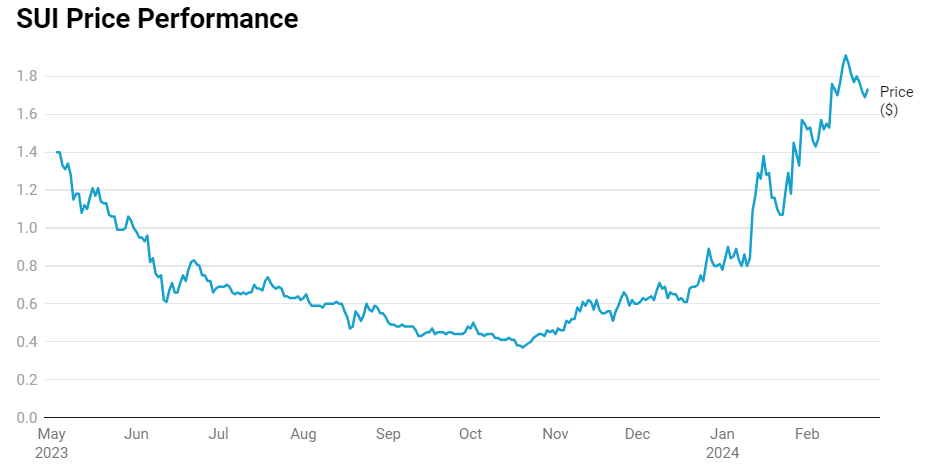
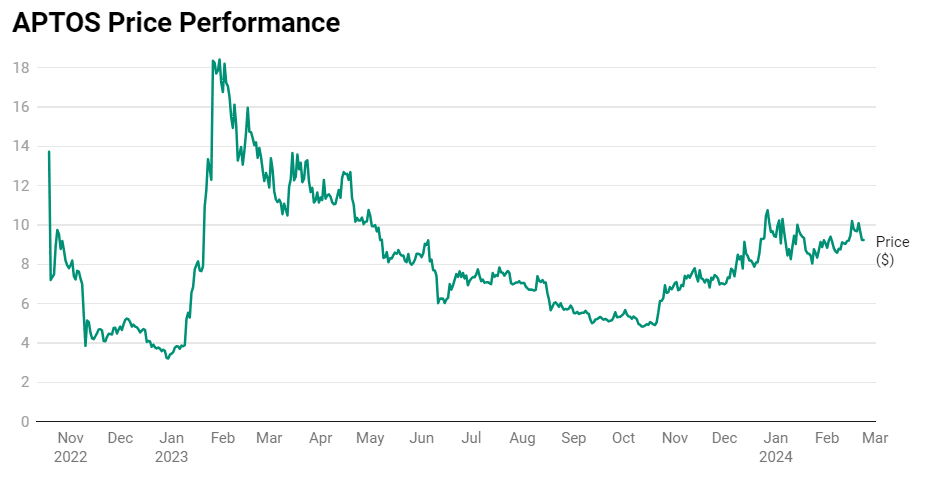
Another similarity is that both blockchains are using the Move programming language; however, there are minor differences in the way the language is used. On one hand, Aptos adopted the way Move is used in Diem, while Sui decided to change some concepts and adopt an object-oriented approach, which makes it more suitable for mass adoption purposes, which is why it belongs to the growing trend of parallel L1 blockchains.
In the coming months, we will witness another round of L1 chain wars, which was the dominant narrative during the 2020/21 cycle. However, this time, we will see new competitors enter the arena, namely Aptos, Sui, Sei, Solana, and the yet-to-come Monad. All of them are monolithic chains, they all support parallel execution, and they all aim to win market share in the same market segment.
Contrarian consensus: Near-term growth
As mentioned earlier, the price action after Sui was launched was not surprising, as the main trade taken by the crypto twitter was to open a short position and hold it for months, which proved to be quite profitable. However, in October 2023, when Bitcoin began its climb and finally broke through the $30,000 mark, the bottom of SUI was formed and it began its upward path.
However, the price is not the only thing that has started to rise, so has the TVL on Sui. From around $80 million in October 2023 to $567 million today, the Sui ecosystem has attracted more capital, but there is a question lurking here, how and with what?
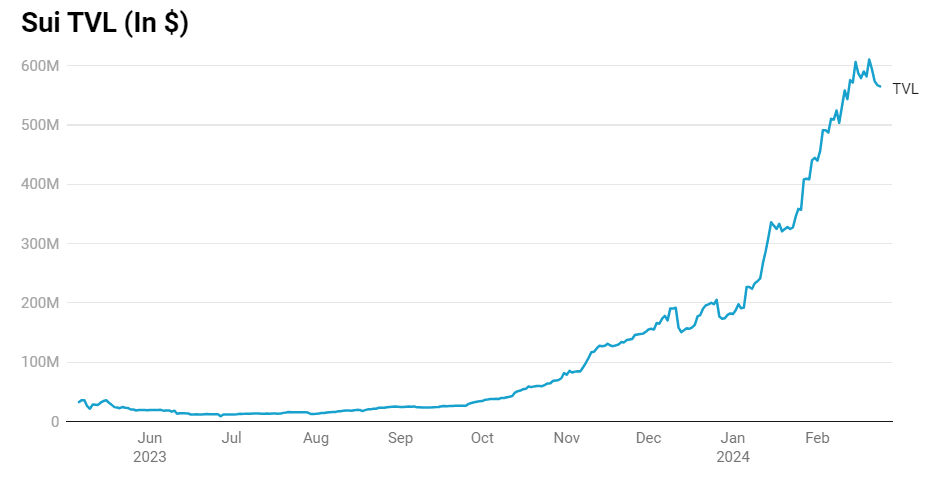
One recent reason could be the upcoming Wormhole airdrop speculation, which has driven the use of bridges and boosted TVL on various chains. Needless to say, once the airdrop snapshot is taken, this liquidity will not stay there, but how much of the recent TVL surge is related to the Wormhole speculation remains a mystery.
So what about the DeFi ecosystem on Sui? Right now, we see a few major DeFi protocols offering liquidity re-staking (NAVI), lending (Scallop), DEXs, and Perps (Cetus and BlueFin), building the core infrastructure of a growing ecosystem. Taking this idea further, we can say that incentivizing DeFi protocols can be a way to attract users and liquidity; however, this must go hand in hand with attracting developers who will build a variety of different dApps and protocols. It is also worth mentioning that BlueFin recently formed a partnership with Elixir, a protocol designed to increase liquidity on DEX order books. This caused BlueFin’s TVL to surge by about 50%, from nearly $9 million to $13.1 million today. It’s hard to say whether this is the beginning of cross-chain integration or a single event that will spread the influence of Elixir, so it’s worth keeping an eye on the Sui ecosystem for further integrations that may emerge in the near future.
There is another selling point that could be a trump card for Sui in terms of attracting users and stirring up emotions, the lack of tokens for ecosystem projects. If there is one marketing trick crypto projects can do, it is to whet the appetite of users with upcoming airdrops as rewards for using the project, and it would be even better if the airdrop activity spreads throughout the ecosystem, which is entirely possible for Sui.
On top of that, we also saw the launch of Stardust, which brings a wallet-as-a-service infrastructure designed to attract GameFi builders who will take advantage of all that Sui has to offer. Building on this, we saw an interesting collaboration between MystenLabs (the creators of Sui) and Team Liquid (one of the most well-known esports teams in Europe). In other words, Sui is trying to enter the GameFi world, but why are we seeing this shift?
It has to be said that in the competitive parallel L1, each ecosystem must find its own niche to attract users and TVL, rather than competing for the same overly general audience. Solana seems to have found its own selling point in crypto culture through its NFT and memecoin, and Sui does not seem to copy others' success stories, but instead moves forward and tries to attract GameFi users, thanks to its object-oriented Move language and a user experience that is far better than what we saw on StarkNet.
Facing the future: potential problems
While this all may sound overly positive and promising, we should not forget to consider all the risks involved and the upcoming unlocks that may affect the price of the SUI token.
As mentioned before, the price of SUI has been rising steadily since the bottom of $0.36 in October 2023 and has risen almost 100% since the beginning of 2024, almost managing to reach the $2 mark, but the narrative in the parallel ecosystem has slowed down. This shows that there are real opportunities to make money for those who venture into the ecosystem and bet on its projects and meme coins, which is always a good incentive if the price rises. However, this is not the case with Sui.
The most famous DeFi projects we mentioned earlier, such as BlueFin, Aftermath or Scallop, do not have their own tokens except Cetus, which may bring airdrop speculation in the future. However, for now, it severely limits the attractiveness of the ecosystem, as there are no tokens worth speculating or investing in.
The most obvious example can be the meme season on Solana, which produced multiple small cycles with short cool-down periods in between. During these cool-down periods, the broader market had time to shift to other trends, which were often associated with meme coins on different chains, and Sui also had such a trend. The most anticipated meme coin on Sui was meme with the ticker symbol $FUD, which followed the hottest trend at the time, dog-themed coins. However, the price action had little to offer, as after the initial surge, interest waned and liquidity quickly left.
What seemed like a promising avenue to attract liquidity to the ecosystem turned out to be extremely short-lived, as liquidity disappeared a few hours after launch. To this, we can also add that the number of people buying and selling tokens was negligible, around 150 for the top four meme coins. Needless to say, this interest is almost non-existent, as even on the de-motivated Solana chain we see thousands of market participants every day.
One more thing that is looming in the ecosystem is the unlocking schedule. Monthly unlocking is set to 0.65% of the max supply, which is equivalent to about 5.5% of the current market cap or $110 million. These are rough estimates, as the price of $SUI changes, and so do market cap percentages and USD values. While the monthly supply appears to be absorbed by the market, the upcoming supply release in May could significantly impact the price.
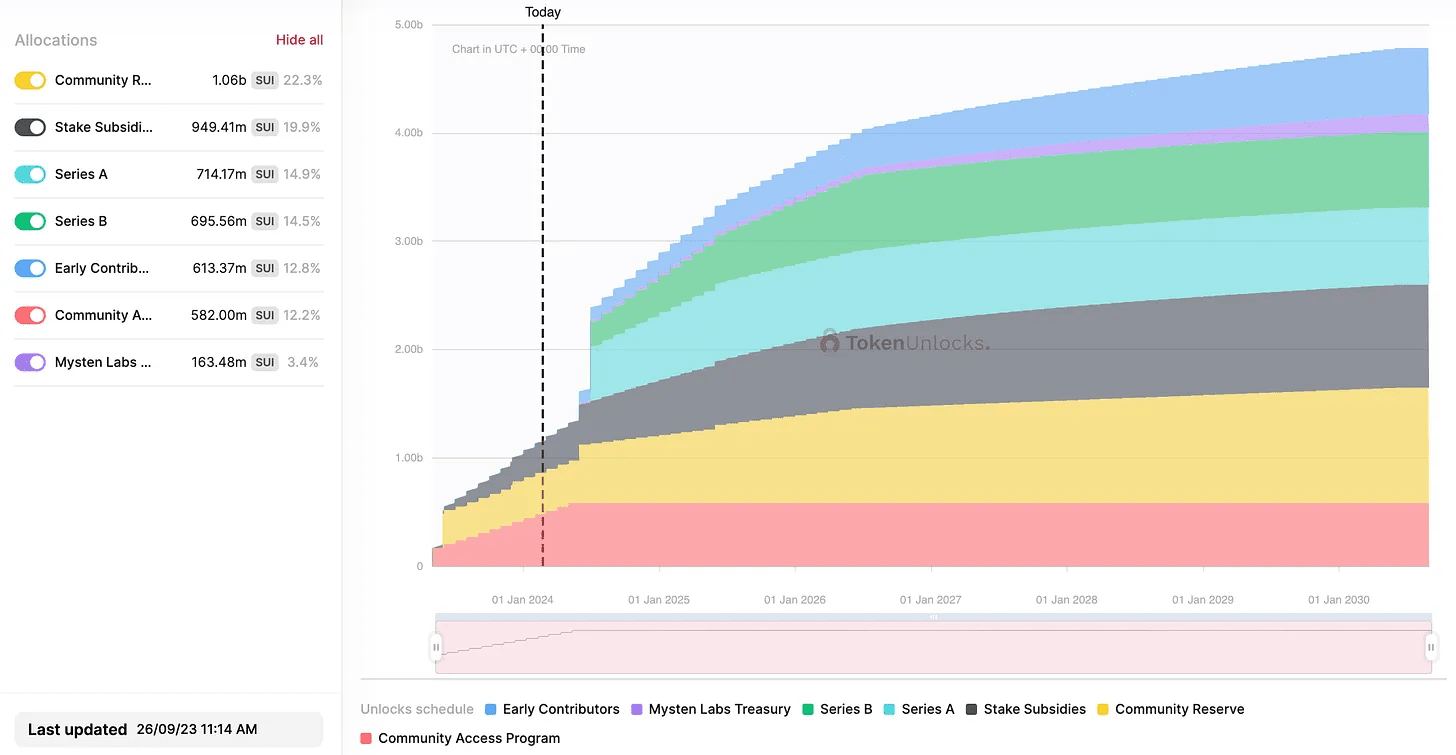
On May 3, Sui's supply will increase by 8.27%, which is about $1.4 billion in USD terms, or about 71% of the current market cap. It is difficult to predict how the market will react to such a large unlock. However, we may see the so-called "liquidity cushion" gradually build up, which will offset the released supply to some extent, as is usually the case with the $DYDX unlock. On the other hand, given the relatively low interest in the Sui ecosystem at the moment, it may be difficult to attract enough liquidity to build such a safety cushion, and the market will start pricing in a few weeks before the unlock occurs.
While predicting the future is impossible, observing the market and SUI’s volume-to-market cap ratio can tell the story of how the market is trying to cope with the upcoming unlock.
Conclusion
The coming months and years will likely see an explosion in blockchain adoption not only among mainstream users but also among Web2 brands, as we’ve already seen this trend take shape during the metaverse mania of 2021. With all this in mind, there is a pressing need for fast and cheap blockchains that can accommodate the millions of users exploring emerging frontiers and the multitude of dApps that come with them.
Sui is not the only competitor in this market segment, there are strong competitors like Solana, Aptos, Sei and the upcoming Monad, all of which will compete for market share. In addition, we will see rapid development of the L2 ecosystem, which will provide similar features, combined with Ethereum's overall strength and network effects, may become a solid competitor to Sui in the same market segment.
The theme of the last cycle was the war between alternative L1s. This time, we will see a similar scene play out. However, instead of the L1 ecosystem, we will see a war between L1 sub-projects and monolithic chains, which will compete to become the preferred place for "mainstream-oriented" dApps.