

During this time, I learned about the lossless savings PoolTogether, which is a defi track method.
The full name of Defi is Decentralized Finance, in which developers deploy smart contracts on a public chain.
For example, new public chains such as Ethereum or Polygon, Arbitrum, and Optimism execute relevant financial services and derivatives business according to the contract code.

When Chuxiao Chain first entered the circle in 2021, it had a brief understanding of DeFi staking and also formed an LP to add liquidity.
At that time, I bought CAKE and pledged it on Pancakeswap, and I bought MDX and pledged it on Mdex, and locked it for a year.
Now CAKE has dropped from $26 when purchased to $2.6 now, a 90% drop; MDE has dropped from $3 to $0.08 now, a drop of 97%, almost to zero.
The overall market trend fluctuates downward, and the decline of altcoins is an inevitable result, especially these "mining coins", which were forgotten by the market after their popularity.

Recently, there have been many DeFi interactions among various public chain interactions. We have experienced cross-chain, exchange, staking, liquidity provision and other functions on the platform, and have refocused on DeFi gameplay.
The initial DeFi experience is to buy project tokens for staking, or LP provides liquidity. Now we are doing Layerzero interaction, one of which is to stake STG in the ecological project Stargate, obtain voting rights, and increase the L0 interaction weight.
The purchase price of STG is 0.7 US dollars. If STG becomes 7 US dollars after one year, it is also a good return; but it is also possible that STG will fall to 0.07 and the staking income will return to zero, just like CAKE and MDX.
One of the risks of playing DeFi is that the tokens of the purchased projects plummet to zero, and not only will there be no income from staking, but the principal will also be lost.
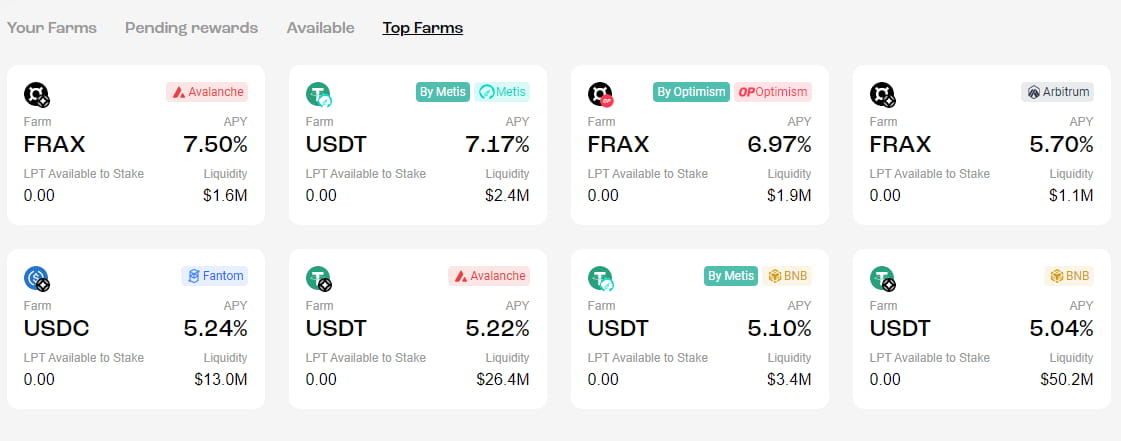
If you pledge stablecoins, is it possible to relatively avoid the risk of a sharp drop? For example, on pooltogether.com, you can deposit stablecoins to earn returns.
Pool is a lossless savings protocol based on Premium Bonds that encourages savings by making savings interesting (opening blind boxes).
The project has been online for more than 3 years, and the current total project deposit is more than 16 million US dollars.
At present, the protocol has distributed more than 5 million US dollars in bonuses to depositors. The luckiest player deposited 74 US dollars and won 40,000 US dollars.
But I deposited 30 US dollars on the platform for 10 periods, but I haven’t made any profit at all.
Users deposit stablecoins or other cryptocurrencies into the fund pool, which will allow them to participate in daily blind box draws and withdraw the money at any time. The more they deposit, the greater their chances of winning.
Even if you don’t win the prize, you will not lose your principal, and all operations are queryable on the chain; any system changes and upgrades must be decided by community voting. It is a decentralized autonomous system.

Judging from the fund flow description in the official Pool document,
1. Users invest funds in the prize pool;
2. The prize pool deposits funds into platforms such as Compound or Aave to obtain a source of income;
3. The prize pool transfers interest to the reserve contract according to the strategy; the reserve measures the amount of funds that have been added;
4. The Reserve contract sends funds to the prize distributor (for users to claim) and the prize pool network (to obtain value);
5. The user receives the prize from the prize distributor;
6. The prize pool network deposits funds into the prize distributor to guide prizes.
To put it simply, users deposit their assets into the Prize Pool, and according to the pool smart protocol, they get a chance to open a blind box every period; opening a blind box may result in a generous prize, or there may be nothing, just simple storage.

Storing stablecoins can relatively avoid losses from token crashes. For users who have funds and do not operate frequently, it is also a way to play DeFi staking.
In addition, for players who don’t know which defi project to play, they can use Pool to stake on the Compound or Aave platform to obtain income.
Of course, the biggest risk is the security issue of the Pool platform. Whether there are project escapes or contract loopholes, etc., may cause storage damage. At present, the Pool has been operating for more than three years and there has been no risk accident.
You can also earn income by staking liquidity POOL/ETH on the platform, but the platform's token POOL has also fallen from US$44 at the beginning of 2021 to US$0.9 now, and the platform currency is even less resistant to declines.

Defi is decentralized finance. It automatically performs operations through smart contracts. There is no insider information. It can be tracked and queried on the chain. All rules are written in the contract. This is the greatest security.
But the safest place is also the most dangerous. If there are loopholes in the contract, the project will be hacked and the funds will be reduced to zero.
Among various attempts on the blockchain, the blockchain + financial DeFi project is also the focus of each ecosystem. As a web3 player, you must also understand the gameplay and have appropriate exposure.
Of course, more exploration also means more zeroing experiences. For example, in 2020 and 2021, defi projects bloomed, but now many of them have disappeared;
But the demand for defi has always existed, and decentralized finance is still very attractive.
The above is just my personal opinion, not investment advice. I am Chu Xiaolian, and I am paying attention to the Metaverse and web3.