

Author | Five Fireball Leader Produced | Vernacular Blockchain (ID: hellobtc)
What many people may not know is that the universe is now at a very critical moment.
You may be wondering? Um? What’s the key? Wasn’t it true that the Cosmos 2.0 roadmap was just released some time ago, and the Token price has been rising accordingly. It seems that everything is developing in a good direction?
This is indeed the case overall. However, this Cosmos 2.0 cannot be deployed and implemented until it is voted through. Otherwise, how can it be called Web3? Then by coincidence, Jae Kwon, the original founder of Cosmos, came back to stir up trouble and proposed a Cosmos One roadmap, which is now competing with the Cosmos2.0 roadmap proposal, plus a basic constitution of Cosmos Zero. Level proposals, the Cosmos community is currently voting and debating enthusiastically on these "three major constitutions"...
Let’s take a brief look at these three proposals:
01 Three proposals
1. Proposition 81 - Constitution Zero

This proposal is very simple. It mainly stipulates the following basic rules. That is, any change to the project that meets any of the following four conditions must receive 2/3 Yes votes before it can be passed. The four conditions are as follows:
Any changes to the implemented token economics (other than bug fixes)
Any Token inflation beyond ATOM’s default inflation
Any changes to the governance process
Adoption of any constitution (except this minimal constitution)
If you think about it carefully, you will actually find that the purpose of Proposition 81 is probably to limit Proposition 82, and Proposition 82 is the roadmap for Cosmos2.0. However, currently there are many opponents, so there is a high probability that it will not affect it. It’s time for Proposition 82.
Then let’s look at Proposition 82.
2. Proposition 82 - Atom2.0
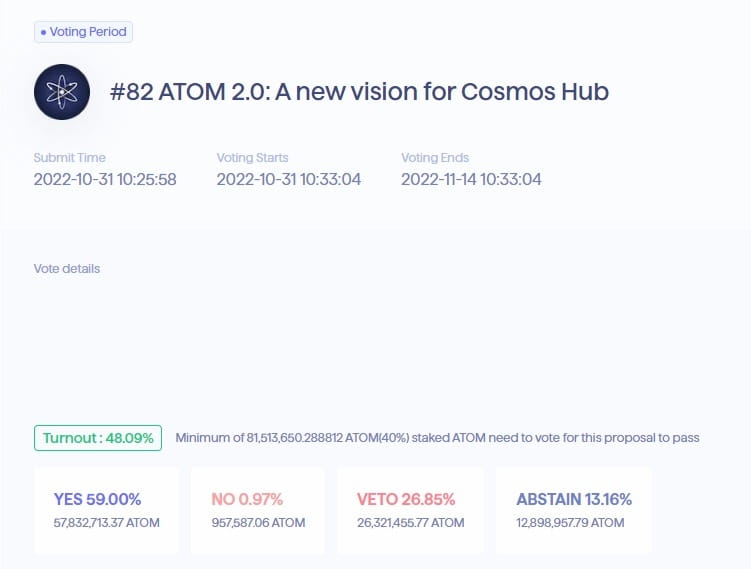
This is the legendary Cosmos2.0 roadmap proposal. In our previous article, "How is the Cosmos ecosystem, which is as popular as Ethereum, developing now?" (Part 2)" has specifically mentioned that there are four key changes:
Interchain Security ICS (Interchain Security) - realizes part of the shared security of Cosmos Hub and improves the value capture of Atom Token (Cosmos Hub is an open proof-of-stake (POS) blockchain, and its native staking Token is Atom)
Liquid Staking - Giving liquidity to staked Atoms (similar to Lido's stETH)
Inter-chain scheduler - extract cross-chain MEV and make money for the protocol
Inter-chain allocator - allocate funds to ecological projects and prosper the entire Cosmos ecological construction
Of course, there is also a very key change in the additional issuance mechanism of Atom Token. The new Token economics divides the issuance of Atom into a transitional and stable stage. The transitional stage lasts for 36 months, with crazy additional issuance to the treasury (10 million per month but monthly index type of decreasing), which is equivalent to a round of financing. After 36 months, the monthly additional issuance will drop to 300,000 pieces, keeping inflation at 0.1%.
Of course it is beneficial in the long run, but the short-term crazy issuance has still caused great controversy in the community. So now in order to deal with Cosmos One, which is Proposition 83, the Cosmos2.0 roadmap has made some changes, mainly targeting It is the modification of the previous Token issuance part of the treasury. The 40 million Atoms issued in the first year were changed to 4 million Atoms, which were injected into the community pool to fund all the features mentioned in Atom2.0 (development costs, inter-chain security, inter-chain allocator, etc.), after that, the community can decide in the form of a vote whether to issue more Atoms (4 million copies, up to 12 copies) to meet the above needs.
At present, most people have voted Yes. However, it is still unclear whether it will be passed. The reasons will be discussed at the end of the article. Let’s look at Proposition 83 first.
3. Proposition 83 – Atom One

This is Jae, the original founder of Cosmos, planning for the future of Cosmos.
The stance on his proposal on Twitter is more subtle. Some people jokingly said that Jae is like a father who ran away from home when you were a child. He gave birth to you but did not raise you very much. He failed to fulfill his responsibilities as a father. Now you have grown up. When you're older, he comes back and starts to dictate your future life plans. If you think about it carefully, there is some meaning in it.
Of course, this is just an emotional thing. Atom One’s roadmap still has some unique things of its own. Jae expressed support for inter-chain scheduling and allocation solutions. His disagreement with Cosmos 2.0 mainly lies in inter-chain security. The main method in his proposal is based on a new Token called Photon.
This Photon Token can only be staked and minted through Bond Atom Token. Photon can be used for Gas, or ICS, etc. instead of Atom to implement various functions, thus allowing Atom Hub to maintain the minimal functions it has always advocated.
This idea was actually proposed by Jae a few years ago, but has never been implemented. This time, he will try it again with the launch of Cosmos 2.0. The controversy in the community about this new token is even crazier than in the Cosmos 2.0 roadmap. The newly issued Token model is even larger. A core developer of Cosmso directly stated that he has never seen any precedent where the dual-Token model of the underlying public chain can run well.
From the current point of view, most people voted No, and few Yes, and there is a high probability that they will not pass. Jae, a "runaway dad", should have failed in his desire to come back and give advice to his son.
However, Proposition 82, which means that the roadmap of Cosmos2.0 will definitely be passed smoothly?
maybe.
02 Possible results of this vote and some noteworthy things
Possible results: There are four options when voting on Cosmos

Needless to say, Yes and No, the third No with Veto is to exercise veto power in addition to disapproval, and Abstain is to abstain from voting.
Any proposal in Cosmos will be invalidated when the number of veto votes exceeds 1/3, no matter how many people vote Yes.
The current ratio of No with Veto is 26.8% at the time of writing, so it is still unknown whether it will reach 33.3% by the end of a few days.
But overall, the problem is not big, because even if the 2.0 plan is not passed, there is a high probability that the main functions of the 2.0 roadmap will be picked out and voted on one by one. Basically, they can be implemented. The veto power is mainly due to the additional issuance of the treasury. After all, this is a matter that actually affects the Token circulation, price and the vital interests of each holder, so if it really reaches that step, it must be that the Token model separately picks out a new proposal, discusses it carefully, and votes again. until community consensus is achieved.
The Atom One proposal is not promising
In addition to the current voting rate, there is a high probability that Jae's Atom One will not pass. Another very important factor is the developer consensus. At present, the Cosmos team and main developers basically support Atom2.0, so even if Atom One is more advanced, or it may have received more votes, but it will be a big problem for subsequent development and advancement. "Developer consensus" is a factor that has a great impact on the upgrade of the underlying public chain.
Some trading platforms have been shut down
For Atom Tokens that were previously pledged through major trading platforms, the trading platforms usually only helped collect Staking benefits on their behalf, and did not participate much in the governance of various proposals, for the sake of better decentralization. However, this major proposal, It has indeed attracted some trading platforms to vote on their behalf. For example, Huobi participated in the governance for the eighth time, and Kucoin participated in the voting for the unprecedented first time. However, these nodes on other large platforms still maintain the "glorious tradition" of zero governance. When the voting period ends, , you can check again to see if there are any new major nodes participating.
In any case, this Cosmos upgrade has attracted the attention of all walks of life. With the rise of modularization and application chain concepts, I believe that the future of Cosmos will definitely get better and better. Friends, what do you think about this?
END
