


When you once again hear that a certain Web3 domain name has been sold for a sky-high price, when you once again see a Web3 friend next to you using a domain name as his username, when you start to look for domain names that you are interested in in the registration column , have you ever thought deeply about the use of these domain names? What are the differences and connections between different projects? What room for development does the domain name track have? If you are interested in these questions, please don’t miss this article!
The structure and core points of this article are as follows. Readers who already know about Web3 domain names can jump directly to the chapters that interest them:
Chapter 1, Introduction to Web3 domain names: User’s “Web3 nickname”, encapsulation of addresses on the chain
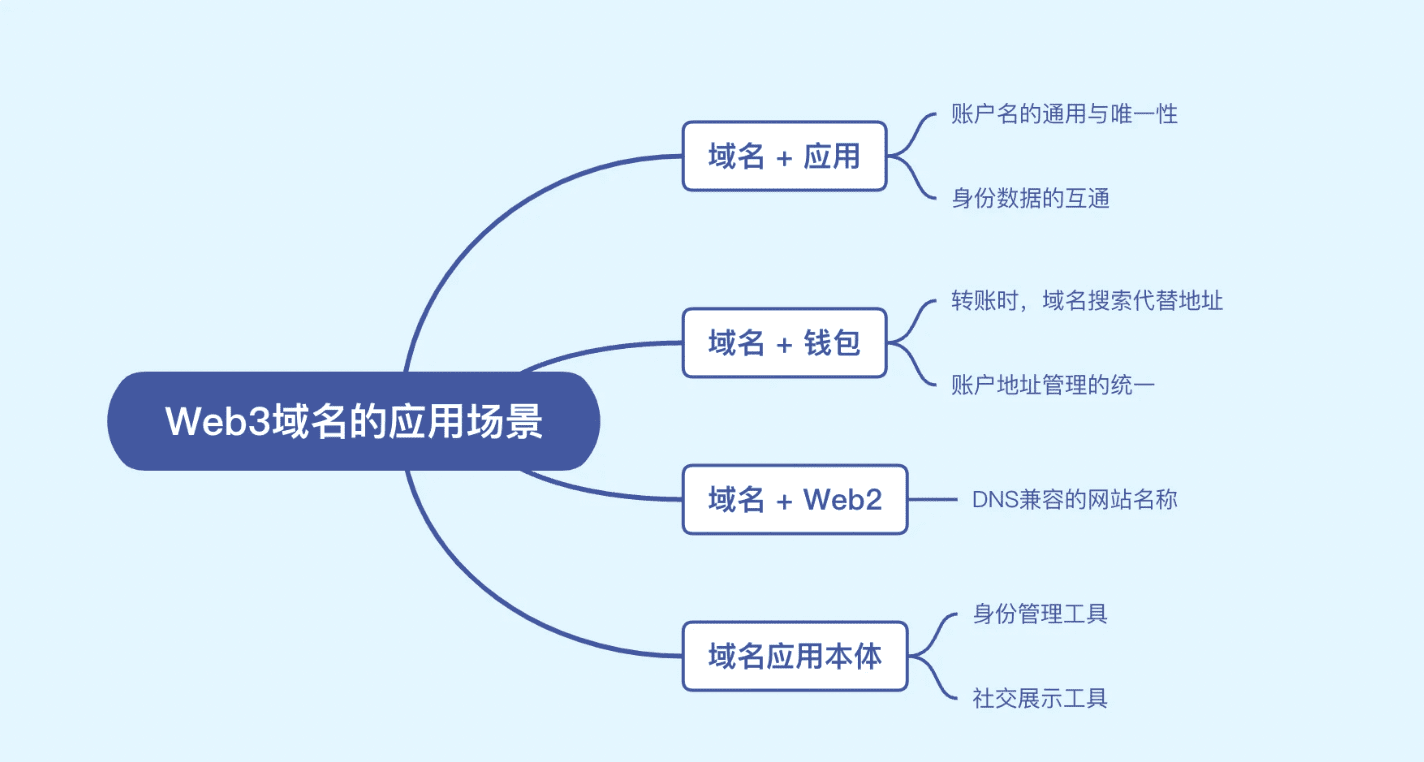
Chapter 2, application scenarios of Web3 domain names: unify account names and identity data in applications, interconnect with Web2 web addresses, and serve as identity management and social display tools
Chapter 3: Classification of the Web3 domain name track: single-chain domain names (including public chain domain names, multi-domain name registrars, and social domain names), multi-chain domain names (including three different implementation paths), and DNS alternative domain names
Chapter 4, the author’s observations and thoughts on Web3 domain names, including: the intensity of user demand for Web3 domain names, analysis of Web3 domain name transactions, prospects for the competitive landscape of Web3 domain names, and potential suffix conflicts in the Web3 domain name project
#Chapter 1: What is a Web3 domain name?
Web3 domain names generally refer to those domain names with suffixes such as .eth, .bnb, nft, .wallet and other public chain abbreviations or abbreviations with strong Web3 characteristics, and whose application scenarios are mainly in the blockchain/Web3 field. Ethereum’s ENS is the most well-known and representative project on this track.
The concept of domain name originated in the early Internet era. In the earliest days, everyone accessed web pages directly through IP addresses. For example, if you enter "202.108.22.5" in the browser address box, you can open Baidu's homepage, because the string of numbers 202.108.22.5 is exactly Baidu’s IP address. But obviously, this string of numbers is unreadable and difficult to remember. Therefore, early Internet designers built the Domain Name System (DNS) to encapsulate digital IP addresses by using more readable domain names such as www.baidu.com as "web page addresses" so that People use it every day. Now, every Internet user knows the concept of "web page address". Even if most of them don't know the underlying IP address, DNS and other principles, this does not hinder their experience on the Internet at all.
The most intuitive value of a Web3 domain name is similar. It is the user's "Web3 nickname" and an encapsulation of the address on the chain. For example, vitalik.eth is an encapsulation of the Ethereum address "0xd8da6bf26964af9d7eed9e03e53415d37aa96045". Every Web3 user will hold at least one on-chain address, but I’m afraid no one will think of remembering their own address, let alone someone else’s. Domain names such as vitalik.eth, 2089.bit, jack.bnb are obviously more readable and memorable than that long string of address characters, and can better meet the needs of people's daily life. For example, if you need to ask your friend to transfer money to you, you may have to find your on-chain address in your wallet or notepad, and then send it to your friend; but if you hold a domain name, such as vincent.eth, you can Directly tell your friends to transfer money to this domain name.
From this perspective alone, the value of domain names has a lot of room for development: after all, it can help mass users shield the technical details of on-chain addresses. So when Web3 enters the public, will it become an address? The "agent" in the user's mind is just like most users on the Web who "only know the web page address but not the IP"?
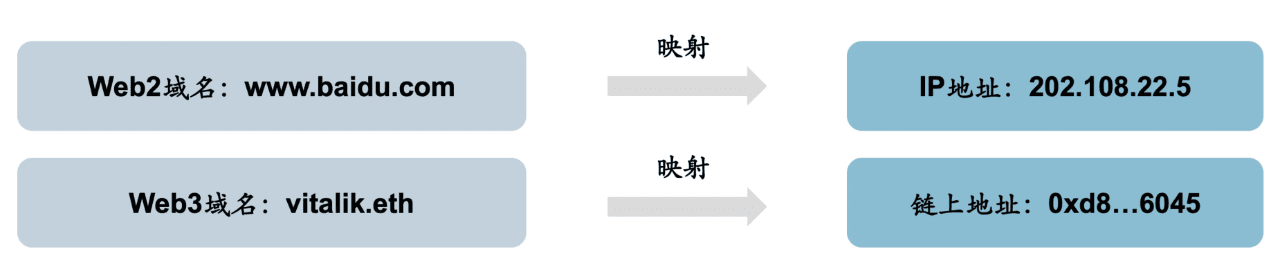
From a technical perspective, the technical nature of domain names is not complicated, it is the data relationship of "mapping". Therefore, its specific implementation can have multiple paths: in Web2, the registration and management of all domain names are handled by ICANN in California, USA, which is highly centralized and supervised by the U.S. government; but in Web3, most The mainstream domain name implementation method is the smart contract on the chain represented by ENS, which casts each domain name into the form of Ethereum NFT, which can be freely registered and traded without permission, and the corresponding resolution address is set by the user himself.
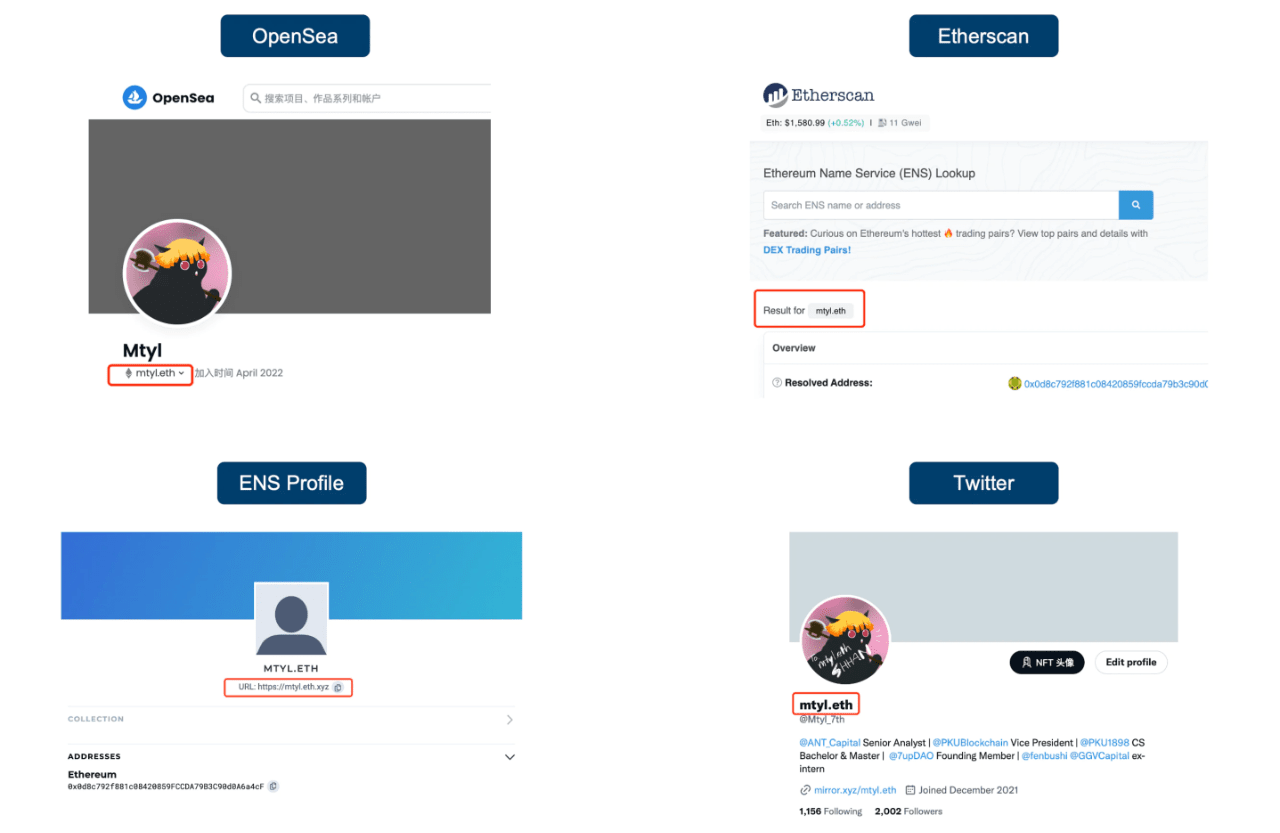
In addition, in addition to being bound to the address of the public chain where it is located, the domain name has more room for imagination, because it can also be bound to other public chain addresses, Web2 accounts, and even Web2 DNS addresses. For example, you only need to know the ENS domain name "mtyl.eth" to directly find one of the author's commonly used Ethereum addresses, its corresponding Opensea account, the author's Twitter account, and the author's personal homepage website in ENS. To some extent, this is the beginning of a Web3 universal identity.
#Chapter 2: Specific application scenarios of Web3 domain names
As an NFT product sold directly to users, what is the use of Web3 domain names? Next, let the author sort out the application scenarios of domain names in Web3 in detail.
2.1 Domain Name + DApp: Unification of Account Names, Interoperability of Data
The most direct application is to use the domain name directly as the account name of each Web3 related application. In Web2, whenever you use a new website/new application, you often have to register a user name; for convenience, many users will choose from some of the names they used to use before when registering a new account to reduce their memory. cost and enhance the visibility of your online identity. However, even if the user wants to use the same username, it is not easy to achieve consistent usernames in different apps due to the different formats and lengths of usernames on different websites, as well as prior registration by other users. If a person uses "Alvin" as a username in application A, and you want to find him by searching for "Alvin" in application B, it may not always be possible. Even if you do find an "Alvin", you still need to spend time identifying whether the person behind the two accounts is the same person.
In Web3, due to wallet address login and on-chain resolution of domain names, DApps can easily support users to use a certain domain name as their account name. And due to the uniqueness of the domain name, as the domain name's support for multi-chains matures, you can ensure that the same person is using the same domain name on Opensea (ETH) and Magic Eden (Solana). Even Web2 applications such as Twitter can use some plug-ins and other methods to authenticate those who use their own NFT domain names as their usernames. It is not even ruled out that platform giants such as Twitter will support similar functions in the future.
Behind the unification of account names is also the exchange of identity data. Since the domain name resolution information contains information from other chains and Web2, the application side can obtain user information through the domain name that cannot be obtained only through the wallet address on the chain. This not only directly imports user data, reducing the cost for users to get started with new applications from the information level (think of filling in various information in Web2 applications), but also allows the application side to make targeted recommendations to users; various information issued by the application side Credentials and badges can also be resolved and bound by domain names, increasing interoperability on the chain and user recognition.
Although this kind of cross-chain and cross-Web2 interoperability of identity data may not necessarily be achieved through domain names, domain names are indeed a natural and excellent carrier for users, and are strong competitors and partners for this segmented value point.
2.2 Domain Name + Wallet: Search addresses through domain names and unify account address management
The most common collaboration between wallets and domain names is to support searching by domain name when transferring money, eliminating the need for users to remember transfer addresses. For example, Metamask, a leading wallet product, has already implemented search support for ENS domain names.
If you want to transfer money to the author through the chain, there is no need for the author to display the specific wallet address here. You can directly enter the domain name in the target address bar of "Send" and you can find the corresponding address to perform the operation.
There is room for deeper cooperation between wallets and domain names, but these cooperation themselves may involve the strategic development of wallets, so they may not necessarily advance quickly.
Taking Metamask as an example, each user's Metamask account can create different sub-accounts; and different sub-accounts have different addresses on different chains. This sub-account management is located in the upper right corner of the browser plug-in, as shown in the lock below:
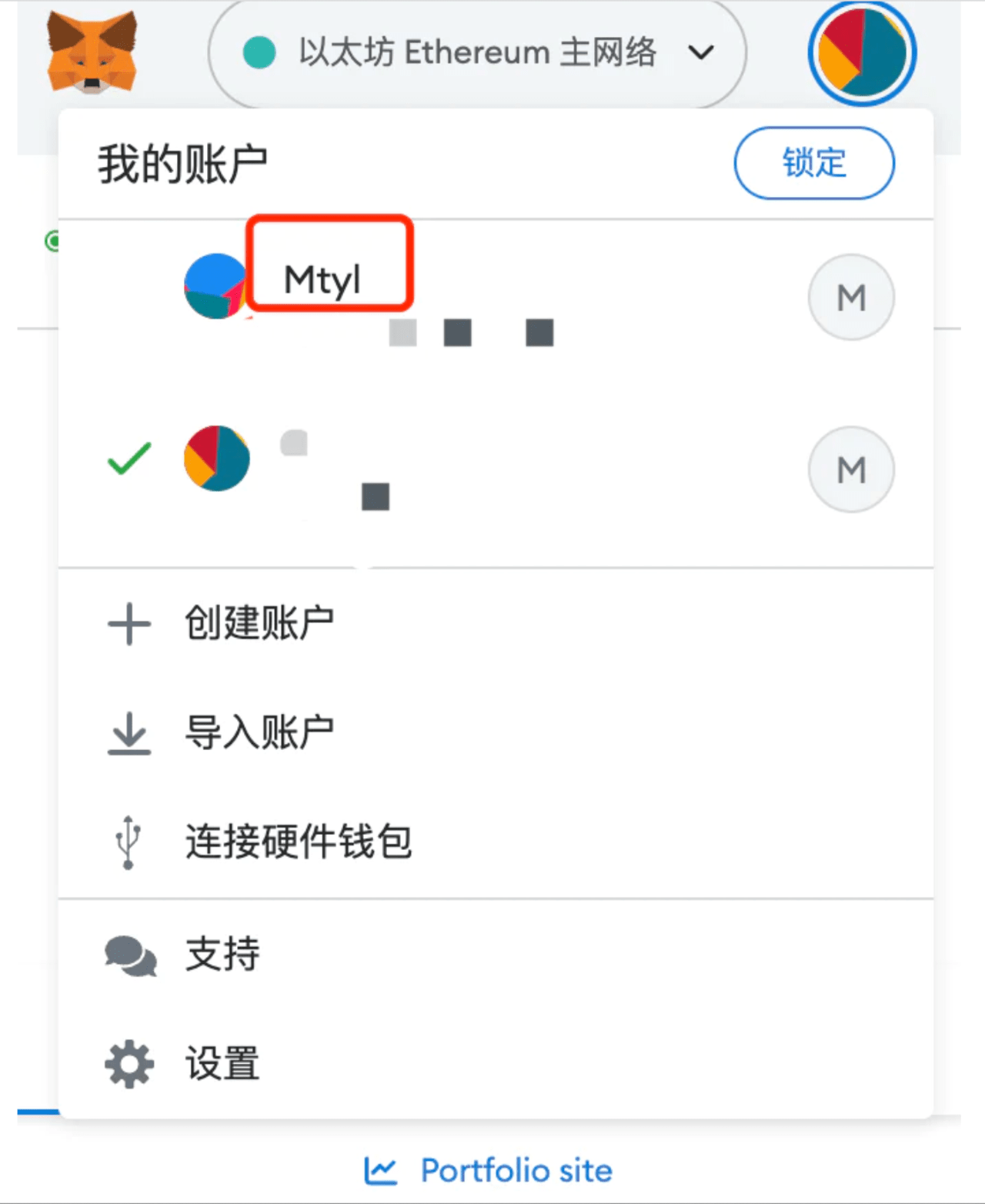
Metamask's account name can currently be set freely by users, and it does not have any application scenarios (it is simply convenient for user management). But in fact, this account name can be cooperated with the domain name project party and use the corresponding domain name. The public chain addresses bound to domain names naturally become the interactive addresses of wallets and applications.
As a further extension, after the wallet integrates the domain name and its various resolution relationships, it can also be displayed in the wallet. For example, it displays the relationship between a domain name account corresponding to Web2 social platforms such as Twitter and Reddit, and the credentials held by users in various DApps. These things are actually what some wallet project parties that focus on DID also hope to do, making this cooperation a potential conflict of interest. In addition, it is not easy for domain name project parties to implement these tool protocols, so there is no practical progress yet. But in the future, this is indeed a possibility.
2.3 Domain name + Web2: Interoperability of web page addresses
Some users who heard about Web3 domain names for the first time may think that Web3 domain names such as "2099.eth" and "2099.com" are similar, and they are both Web2 domain names (i.e. web page addresses), but in fact this is not the case. So, can the Web3 domain name you register really become a website address that can be opened by a general browser? This is actually something that many domain name projects hope to promote, but its difficulty is not reflected in the technology, but in the communication between the real world and ICANN.
In ICANN's Web2 domain name management system, "web suffixes" such as ".com", ".cn", ".xyz", ".link" and so on are called "top-level domains", and the application for a new top-level domain name requires special submission of materials + auction. This not only requires a high application fee, but also the opening and auction time of the domain name are completely determined by ICANN. In addition, ICANN has a brand protection rule - if a brand (such as Apple) finds that its trademark domain name has been registered, it can appeal to obtain its own domain name. Even if this appeal is not necessarily successful, it also brings many potential troubles to the project party. In addition, ICANN will reserve top-level domains for countries (such as .cn for China), and the suffixes of a few projects conflict with the country abbreviations, such as ENS's ".eth" and ICANN's national top-level domain reserved for Ethiopia (Ethiopia).
Therefore, since the connection of Web2 websites is not the core value of Web3 domain names, and for the various reasons mentioned above, no Web3 domain name project can realize "directly using Web3 domain names as website addresses." But after all, there is a precedent for Web2 domain names. The concept of buying a Web3 domain name and getting a website address, and building a personal homepage/company homepage around it is still very attractive. For example, Unstoppable Domains is very active in Web2 connectivity. Other projects such as ENS have also formed a relatively mature "curve to save the country" plan under the unremitting exploration of Web3 community members: using Web3 domain names as second-level domain names under the top-level domain.
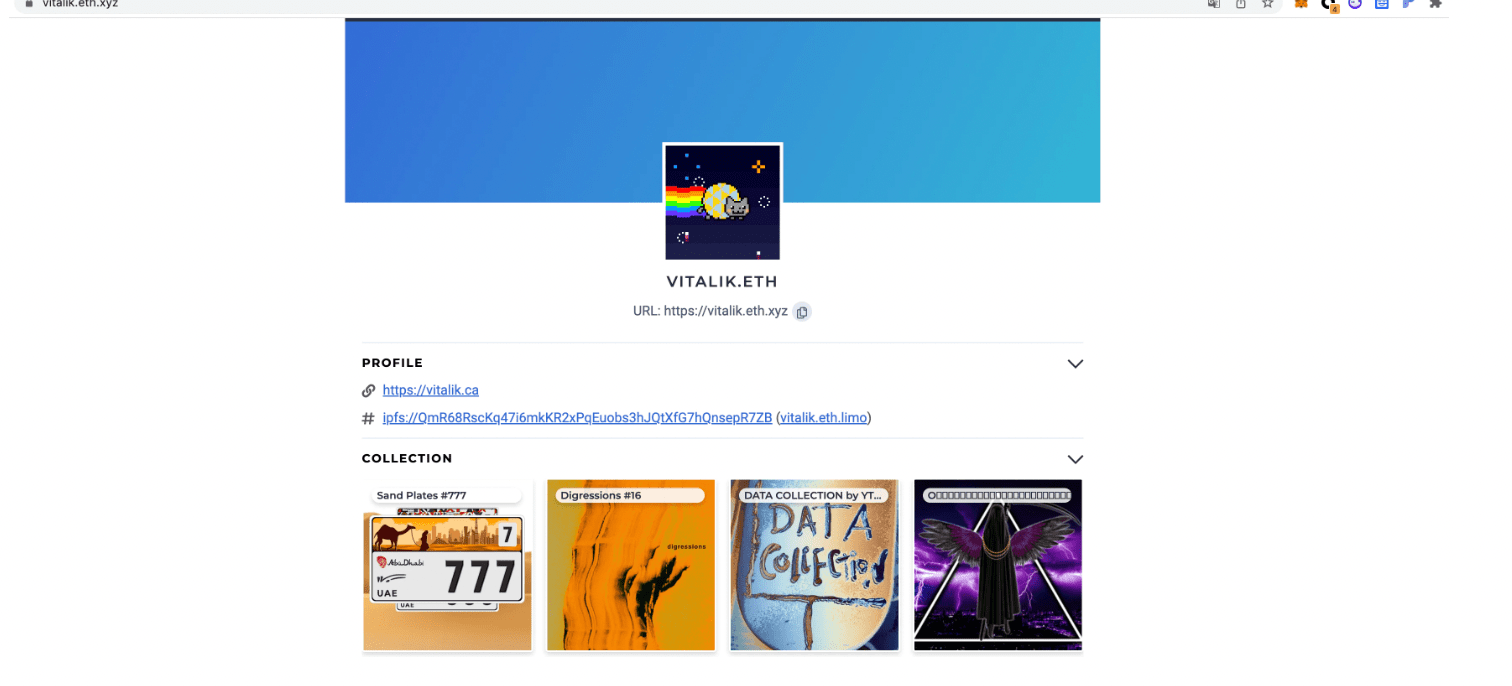
Although "vitalik.eth" cannot be directly entered into the browser and parsed, "vitalik.eth.xyz" and "vitalik.eth.link" can. Readers may wish to give it a try. For example, enter "vitalik.eth.xyz" into the browser to see the ENS Profile generated by Vitalik by default; enter "vitalik.eth.link" to see Vitalik's personal homepage:
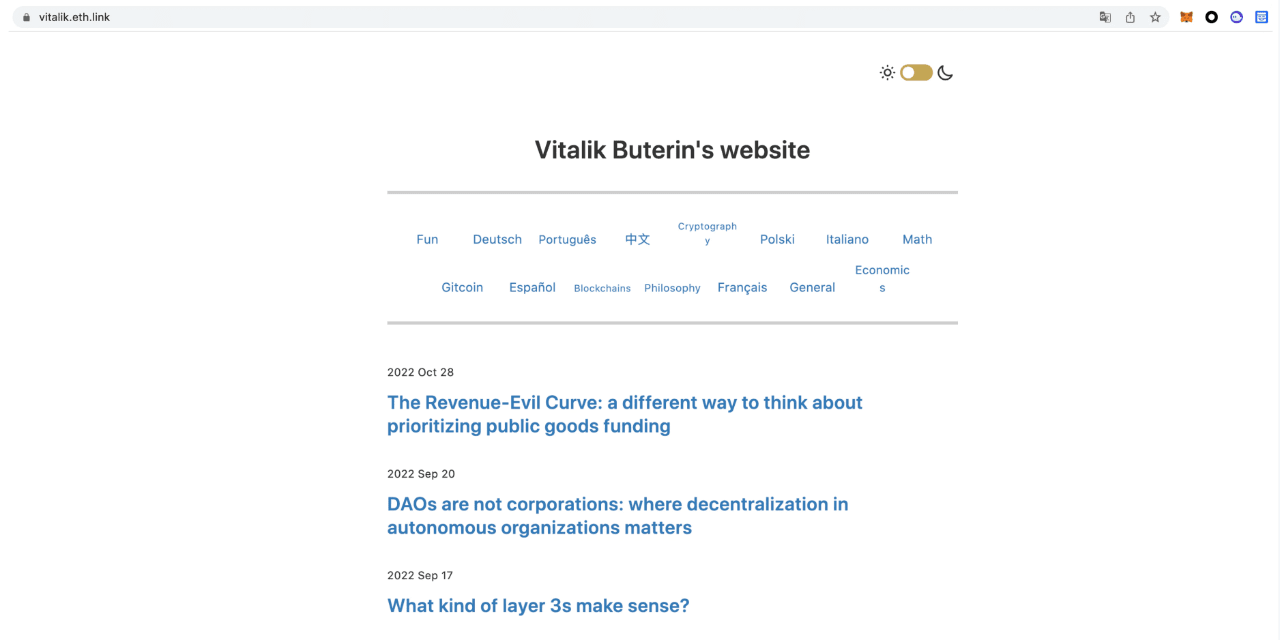
There is no common practice as to which top-level domain name to use, what the different meanings of each top-level domain suffix represent, and even whether the project party can obtain control of the corresponding domain name. Taking ENS as an example, .eth.link was previously registered by co-founder Virgil Griffith, but due to Virgil’s imprisonment, the domain name was auctioned to Manifold Finance after expiration. ENS has filed a lawsuit in court, hoping to regain control of the domain name. The case is still under review.
Although its specific implementation of this direct connection with web page addresses still relies on the Web2 domain name system and requires the project party to obtain control of the second-level domain name it is interested in, this is compared to other solutions (such as IPFS static resolution). + Open in Web3 browser), it is more acceptable to the public. This natural interoperability with Web2 websites is also a natural feature of Web3 domain names and is unique compared to other similar identity management carriers.
2.4 Domain name application ontology: identity management tool & social display homepage
The ontology of Web3 domain name application is now mostly responsible for registering domain names and binding addresses on the main chain, and its presence is not high. But as more and more applications and wallets support domain names with applications, wallets, and Web2, the domain name application ontology will also carry more identity management functions. Specific examples are as follows: set the parsing targets corresponding to each chain and each Web2 platform, set the address, format and display information of the personal homepage, set some private content/content that requires specific permissions to access, etc.
Domain name project parties can also naturally create a social display homepage to present the information registered by users and wished to be displayed in a structured way.
For example, the second-level domain name suffix .eth.xyz carries the function of ENS personal homepage. As long as you know any ENS domain name, you can add .xyz after it and enter it into the browser to see the corresponding address of the domain name owner. some display information. Although the experience of this display is still very rudimentary at present, it will indeed be established in the long run. In addition to being operated by the domain name project itself, the personal homepage can also be cooperated with projects such as link3 that hope to do similar things.
If we use our imagination further, domain name projects can also do social networking themselves, or social networking projects can use the issuance of domain names as one of the core operations. The SNS domain name issued by Linkkey is one of the more practical projects of this type.
If readers are interested in the decentralized identity track, they can refer to the author’s previous long article on DID research:
2.5 Summary of this chapter
The above is the author’s integration of the more practical application scenarios of current Web3 domain names. Different domain name projects have different priorities in development.
In the third chapter, this article will classify and sort out the main projects of the Web3 domain name track, so that readers can understand the differences and connections between these projects, as well as the specific data and implementation details of the domain name projects.
#Chapter 3: Classification of Domain Name Projects
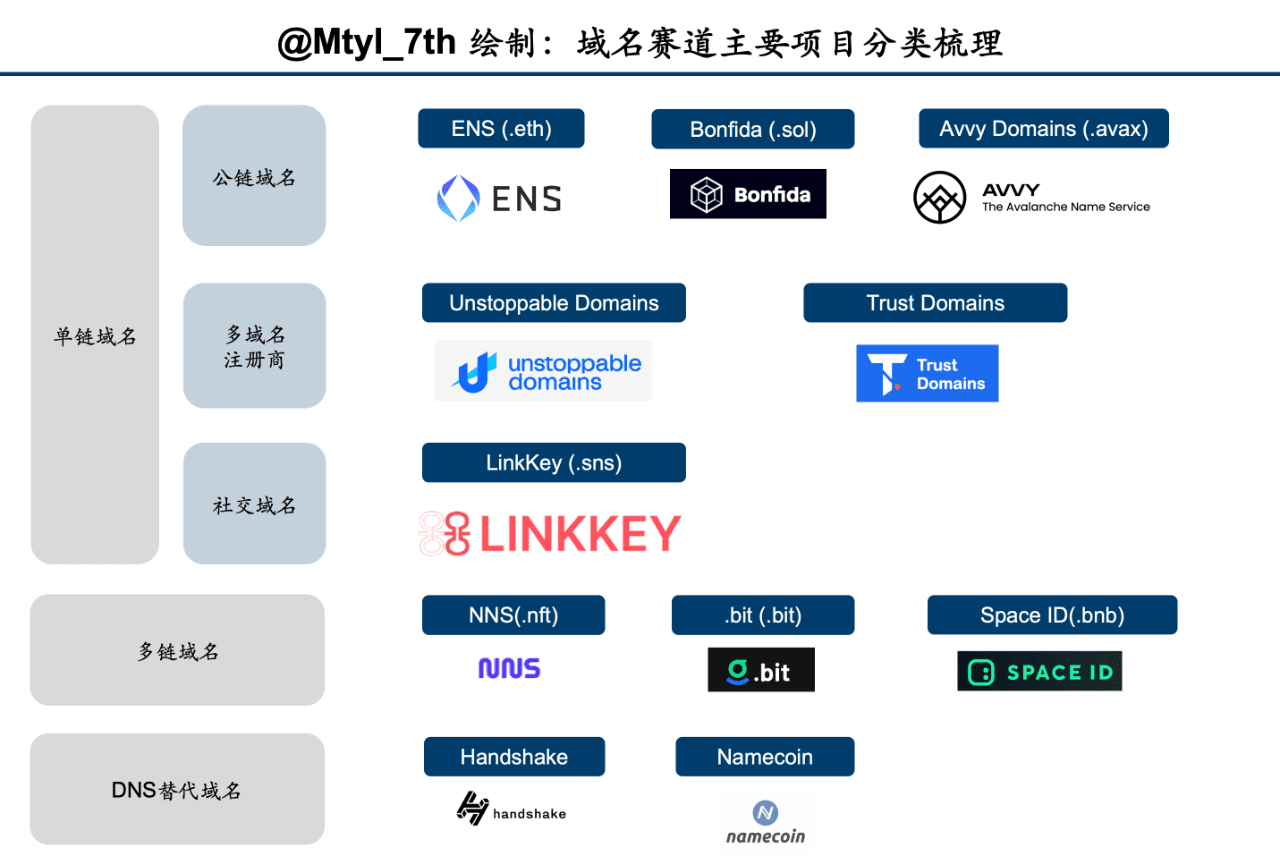
There are currently many domain name projects, perhaps nearly forty or fifty, but if divided from technical implementation and application scenarios, it is not too complicated - you can regard ENS as the "pioneer" and "big brother" in the domain name field. Most domain name projects are replicas of ENS on different public chains. Even if they are not direct replicas, their specific implementation on the chain highly refers to ENS.
The author divides the current domain name projects into the following three categories: single-chain domain names, multi-chain domain names, and DNS alternative domain names. Among them, single-chain domain names can be further refined. As shown below:
3.1 Single-chain domain name
3.1.1 Public chain domain name: represented by ENS
These projects are very recognizable: they all have the abbreviation of the public chain as the suffix, such as .eth, .sol, .avax, and all have the official background of the public chain or the official support. Their implementation logic and application scenarios are also highly similar, except that they are on different public chains. Therefore, to study this type of project, you only need to focus on ENS.
ENS is the leading project in the Web3 domain name field. It was founded in 2016 by Nick Johnson, a former Google software engineer. Initially, ENS was a side project authorized by the ETH Foundation. Later, the ENS team was established with the support of the ETH Foundation. ENS has not received any external financing and has only received donations from organizations such as the Ethereum Foundation.
ENS launched the beta version in May 2017 and the official version in May 2019. The trading volume of ENS has been among the top ten in Opensea all year round, and there have been two waves of trading peaks in November 2021 and April-May 2022. As of early November 2022, ENS has registered 2.62 million domain names, 573,000 registered users, and 508 ecological cooperation projects. These data are significantly ahead of many other similar projects. ENS will be airdropped and issued in November 2021. In early November 2022, its fully diluted market value will be approximately US$1.5 billion.
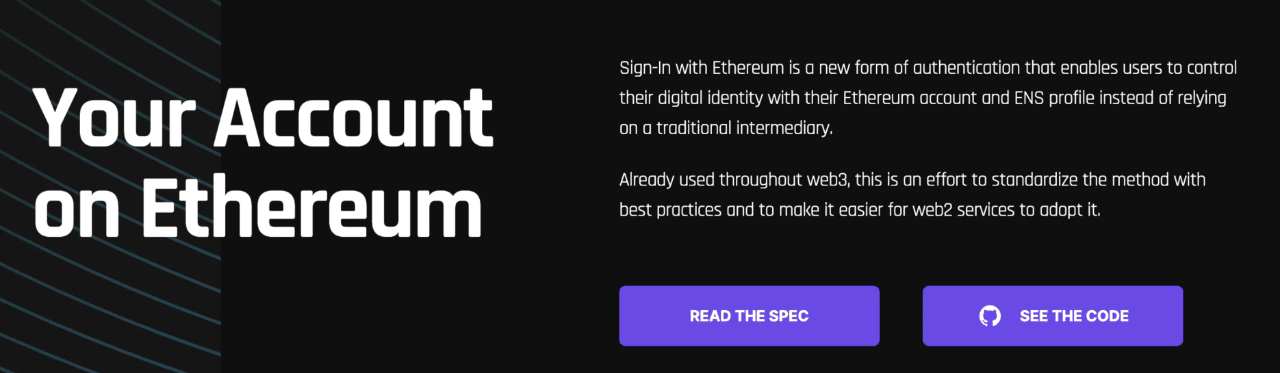
ENS currently has no plans to directly expand to other public chains. The project team’s recent actions are mainly reflected in the connectivity of Web2 web pages, such as the second-level domain name web pages and their corresponding applications mentioned above. In addition, ENS is also promoting Sign-in with Ethereum (EIP -4361), a new login method with Spruce ID, hoping to use it to connect identity data, which is very worthy of attention and expectation.
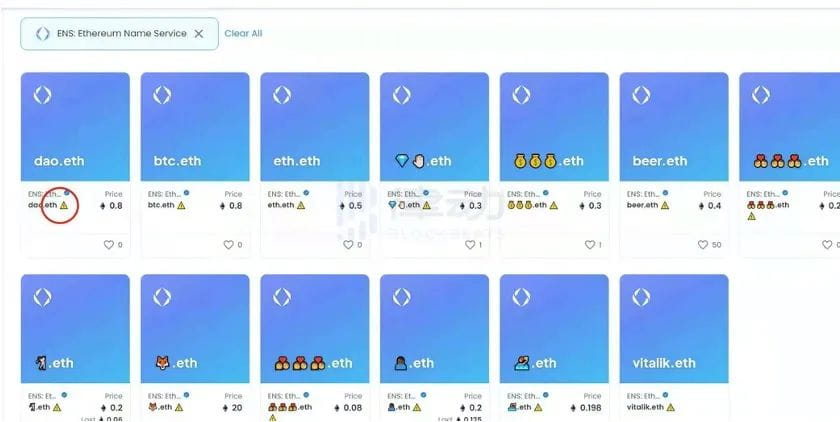
Although ENS and its popularity are high, it is not perfect. ENS exposed the "ZWJ character problem" after it went online:
The ZWJ problem refers to the fact that ENS supports the padding character ZWJ when registering, such as "%E2%80%8D", which allows domain names that are actually different to appear in the same appearance. For example, "vitalik%E2%80%8D.eth" and "vitalik%E2%80%8D%E2%80%8D.eth" are both displayed as "vitalik.eth" on the web page, which means that if users transfer funds by copying and pasting the domain name, they are at risk of being deceived by "fake domain names".
At present, this problem cannot be solved technically by ENS and can only be patched by the application layer consciously. For example, Opensea and Metamask will put yellow exclamation marks on domain names with ZWJ characters. However, if ENS enters a large-scale promotion period, it can be expected that related fraudulent applications will inevitably appear. This creates potential troublesome factors for the large-scale promotion of ENS.
3.1.2 Web3 domain name registrar: represented by Unstoppable Domains
Such projects often sell Web3 domain names with multiple suffixes at the same time, and these domain name suffixes are often highly related to Web3. The representative among them is Unstoppable Domains.
Unstoppable Domains completed a $65 million financing in July this year, with a valuation of $1 billion, close to the level of ENS. It also supports the registration of 9 domain names: .crypto/.nft/.x/.wallet/.bitcoin/.dao/.888/.zil/.blockchain. It is worth mentioning that, unlike most domain name projects that require annual renewal, Unstoppable is a permanent registration mechanism, so the fees for some rare domain names will be more expensive.
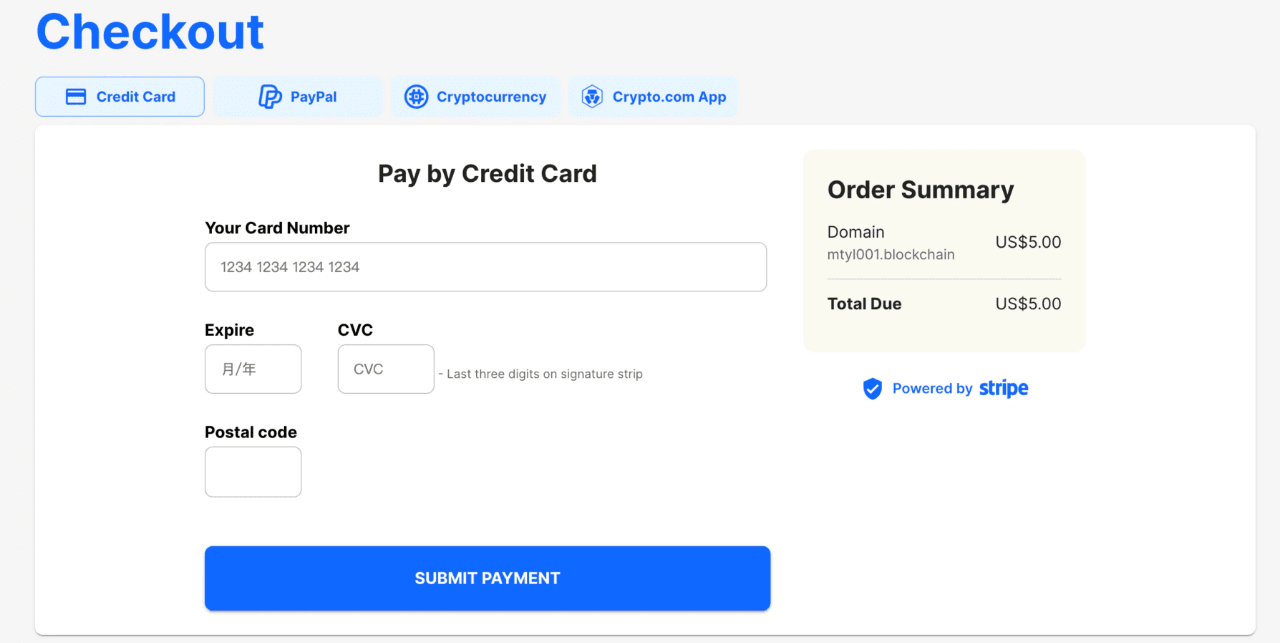
The registration process of Unstoppable Domains is not completely on-chain like ENS and other projects, but a centralized registration management + on-chain NFT minting model: users can log in with Google + pay by credit card when registering, and then go to Polygon to mint NFT (except for .zil domain names, which can be mined on Zilliqa).
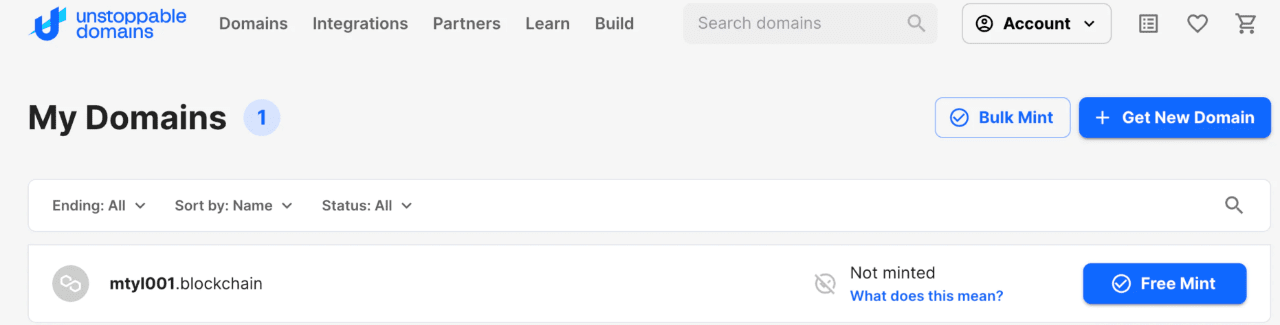
In terms of project development, Unstoppable Domains will also focus on the concept of "Web3 name", but its actual product design and publicity focus more on the experience of Web2 users, as well as the interoperability of its domain name and Web2 website. In terms of Web3 connectivity, in addition to the account name cooperation mentioned earlier, Unstoppable Domains also launched "Login with Unstoppable", which is a button parallel to the wallet login method such as "Metamsk" after you click "Connect Wallet". Users can use this method to log in in cooperative projects such as yearn.finance. However, this login cannot bypass the wallet at present, but requires an additional process of filling in the domain name, and the current user experience is not good.
Unstoppable Domains may not be particularly well-known in the Chinese community, but its popularity overseas and its overseas marketing efforts are very strong. At present, the total number of domain names registered by Unstoppable Domains has exceeded 2.7 million, and more than 500 applications have integrated Unstoppable Domains.
The main problem with Unstoppable Domains and similar projects is that the domain name suffixes they sell are not supported by an authoritative organization, so the ownership of popular domain names is often disputed. This problem of domain name suffix conflict is also a problem faced by this track. The author will discuss it in the next chapter.
3.1.3 Social domain name applications: represented by Linkkey
This type of project may not be particularly innovative in domain name technology, but it focuses more on combining domain names with social applications.
Linkkey's SNS is one of the representatives. It hopes to use domain names as a carrier to do "value social networking" in the Web3 field. According to the theory that "a person can only maintain deep social links with 150 people at most at the same time", each SNS user can issue NFTs that symbolize their social value, and the social value of users is determined by market prices. Linkkey's token model design is also innovative. Its domain name registration function and some product functions have been launched. The complete product will be launched and available at the end of this year and the beginning of next year. Interested friends can go to its official website to experience and learn more.
3.2 Multi-chain domain names
NNS, .bit, and Space ID are the three main projects in this category. In the promotion and development of the project, they all emphasize the nature of "Web3 identity business card" and "Web3 identity management", and have written clear multi-chain support plans.
However, when it comes to how to specifically implement "multi-chain support", the three domain name solutions have their own characteristics. Below, the author will focus on a brief introduction to their multi-chain implementation solutions.
3.2.1 .bit
The .bit project team has launched a domain name system with the .bit suffix. The project team believes that the development of public chain suffix domain names such as .eth, .bnb, and .sol may encounter some upper limit issues (especially new public chain domain names), because core projects on other mainstream L1 public chains may be difficult to accept and Cooperate with the domain name of another public chain suffix. .bit is just a domain name suffix without a public chain label. It may have more natural advantages when cooperating with multiple public chains.
.bit is implemented based on the Nervous CKB public chain. This public chain is not a mainstream public chain in public perception, but it has unique properties - it is specially built to achieve unified management of different public chain assets. of.
How Nervous assets implement multi-chain asset management specifically involves some technical issues based on cryptography principles. There is a relatively intuitive metaphor in its official documentation, which is briefly described as follows:
If we compare the ETH public chain and the BTC public chain to the United States and the United Kingdom, respectively, and compare the ETH address and the BTC address to the ID cards of the United States and the United Kingdom, respectively, the current situation is that residents must have a US ID card (BTC address) to hold and manage assets in the United States (BTC), and the same is true in the United Kingdom (ETH). The two countries do not recognize each other's national ID cards (addresses).
The Nervous public chain can be regarded as a neutral and open third country. It supports citizens of other countries to hold assets through ID cards of other countries. For example, if a BTC user sends assets issued on Nervos CKB in a BTC wallet, it can be regarded as Selling TA's house in a neutral country for US residents holding US ID cards, and this process is officially recognized by the neutral country (verified by the Nervos CKB node).
3.2.2 NNS
NNS is a domain name system with the .nft suffix launched by the Metascan.pro (the parent company of Twitterscan) project. It currently mainly implements core functions such as registration and resolution on the Ethereum main chain.
The Metascan project team will launch the NNS contract on other public chains (such as BSC) in the next few weeks, so that users can register and manage domain names with lower gas fees. The NNS domain name systems on different public chains are unified. The specific implementation of this "unification" may involve the deployment of some information cross-chain nodes, or it may also involve some forms of centralized management.
Theoretically speaking, domain name cross-chain is not complicated, as long as the domain name resolution information on all chains can be unified through cross-chain nodes. But in fact, when multiple public chains are involved at the same time, maintaining the synchronization and real-time consistency of domain name registry information still faces many challenges under the current Web3 infrastructure. This is also the reason why most domain name projects currently only support one public chain. How NNS specifically implements this cross-chain and how stable and decentralized it is is worthy of attention.
3.2.3 Space ID
Space ID launches .bnb domain name on BSC. At present, as far as the domain name smart contract itself is concerned, its nature is highly similar to that of ENS. It only supports the connection and resolution of projects on BSC, and there is nothing very special about it. However, Space ID plans to launch a set of "namespace" (NameSpace) to cover the domain name projects of various public chains, and even allow Web2 platform companies to issue their own domain name spaces. Rather than like .bit, I hope my domain name suffix can become a common name in the Web3 field.
This namespace can be roughly understood like this: If a person holds Solo.bnb on BSC, then in the namespace of Space ID, it will hold bnb:solo in the future; if he holds Solo.eth, then in the namespace It holds eth:solo; even the account names of Apple and Google can be converted into forms similar to apple:solo, google:solo, etc.
This vision is worthy of attention and anticipation, but the part of Space ID that has been launched is still somewhat different from this vision and may require a longer iteration.
To sum up, although most Web3 domain names regard identity management as a core narrative, once it involves multi-chain smart contract domain name interoperability, they will face more complex technical details in cross-chain and multi-chain issues. At present, .bit's multi-chain solution is the fastest to be implemented.
3.3 DNS domain name replacement: Handshake, Namecoin
The centralized management of Web2 ICANN domain names has caused dissatisfaction among many decentralization believers. Therefore, some people are exploring the realization of decentralized website domain name resolution. The main vision of these two projects is to serve as a supplement and replacement for the Web2 DNS system.
Since their concepts and development directions are very different from most Web3 domain names, and they have not attracted much market attention recently, this article will not focus on them. Interested readers can learn more about them on their own.
#Chapter 4: Thoughts on key issues of Web3 domain names
4.1 Analysis of user demand for Web3 domain names: currently not strictly needed; transactions are mainly concentrated in short numeric domain names
Although the author previously introduced in detail the current application scenarios and uses of domain names, it has to be admitted that domain names are not a rigid need for current Web3 users.
Even if the user does not purchase any Web3 domain name, it will not affect his normal Web3 application experience at all; even if he loses the Web3 domain name he purchased, unless he has used this domain name on a large scale for his social account (just like the author used mtyl.eth ), otherwise his perception would be limited. Readers may wish to think about the use of domain names by themselves and those around them: what percentage of people never purchase it, what percentage of people purchase it just for a taste or investment, and what percentage of people actually use his domain name on a large scale.
The author once made statistics on the renewal/retention situation of ENS users through on-chain data, and found an interesting conclusion: among the active domain names on and before August 20, 2021, 52% of the domain names were active on August 20, 2022. failed. This means that during this year, 52% of the domain names expired (maybe they were registered more years ago), and the original users did not renew, and no new users registered the same domain names in time. Observing the other 21 years, the failure rate is basically between 45-55%.
Considering that the minimum registration time for ENS is one year, although this caliber can only show the situation of old ENS users who registered before November last year, it can also explain a lot of problems. Compared with many short-lived "hot" application projects in the Web3 field, this retention status can be said to be quite good. It can also reflect the nature of domain names as Web3 infrastructure and long-term growth with the development of the Web3 ecosystem; but from its absolute figures Judging from the above, this ratio is still not high, indicating that Web3 domain names are still not a rigid demand for users.
The author believes that the long-term development of domain name projects mainly depends on the development of the Web3 application ecosystem, especially the development of Web3 social projects. Because it is difficult to bring fundamental large-scale increments to the entire field by simply relying on the domain name project itself to promote the account name of applications and wallets; only the vigorous development of application projects can highlight the importance of the account name system and identity management system associated with the domain name, and highlight the value of the domain name itself. However, before that, the domain name project must be well prepared, so as not to find that its core functions such as identity management, cross-chain solutions, and Web2 URL connection are still not mature enough when the real application wave comes. In addition, it is also a possible development path for the domain name project to start its own social application, or a login system similar to a wallet.
4.2 Web3 domain name transaction analysis: currently focused on short numeric domain names
ENS is the domain name project with the most active transactions and completely public data, so its transactions are highly representative.
In the ENS domain name transactions in the past three months from April 25 to July 7, 2022, pure digital domain name transactions contributed 44% of the number of transactions, accounting for 65% in terms of transaction volume; and in the case of digital domain names, In this segment, 97% of transactions are short 3-5 digit domain names, and 3-digit domain names contribute 29% of the transaction volume with 1% of the transaction volume. (Source: W3.Hitchhiker)
Judging from the development of various new domain name projects, short numeric domain names such as 982.eth, 2089.eth, 12346.eth, etc. What value do they have and are they worthy of such concentrated attention and transactions? The author believes that there are mainly two reasons:
1. Short numeric domain names have strong potential brand value due to their readability and memorability. For example, when the numbers 58, 360, 4399, and 12306 are mentioned, the first thing readers who have used related products think of is the corresponding company name? In the Web2 field, using short numbers as the brand name of an enterprise/business/product is a proven business logic, and it may still hold true in Web3.
2. Short numeric domain names naturally have a certain scarcity and cannot be added (unlike English abbreviations). For example, the maximum number of three-digit domain names is 1,000, and the maximum number of four-digit domain names is 10,000. Coupled with the emergence of NFT digital numbers such as BAYC and concepts such as the corresponding 10k Club, the value of this scarcity has also been verified. The floor price of a four-digit ENS digital domain name is now close to 2 ETH, and it is not ruled out that it will be on par with or even exceed BAYC in the future.
In the Web2 field, there are a large number of cases where short domain names have been sold for sky-high prices. So when Web3 becomes popular in the future, can the short domain names of the header domain name projects also be sold for sky-high prices? This is indeed very imaginative. However, precisely because of this, whenever a new domain name project appears, there will always be speculative users who will rush to register a large number of three- and four-digit domain names, and the project parties are also aware of this. Some project parties will explicitly increase the registration fee for short domain names when registering, while other project parties will reserve short domain names and market them as a special product.
It is worth noting that the emergence of this speculative phenomenon has, to a certain extent, made issuing domain names a "costless business" for the project side: you only need to fork the ENS contract, make an official website and write documents, and then you can expect Users with a speculative mentality come to register various "high-value" domain names and charge expensive registration fees (for example, if you refer to ENS, three-digit domain names are US$640/year and four-digit domain names are US$160/year). As for whether the pie drawn by the project can be realized in the future, that is another matter.
Therefore, when choosing a domain name project, users should conduct more detailed inspections and pay more attention to the actual progress of its application scenarios, including: the number and quality of application projects that support the domain name, and the vision drawn by the project party (such as Social display, multi-chain interoperability, Web2 web page support, etc.) progress and possibilities.
4.3 Prospects for the competitive landscape of domain name projects: the Matthew effect is obvious
Judging from the price of domain names, I think the competition among domain name projects with different suffixes is a matter of great Matthew effect. When it comes to choosing a domain name suffix, the top domain names will become the first choice for wealthy people and KOLs, and this choice will further expand the value of the top domain name suffixes. Therefore, in the end, there may be only 1-2 top domain names at most. Because domain names have stronger social attributes, their status will be similar to or even exceed that of the .com suffix in many Web2 DNS top-level domains.
At present, the .eth suffix of ENS is the most likely to develop into a leader, but the ZWJ defect and lack of multi-chain support of ENS may give later competitors an opportunity to catch up. Considering that even ENS has less than 3 million registered users, which is not high compared with the user base of Web3 and the Internet, there is still some room for competition in this area.
One thing worth discussing is, will the transcendent status of the head domain name in price make other domain name projects completely lose their living space? In Web2, in addition to .com, there are also many other common top-level domain names such as .net and .org. However, Web2 domain names are mainly for B, and the value of business and brand has higher priority. If the domain name itself has high symbolic meaning and brand value, then the suffix may have lower priority than an excellent and readable prefix. For example, if your company is called Silver Stars, would you like to register silverstars123.com or silverstars.xyz as your website homepage address?
But in the Web3 field, the application scenarios of domain names are currently mainly to C. Suppose your English name is Charles, and you and your friends are used to seeing Charles as your account name, but charles.eth has been registered on ENS. If each domain name has similar application scenarios and experiences, you are Would you rather register a name such as charles2874.eth or a name such as charles.gate? This is a difficult question to answer, and it may depend on the future development of the header domain name and the specific positioning of the user's mind on it. However, if the assumption that "each domain name has similar application scenarios and experiences" is not true, and the application of the head domain name supports far more than the waist and tail projects, then it is obvious that users will further flock to the head domain name.
From a long-term perspective, Web3 domain names may also become a rigid need for every B-side project like Web2 web page addresses. At that time, the logic of the domain name demand side may change. But this not only requires the maturity and promotion of the domain name project itself, but also requires the matter of "registering a Web3 domain name - building the project homepage through the website address connected to the Web3 domain name" to become a certain practice and consensus. Judging from the current focus of the development of various domain name projects, this may still be relatively far away.
4.4 The suffix conflict problem of domain name projects: the necessity of decentralization and the damage to user experience
The issuance and registration of Web3 domain names does not require permission from a centralized organization, which is intuitively a good thing. But this also brings about potential disputes and conflicts: If two projects open the registration of the same domain name suffix to users, how should they be resolved? After all, there is almost no threshold for making a smart contract imitating ENS and issuing NFT with a certain domain name suffix to the public.
This is a question worth pondering in the domain name field, because the reason why a domain name can be used as a "Web3 common name" lies in its uniqueness on the public chain and even within the entire Web3 system. If this uniqueness is compromised, the value of the entire domain name is compromised. Just imagine, if there are two .eth projects open for registration at the same time, and both have their own cooperative applications, which project's .eth domain name would you register? If a friend gives you a domain name instead of an address as the transfer destination, do you have to ask one more question: Is the domain name project supported by the wallet you are using the same as the one registered by your friend? Obviously, this will bring great confusion to the identity system on the chain.
Intuitively, the issuance of domain name suffixes generally follows a "first come, first served" principle. The domain name project that develops the corresponding business first can obtain control of the corresponding domain name project first. Later projects are more like imitation disks and should not be used by the mainstream community. Accept. For example, if I now copy the ENS contract and issue the exact same .eth domain name on Ethereum, without using fraudulent means such as phishing websites, it is difficult to imagine what kind of users would knowingly know the details of the two projects. I will pay to register the .eth domain name issued by the author.
However, things are often not that simple, because the two projects may not be on the same public chain, and the "first/last" judgment for conducting business may not be clear. The business focus of the project may also be different, and the users attracted at launch may also be different. Same. Therefore, in the early stages, the consequences of this conflict are not obvious, and both projects can be developed simultaneously. So for application project parties, how should they solve related cooperation support issues?
A recent controversy worthy of attention in the domain name field is that the .nft domain name issued by NNS was removed from the shelves by Opensea (other exchanges did not remove it) because Opensea received a complaint from Unstoppable Domains, which publicly sold the .nft domain name on the market before the former. , and has registered the ".nft" trademark in Hong Kong. But in fact, the .nft domain name NFT issued by NNS and Unstoppable Domains are not on the same public chain, and the business focus of the two is also different. It is not the relationship between the imitated disk and the imitated disk; from the perspective of trademark infringement, NNS It also registered the ".nft" trademark in Japan, South Korea and other countries earlier. Therefore, the rationality of Opensea removing NNS from the shelves is actually open to question.
This is not the first time that Unstoppable Domains has had conflicts with other domain name projects over the suffix issue. Unstoppable Domains has had conflicts with other projects on .coin, .wallet and other suffixes. In the end of the conflict, either one side gave in voluntarily or relied on Litigation and U.S. court decisions. This is ridiculous, and it was finally solved by the US government system. Isn't it back to the old centralized path similar to Web2 ICANN?
But if we do not rely on this centralized approach and allow projects with the same domain name suffix to develop freely on the chain, how to solve potential conflicts in the future? Like the ZWJ problem of ENS, is it up to the application party to make additional annotations for different projects with the same suffix? Or should we build an organization similar to a DAO and hope that various domain name project parties can coordinate and build a decentralized "Web3 ICANN"? These issues are the focus of concern and discussion among users at home and abroad who are concerned about the domain name field.