


Cashmere Labs previously won second prize in the BNB Chain European Innovation Incubator Program in December last year, and was selected for the Binance Labs Season 6 MVB Accelerator Program in April this year.
Written by Karen, Foresight News
It is very easy to be attacked by MEV (Maximum Extractable Value of Ethereum) when trading on DEX. The most common typical attacks are front-running and sandwich attacks, which often take advantage of traders’ interests.
According to a MEV report previously released by EigenPhi, mainstream MEV robots generated at least $307 million in revenue on Ethereum in 2022, of which arbitrage robots generated more than 47.5% of the total revenue. As for the commonly used DEX Uniswap V3, the revenue scale of mainstream MEV robots on Uniswap V3 accounts for 25% of LP revenue, which may be part of our contribution. At a time when cross-chain transaction demand is high, cross-chain DEX aggregators that can resist MEV are relatively important.
Last weekend, Cashmere, a LayerZero-based cross-chain anti-MEV DEX aggregator, released its initial public testnet. As a project selected by Binance Labs' MVB accelerator, will Cashmere once again set off the "LayerZero fever" after the LayerZero-based full-chain lending protocol Radiant Capital became popular? Today, Foresight News will give you a brief introduction to Cashmere's background and anti-MEV attack design.
What is Cashmere?
Cashmere (Chinese translation: "cashmere") has not announced the background of its team. The CEO's official Twitter account is @0xReliq, but no further information has been found. The project team Cashmere Labs previously won the second prize in the BNB Chain European Innovation Incubator Program in December last year, and was selected for the Binance Labs Season 6 MVB Accelerator Program in April this year.
Cashmere is built on LayerZero. It aggregates DEXs on multiple chains and provides users with cross-chain exchange services. At the same time, it recommends a better exchange route. However, at this point, Cashmere will also take MEV attacks into consideration to help users avoid MEV attacks during transactions.
In terms of aggregation, Cashmere will initially aggregate 11 chains, and the testnet has been deployed on Ethereum Goerli, Polygon Mumbai, BSC Testnet, Arbitrum Goerli, Avalanche Fuji, Fantom Testnet, Optimism Goerli, Base Goerli, Linea zkEVM Testnet, Polygon zkEVM Testnet, and Metis Goerli.
In its first Medium article published in July last year, Cashmere stated that in addition to cross-chain DEX, it will also support cross-chain and inter-chain stableswap through unilateral AMM, which will allow stablecoins to be exchanged with very low slippage, thereby solving the stablecoin liquidity problem. The progress of Cashmere stableswap is currently unclear.
So what countermeasures did Cashmere take in the anti-MEV attack design in the cross-chain DEX aggregator?
How does Cashmere resist MEV attacks?
Although you can set your own slippage when trading on DEX, due to factors such as transaction volume, improper slippage settings, potential price changes of assets, and pool reserves, MEV attack robots often have the opportunity to take advantage of the situation.
Cashmere said in September last year that Cashmere has developed a variety of MEV front-running mechanisms to help protect user interests.
For example, the target assets that a user wants to retrieve on the target chain can only be known to the Cashmere validator. Due to the use of ZK-like proofs, ordinary MEV front-running robots will not be able to see it on the chain.
For example, on Ethereum, users will be able to hide their transactions from the Ethereum memory pool and provide the option of using private RPC flashbots through the Cashmere application to protect them from front-running. On other L1 and L2, Cashmere has developed a front-run protector tool that is based on the liquidity of the exchanged assets on Cashmere (on the source and target chains) and calculates the optimal slippage value for the user's transaction, making it unprofitable for MEV front-running attackers.
At the end of last month, Cashmere explained its MEV strategy by simulating attack returns to calculate the optimal slippage for users that the MEV robot cannot profit from. The specific calculation method can be found here.
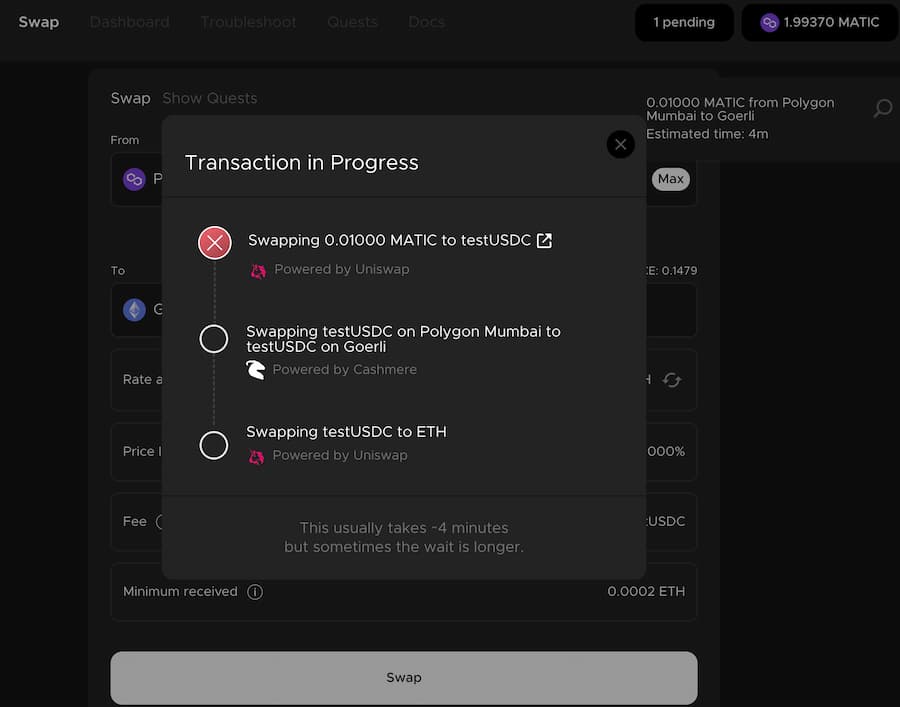
Of course, Cashmere is still in the early stages of the testnet, and the current App experience is not very smooth. Operations including redemption, signature calls, and transaction processing are all relatively slow and need to be continuously optimized.
reference:
https://www.dropbox.com/s/9wphe0hp4t00qn6/cashmere_wp.pdf?dl=0
https://cashmerelabs.medium.com/introducing-cashmerelabs-mev-strategy-e9fd3ff69419