


Warning. Binance Futures products are only available in certain countries and only to certain users. This content is not intended for restricted users/countries. Please review our Terms of Use and Risk Disclaimer.
Main conclusions
The long/short ratio is a sentiment analysis indicator that relates to the opinions and actions of market participants.
It is calculated by dividing the number of long positions by the number of short positions.
A high ratio indicates bullish sentiment in the market, while a low ratio indicates bearish sentiment.
Traders in the cryptocurrency futures market use various indicators to analyze market trends. One of the metrics that traders use to assess the overall mood of the market is sentiment analysis.
Sentiment analysis is a method of assessing the overall sentiment or attitude of market participants towards a particular asset. Movements in markets are determined by the collective actions of their participants, and sentiment analysis evaluates them to determine market trends.
The long/short ratio is a sentiment analysis indicator that relates to the opinions and actions of market participants. In this article, we'll cover the long/short ratio, how to analyze it, and how traders can use it to assess market trends.
Long and Short Positions Explained
Before diving into the meaning of the long/short ratio, let's look at what is meant by long and short positions in futures trading.
Long (long) and short (short) positions represent the two sides of the futures market. Traders take these positions depending on which direction they think the market will move. When a trader takes a long position, he expects the price to rise from a certain point. When a trader takes a short position, he expects the price to decline from a certain point.
Opening a long position when trading futures is similar to buying an asset. Conversely, opening a short position corresponds to selling an asset. However, in futures markets, traders buy and sell futures contracts that reflect the value of the underlying asset. With cryptocurrency futures, traders can take long or short positions in digital assets without actually owning them.
Typically, a bull market will see more long positions as traders expect prices to rise. In turn, in a bear market, the number of short positions often exceeds the number of long positions.
What is the long/short ratio?
The long/short ratio is a sentiment analysis indicator that is used to assess the relative strength of bullish or bearish trends in the market.
The calculation of the long/short ratio shows the ratio of long positions and short positions in a particular market. By analyzing the long/short ratio, traders can better understand the market sentiment towards a particular cryptocurrency asset.
If the long/short ratio is high (meaning there are more long positions than short positions), this may indicate bullish sentiment in the market. If the long/short ratio is low (there are more short positions than long positions), this may indicate bearish sentiment in the market.
How is the long/short ratio calculated?
It is calculated by dividing the number of long positions by the number of short positions. For example, if there are 80 long positions and 40 short positions in the market, the odds would be 2 (80/40).
Thus, a ratio greater than 1 means that there are more long positions than short positions, and this may indicate positive market sentiment regarding the asset. A coefficient less than 1, in turn, means that there are more short positions than long positions, and negative expectations prevail in the market.
Example of long/short ratio for Bitcoin
The Binance Futures platform provides analytics on various perpetual contract metrics, including open interest, long/short ratio, and taker buy/sell volume. The information is displayed in graph form for various perpetual contracts over the last 30 days. This data helps traders gain insight into market movements and sentiment to make more informed trading decisions.
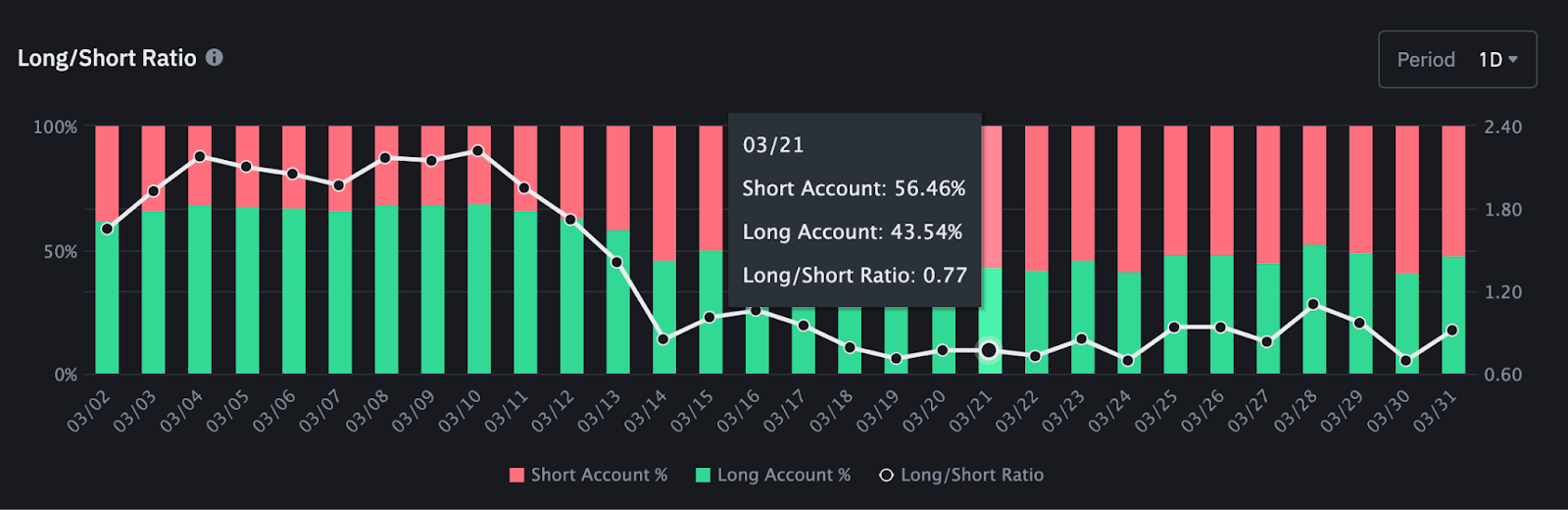
Let's look at the example below, which shows the long/short ratio for the BTCUSDT perpetual contract. In this chart, we have set a period of 1 day for each bar. This shows data for the last 30 days.
For example, on March 21, 2023, the long/short ratio for BTCUSDT closed at 0.77 as 56.46% of all Binance Futures accounts with an open position in BTCUSDT were net short and the remaining 43.54% were net long.
Conclusion
The long/short ratio can be a useful tool for traders to gauge market sentiment. It provides insight into the relative strength of bullish and bearish expectations for a particular cryptocurrency asset.
Traders can monitor this ratio over time to look for possible trends to adjust their strategies. But it is important to note that the long/short ratio should not be the only factor when making trading decisions. It should be used along with other fundamental and technical indicators to reduce risks and more fully assess the state of the market.
Additional Information
(Blog) 10 Most Frequently Asked Questions About Binance Futures
(Blog) Crypto Futures Risks and Money Management: 5 Ways to Better Manage Risks When Trading
(Blog) What information does open interest convey?
(FAQ) Grid trading in long/short mode
Risk warning. Digital asset prices may be volatile. The value of the funds invested may go up and down. You may not get your invested funds back. You are solely responsible for your investment decisions. Binance is not responsible for your possible losses. Futures trading in particular is subject to high market risk and price volatility. If there is a sudden price change, there is a chance that your entire margin balance will be liquidated. Past performance is no guarantee of future performance. Before entering into a transaction, you should make an independent assessment of the appropriateness of the transaction, taking into account your own objectives and circumstances, including the risks and potential rewards. If necessary, contact your advisor. This information should not be considered financial or investment advice. To learn more about how to protect yourself, visit our Responsible Trading page. To learn more, please read our Terms of Use and Risk Disclosure.
Trading in cryptocurrency derivatives may be restricted in certain jurisdictions or regions or only to certain users (subject to legal and regulatory requirements). This content is intended only for those users who are authorized to access and receive such products and services, and is not intended for restricted users. When accessing or using any products or services offered or available on Binance, you are responsible for reviewing any applicable restrictions or requirements regarding those products and services that apply in the country or region from which you (or another person from your name) interact with these products and services. Binance reserves the right to change the terms and conditions and impose further restrictions on access to and use of any products and/or services offered, at its sole discretion, at any time and without notice.