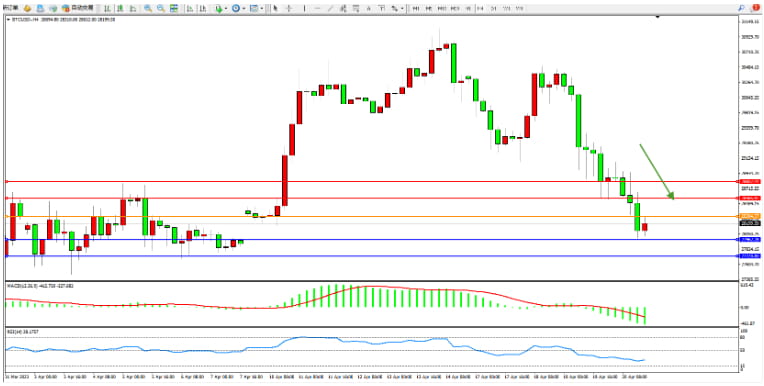

Bitcoin nearly fell below $28,000 in the Asian market on Friday (April 21), which shows that hot money is retreating quickly compared with the strong performance of breaking through $30,000 last week. This wave of Bitcoin's market crash is extremely strange because the market is obviously decoupled from the traditional financial market. Analysts believe that the rapid drop below the range is mainly related to China and the United States. The strengthening of US supervision and the fading of the positive news that China has provided low-key support for Hong Kong have dissipated Bitcoin speculation.
MICA market analysis pointed out: "We believe that this decline will only be a short-term correction. If the time frame is extended, $30,000 this year is still a reasonable price for Bitcoin, because the inflation pressure and interest rate market in the United States have eased. As a digital commodity, Bitcoin always follows the interest rate policy. Now it is only a short-term correction caused by investors' unwinding and cash turnover needs. The target price remains at $30,000."
According to on-chain data, a Bitcoin whale address moved 2,071.5 Bitcoins, worth about $60 million, this week after being dormant since December 19, 2013. Interestingly, this Bitcoin address is associated with two wallets that sent 10,000 Bitcoins in the summer of 2022, the first time in nine years, and is associated with the defunct exchange Mt Gox.
Bitcoin continued its two-day slump, with Mark Connors, head of research at Canadian crypto asset manager 3iQ, linking its decline to U.S. regulatory issues and noting that "market liquidity remains heavily skewed toward Asia."
“The regulatory drama that has played out in the US this week suggests that Asia and other jurisdictions will continue to take market share from the US,” Mark said, adding: “The decision by Coinbase to obtain a license in Bermuda to launch an exchange as early as next week suggests that US digital asset companies are now voting with their feet. As a result, we have had both price and regulatory volatility this week with only one clear loser, the US economy.”
With bitcoin down about 10% from last week’s high near $31,000, investors are more anxious than optimistic about the crypto asset’s path forward, thanks to a fiery U.K. inflation report and a massive sell-off on the Binance exchange.
Mark noted that market liquidity remains heavily skewed toward Asia, so he wasn’t particularly surprised that Bitcoin began to fall as crypto-positive news about China’s low-profile Hong Kong support quieted. “Remember, the dislocations in May and June 2022 occurred in a similar window,” he wrote.
Ethereum recently changed hands around $1,936, well below its recent highs above $2,100 after the Shanghai rally. Other major cryptocurrencies were mostly in the red, mostly in dark colors. XRP, the token of the XRP open-source public blockchain XRP Ledger, and ARB, the native cryptocurrency of the Arbitrum second-layer blockchain, both fell more than 3.5%.
Stock markets fell, but not by much, with the tech-heavy Nasdaq Composite and S&P 500 falling 0.8% and 0.6%, respectively, as technology stocks performed strongly. Gold prices hovered comfortably above $2,000, suggesting that investor appetite for assets that hold their value in good times and bad remains strong.
Despite encouraging first-quarter results from many major banks, investors remain cautious given the decline in many key economic indicators that could signal a recession. Recent employment data pointed to a slump in the job market, and on Thursday, a monthly report from the National Association of Realtors showed the biggest drop in home prices since 2012 and rising mortgage rates.
Meanwhile, Mark wrote that Bitcoin could see “greater volatility, but not to the upside we’ve seen so far in 2023.”
“We may be entering a period of consolidation as U.S. regulatory hopes dim and prompt many players to reboot, both offsetting long-term and structural tailwinds for Bitcoin,” the firm highlighted in its 2023 outlook.
In terms of crypto regulation, we have to mention that the European Parliament passed the Crypto Asset Market Regulation Act (MiCA) on Thursday, which is expected to be implemented as early as April next year, making the EU the world's first major jurisdiction to fully legalize cryptocurrencies. The blockchain subsidiary of Societe Generale Group announced the launch of the euro stablecoin EUR CoinVertable for institutional clients, and officially launched it on Ethereum.
For many, the MiCA bill represents a key step forward for the crypto industry. It is the first major attempt to provide a comprehensive set of rules for cryptocurrency companies so that they know in advance what they can and cannot do, and where their responsibilities lie if they want to operate in the 27 member states. It also shows the EU's ambition to set global standards.
Further reading: Breaking news! The EU approved the "full legalization" of cryptocurrencies. Societe Generale Bank went online on Ethereum and announced the issuance of a euro stablecoin
Here is CMTrade’s daily Bitcoin technical analysis:
Looking at the 4-hour chart: the market is shrouded in short-term sentiment, and the short-term will continue to decline. The short-term sentiment of the market shows no signs of finally stopping. The MACD indicator is in the short-term area and continues to decline, and the RSI indicator is in the short-term area.
Resistance: 28565 28807
Support: 27962 27720
Trading strategy: Bearish below 28304, target 27962 27720