

⚠️Before we get started, always remember that trading is complex and risky.
There is no “easy way” to quickly speed up an account without losing money.
People who blew up accounts quickly usually risked almost everything in doing so.
I will present you with ways to increase your deposit quite quickly and more importantly, in a way that you can still keep your risk quite low.
Also, if the simple terms of risk management seem confusing to you, I strongly recommend that you first read other articles on risk management.
Trade in various crap
If you decide to trade on the BTC, SPX, Gold or currency pairs markets.
You are immediately paired with retail traders like yourself and large institutional players, firms, etc.
This is simply because these large markets are liquid, allowing high volume traders to trade without much hassle.
Trading these markets is not impossible and I will cover it in later paragraphs, but if you have a small account you have an advantage in trading markets where these larger players cannot compete due to their volume.
Many altcoins are not attractive to large players because it is difficult for them to trade as much as they want.
When I started researching altcoins, I often found good setups in very illiquid markets.
At first I was very happy with these easy trades, but when I wanted to execute a large position and saw my order sticking out like an eyesore in the order book, I quickly realized the downside.
If you have a small account, you don't need to worry much as you won't run into these issues until the order size reaches large 5-6 figure amounts.

As we can see in this chart of Lina on coinalyze, a potential breakout on Lina could have been spotted several days before it happened.
This would of course lead to big profits, but we also have to think about possible losses.

If you look at the volume and open interest on Laevitas, you can see that before the pump happened, Lina had 16 million daily volume with 4.5 million open interest.
In a scenario where this trade doesn't work out and you are in a large position, your stop loss will most likely be missed and you will suffer a much larger loss than expected, which is not something that smaller account traders have to deal with , since their feet are very close to their orders.
Low-cap alt derivatives aren't the only thing you can get involved in. The same applies to on-chain coins or NFTs.

As much as some people may think that NFT charting is a meme, if you look at this Famous Fox Federation chart on Tensor trade, it's not much different from any other coin's chart.
You can clearly see an increase in volume with a breakout of the balance sheet and a good opportunity to buy on the retest.
After all, NFT trading follows the same psychological principles as trading anything else.
People chase high prices and then sell, then the price goes into a correction to find support in the area where the large purchase originally occurred.
The same applies to coins that are traded on-chain.
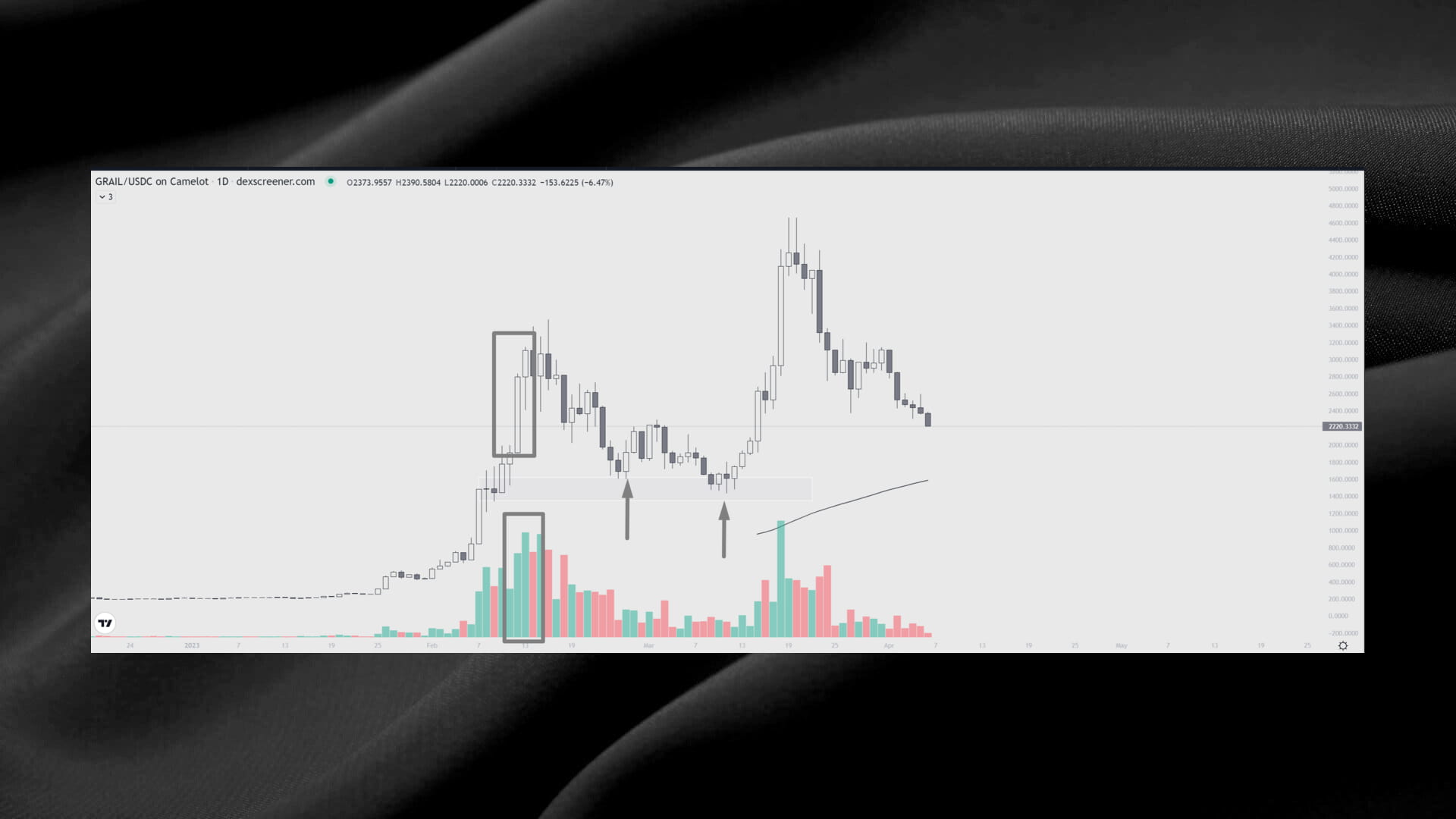
Your advantage with weird crap is that you're competing with regular fomo-eating monkeys who buy high and sell low, and it doesn't take a genius to outsmart these people.
Of course, the downside is that these markets can be turned against you very quickly by large participants; you're always one big sale away from being knocked out.
Therefore, you should not be greedy and strive for a 10-fold increase in profit in each transaction. Keep your risk low and take profits as you go.
Day trading
The price is fractal; this means that if I show you a chart, you won't be able to tell if you're looking at a daily, monthly, or 5-minute time frame.

Additionally, you won't be able to tell which market you're looking at in most liquid markets unless you're very familiar with it.
For those interested, above is a 5-minute chart of XRP.
If you are swing trading, your trade frequency will be quite low.
Even if you make a profit, you are basically sitting back and just waiting for the opportunity, which usually happens 1-2 times a week in every market you trade.
I'll talk more about swing trading later, but day trading gives you instant feedback with lots of small moves throughout the day.
So if you day trade and make multiple trades each session, in theory your account will grow much faster.
That being said, day trading is one (not one) of the hardest parts of trading.
You can lose money as quickly as you made it, within minutes, if you stop paying attention and make the smallest mistakes.
I believe that everyone should engage in day trading when starting out as they get instant feedback from the market and learn much faster.
The big advantage of day trading is that you are trading in large liquid markets, so it is easy to scale and you will not run into problems if you are trading BTC, ETH, ES, NQ, gold or major currencies.
As I said, day trading is very difficult and definitely not for everyone; it requires great focus, quick decision making, the ability to cut deals quickly, and much more.
It is very important to prepare your trading plan and strategy for each step, because when you are in trading and full of emotions, they will definitely come in handy.
You can trade price action, order flow, news, use various indicators and so on - there are many ways, and not necessarily one way is better than another.

Levels on higher timeframes, work on a lower timeframe
If day trading isn't for you, don't worry. This approach can also increase your score quickly, and it takes a much more relaxed approach.
In fact, this is not only suitable for small accounts; a few months ago I completely switched to this style of trading because I decided that I no longer wanted to spend long hours looking at charts.
With that in mind, I can't stress enough how important it has been for me to have the experience of day trading various futures markets over the years and understanding the microstructure of the market and how glad I am that I did it in the past.
Although I already mentioned that price is fractal, markets tend to give stronger reactions from levels that are visible on daily, weekly or monthly time frames, much more than from what you find on a 1-minute chart.
This is simply because more people and their algorithms are seeing these levels on higher timeframes and acting on them.

Without further complicating matters, we can look at Solana, which rallied to daily resistance in late February and then pushed past it to the next daily support.
Entering short at the close of the day with a stop loss based on the 1-day ATR would result in a 2.5 return per risk (R) over 18 days.
Don't get me wrong, making 2.5 times your money in 18 days is great, but if you have a small account and you're risking $100 on one trade, then making $250 in 18 days doesn't sound that great in comparison. to risk $10,000 and win $25,000.
If you want to increase your account, you can increase it on lower time frames, keeping in mind your HTF (High Time Frame) trading idea, then as long as your goal remains the same. You will take trades on the LTF (lower time frame) to tighten your stop loss and increase your position size.
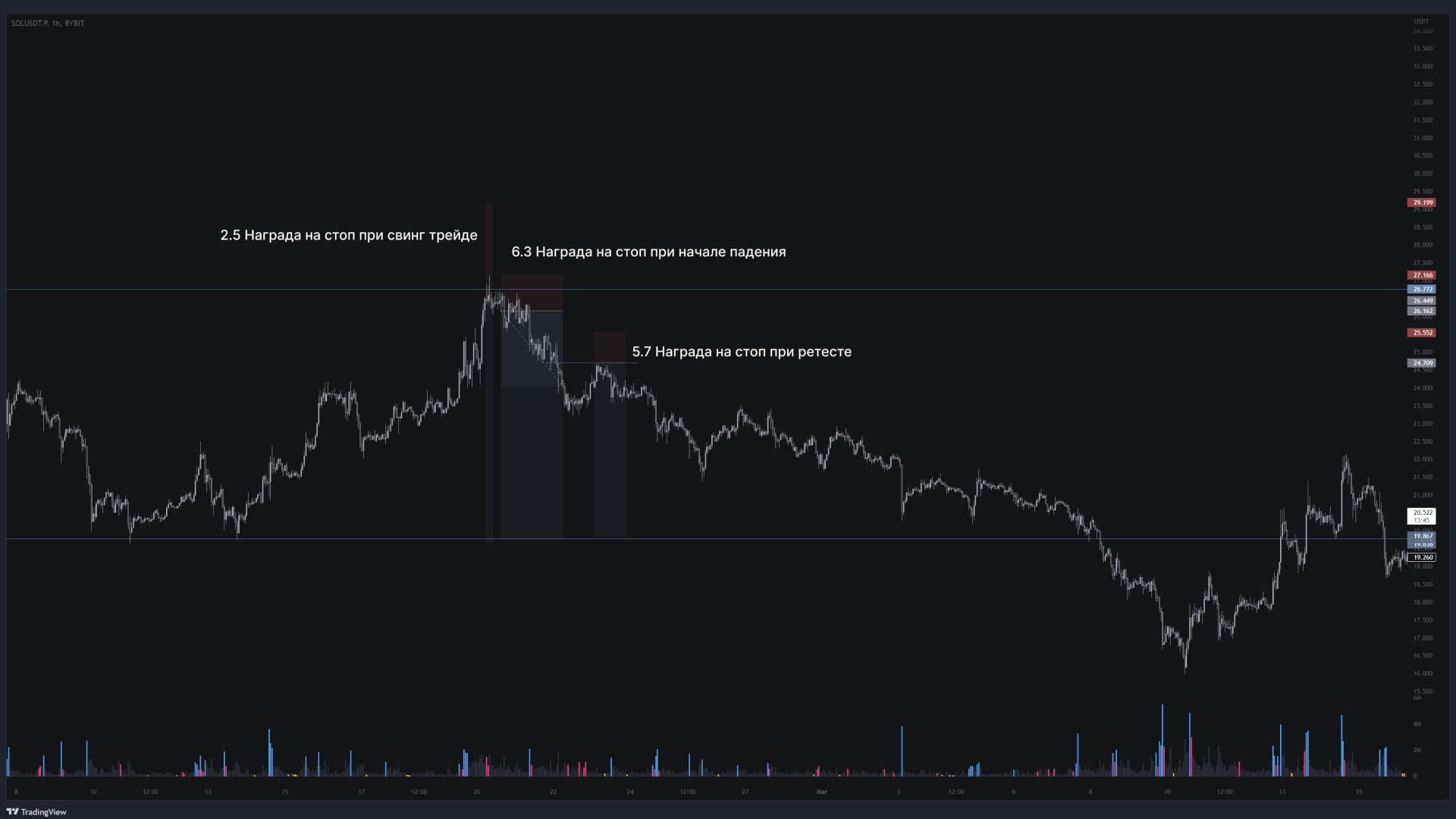
To do this, you do not need to switch to 1-minute or 5-minute charts. It's more than enough to look at H1 or H4. Moving to lower time frames can increase the risk/reward ratio, but will also greatly increase the risk of getting stopped before the move occurs.
If you stick to Ch1/Ch4, there may still be changes: you won't get the LTF entry you want, or you'll get stopped out before the move reverses, but given your ideas on a higher time frame, 1-3 attempts at executing LTF is still the same. in my experience, will bring greater results than simply trading exclusively on the daily time frame.
Conclusion
Trading is hard work and takes time, but it is possible to grow a small amount of money into a large sum while maintaining reasonable risk.
Always try to think outside the box with your trading ideas, remain patient when executing, and have a well-thought-out trading plan.