
1. Summary
1) DWF Labs rose from obscurity to become one of the most active investors in crypto this year.
2) But behind the boom, some in the industry see red flags in its opaque investment structure and habit of moving token investments to exchanges.
3) DWF refuted this and said there was nothing wrong with its approach.
DWF Labs has soared up the list of the most active investors in the crypto industry, causing concern and dissatisfaction.
The figure below shows the number of institutional investments in the encrypted data platform RootData in Q1.
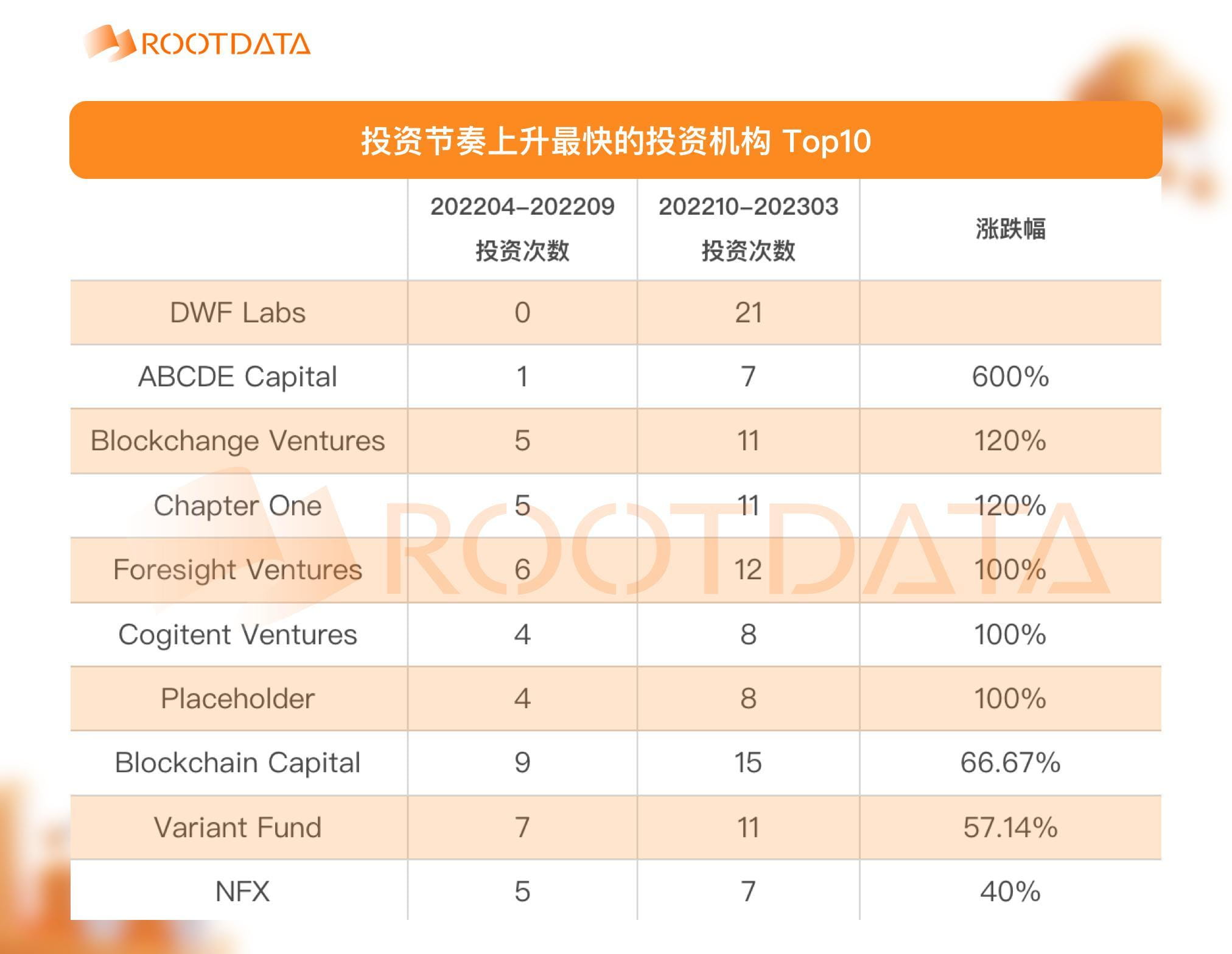
In a tumultuous six months in an industry rife with scandals, bankruptcies and a crackdown by U.S. regulators, DWF Labs went from obscurity to the spotlight. Block Pro’s transaction data shows that the company invested $232 million in 25 rounds of financing, 18 of which had DWF as the sole investor, and the company itself said that it has invested at least $100 million in more than 100 projects.
It's not just DWF's payouts that have fueled speculation about its investment, but many venture capital deals that appear to be opaque and non-standard, and compare DWF to Alameda Research, which collapsed last year. Alameda Research is a hedge fund and market maker founded by former FTX CEO SBF. In its defence, DWF responded to all questions raised against it.
Matt Walsh, founding partner of Castle Island Ventures, said: "I have seen such a script before, and the ending is that retail investors are damaged and the SEC takes enforcement actions." "This industry does not need Alameda 2.0."
DWF Labs was founded in 2018 by Managing Partner Andrei Grachev – CEO of Huobi Russia and several crypto trading companies. DWF Labs describes itself online as a leading "digital asset market maker and Web3 investment company" with operations in Singapore, Switzerland, the United Arab Emirates and the British Virgin Islands. It is an affiliate of Digital Wave Finance, an entity with little online presence. DWF Labs’ website describes it as “one of the largest high-frequency cryptocurrency trading entities in the world, with over 40 top exchanges. Spot and derivatives market transactions conducted.”
2. Problems with DWF Labs
Central to concerns about DWF are the trading protocols for tokens from startups sometimes reported as venture capital investments, and DWF’s habit of moving these tokens to exchanges for sale.
Starting with the deal structure, many industry figures have raised concerns with The Block, arguing that DWF’s multi-million dollar investment in crypto startups is more appropriately called an over-the-counter transaction. These OTC exchanges allow startups to convert their tokens into stablecoins, rather than DWF injecting cash up front and DWF then transferring the tokens to an exchange.
“All these ‘investments’ you see are not actual investments,” said a person with direct knowledge of DWF’s business. "They were over-the-counter transactions. They were token purchases. They were over-the-counter transactions over a period of time."
3. DWF Labs’ “Commitment”
For example, in late February, encryption privacy startup Beldex announced a $25 million deal with DWF. In a blog post, Beldex stated that DWF Labs will "commit $25 million to the research and development of the Beldex network and ecosystem." However, in some reports of the deal, the word "commitment" was omitted, instead describing it as a direct financing exercise. A spokesperson for Beldex said the money had actually been pledged for two years.
The spokesman said this week that DWF remains involved in the project in its capacity as a "marketing and partnership advisor" while also helping to introduce other industry players, including developers and researchers. DWF said the arrangement was "extremely beneficial to Beldex".
Just this week, CryptoGPT announced it had received $10 million in Series A financing from DWF Labs, bringing the token valuation to $250 million. However, CryptoGPT co-founder and CTO Dejan Erja said that the total investment amount so far is only $420,000. Erja said DWF started investing last week and the remaining amount will be available within 285 days. As part of the transaction, DWF Labs will also make the market for CryptoGPT’s GPT tokens.
4. DWF’s “unwise” transactions
Bainy Zhang, founder of Fisher 8 Capital and eGirl Capital, who goes by the pseudonym Hedgedhog on Twitter, said: “The types and amounts of projects DWF Labs is investing in really don’t make sense to me.” Neither seems wise. Presumably, the amount DWF invests in projects accounts for a significant portion of the token supply of these projects. For example, Beldex's $25 million is 5% of its fully diluted valuation, assuming DWF pays market price.
Once made public, such transactions could have a huge impact on the price of the project’s tokens. According to CoinGecko data, in the days after announcing the trading agreement with Beldex, the price of its BDX token increased by approximately 50%, from $0.04 to $0.06. It is now about $0.057.
A project called Tomi, which aims to build a platform that can replace the Internet, said it raised $40 million from DWF Labs on March 22. In the short term, its token price surged from $1.3 to $4.3 before falling to its current level of around $2.58. The price also rose after The Block reported that DWF Labs committed to buying $10 million worth of tokens issued by crypto infrastructure project Orbs.
5. “I don’t see anything wrong with it.”
In an interview, when asked whether the DWF Labs investment was an upfront venture capital check or an over-the-counter token transaction, Grachev made no mistake.
"We allocate capital based on our risk management. Frankly, I don't think there's anything wrong with that." "I don't care what other market makers/investors are doing. Because our main goal is not to imitate what other market participants are doing." approach. Our goal is to make our partners happy.”
Continuing with the discussion of DWF moving its token investments to centralized crypto exchanges, it’s not hard to find people citing on-chain data to highlight this practice and wondering if this means DWF is selling tokens.
When asked about the changes, Grachev dismissed suggestions that the company was being sold for profit. Instead, he said DWF found it safer to leave the tokens on an exchange than use an on-chain wallet.
“We move tokens to exchanges, but we never sell them,” Grachev said in an interview. “If we send tokens to an exchange, it doesn’t mean we will sell those tokens immediately or in the near future. We have been moving tokens to exchanges because for us, storing the tokens Being on an exchange is a more convenient way to manage inventory.”
In another Twitter post this week, he added: “Crypto market makers must be prepared for emergencies and extreme volatility and have an inventory of tokens and stablecoins available with the goal of meeting around-the-clock liquidity.”
6. DWF’s funding situation
DWF's lavish spending has also led some in the industry to wonder where its funds come from. Grachev said DWF Labs has no outside investors and has been funded by transactional activity since the company was founded in December 2018. There are also crypto-based loans.
In addition to running DWF Labs, Grachev’s LinkedIn profile shows that he has held several other positions over the past five years – all involving trading and cryptocurrency.
From 2018 to June last year, he served as CEO of a high-frequency trading company called VRM.Trade. From May 2018 to July of the following year, he served as Vice President of Trading at a Moscow company called Racib. Before that, he also ran another cryptocurrency company called Crypsis Blockchain Holding, which also worked in Moscow, according to LinkedIn.
Starting in September 2018, Grachev also served as CEO of Huobi Russia, a branch of Chinese cryptocurrency exchange, for a period of one year. Huobi Russia shut down in 2020. A Huobi spokesperson said: “Due to strategic adjustments within the Huobi Group, the two parties reached an agreement to terminate this partnership.”
While Grachev has been keen to refute claims of wrongdoing in interviews with The Block and on social media, many in the crypto industry remain concerned.
“At a time when most VCs are tightening their wallets, DWF is investing tens of millions of dollars every week in OTC token transactions,” said angel investor and former chief marketing officer Matthew Howells-Barby. “Something doesn’t feel right. .”