


Main
Cryptocurrency options contracts allow investors not only to diversify their portfolio, but also to more effectively manage market risks.
Investors can use put options to protect their portfolios from market downturns.
Unlike a stop loss order, which is set at a specific price of the underlying asset and can be triggered if it fluctuates sharply, a protective put is limited only by the expiration date, not the price of the cryptocurrency.
Cryptocurrency options contracts allow traders and investors to diversify their portfolio and more effectively manage market risks. In this article, you will learn how to hedge long positions with protective put options.

Cryptocurrency options contracts have become a popular derivative because they offer investors another way to profit from the direction of an underlying asset using leverage. However, their use is not limited to this: they can also serve as a risk management tool. One risk management strategy involves using a protective put option to hedge potential losses on a downside. This is exactly what our article is dedicated to.
Quick Overview: How Call and Put Options Work
An option gives the holder the right (but not the obligation) to buy or sell a contract at a pre-agreed price at a pre-determined time. In turn, the holder of the option contract pays the seller a commission called a premium.
Some traders prefer options contracts to futures contracts because the former usually carry less risk. Because options traders are not required to exercise their contracts, their losses are limited to the premium they pay for the option.
The two most common types of option contracts are call options and put options. Call options give an investor the right to buy, while put options give an investor the right to sell an asset at a specific price at a specific time.
How the Protective Put Options Strategy Works
Crypto investors can use put options to protect against market downturns. This hedging strategy, called a protective put option, is a sort of insurance policy in case the price of a cryptocurrency falls during the life of the option.
Example of using a protective put option
When using protective put options to hedge long positions, it is important to consider key factors such as the strike price, contract duration and premium. The strike price is the price at which a put option can be exercised. It should be set at a level that provides sufficient protection for the portfolio.
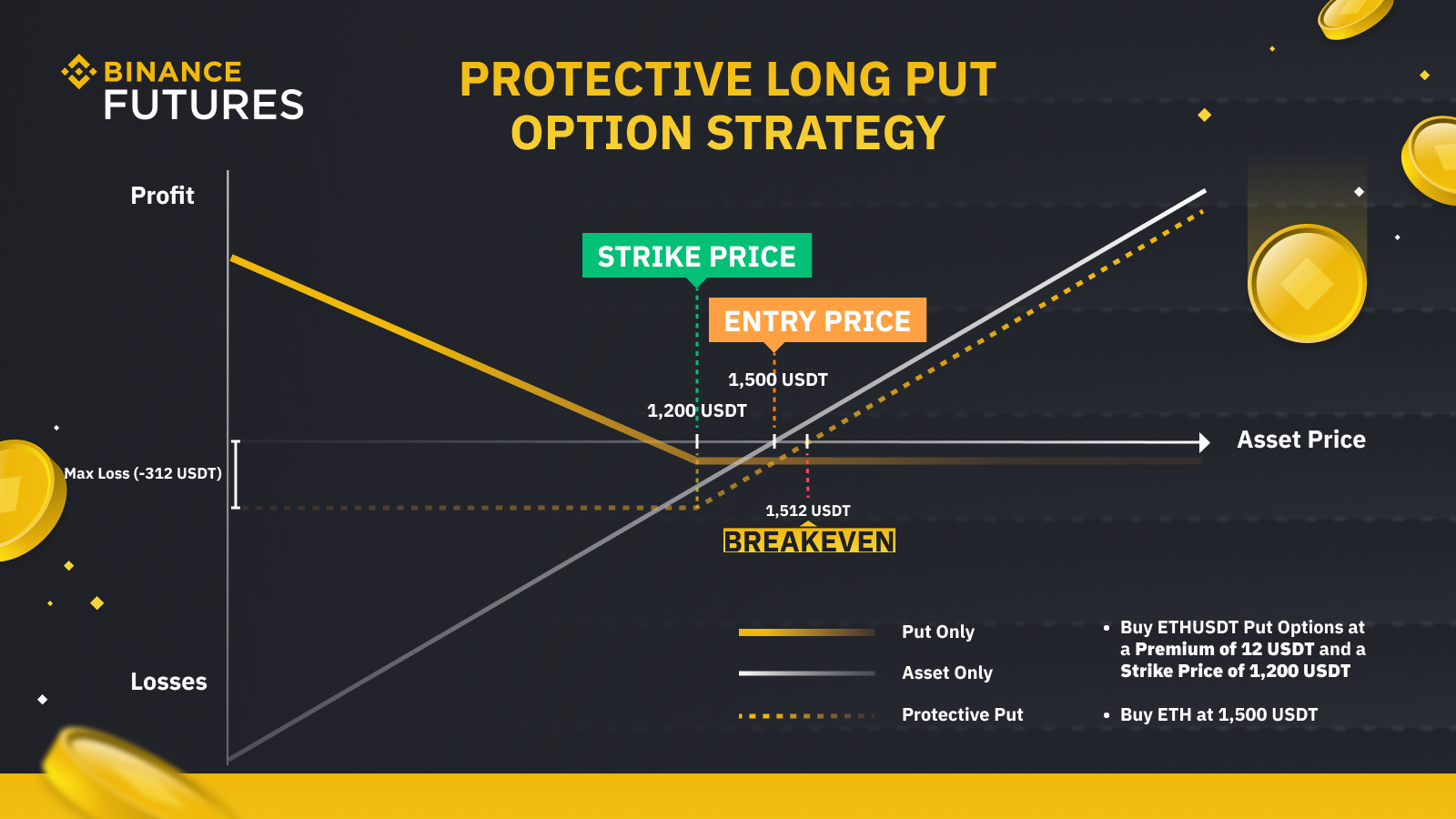
For example, consider a trader who buys 1 ETH at 1,500 USDT. To hedge possible losses, the trader decides to purchase a one-month put option with a strike price of 1,200 USDT and a premium of 12 USDT.
Let's say that after the market falls, the price of ETH drops to 1,000 USDT. Put options give our trader the right to sell their ETH for 1,200 USDT upon expiration. So he doesn't lose 500 USDT, but only 312 USDT (500 - 200 + 12, where 500 is the spot loss, 200 is the profit from the long put option position, and 12 is the put option premium)*.
However, if the ETH price remains at 1,500 USDT at option expiration, the put option will not be exercised and the trader will only lose the equivalent of the premium value, i.e. 12 USDT. In this scenario, the cost of the premium can be thought of as the cost of insurance for one month.
On the other hand, if the ETH price exceeds the break-even point of 1,512 USDT (ETH price + option premium cost), the trader will not exercise the option and will profit from the long ETH position. For example, if the price of ETH rises to 2,000 USDT at the expiration of the put option, the trader's unrealized profit would be 488 USDT (500 USDT is a premium of 12 UDST)*.
*To simplify calculations, this example does not include trading or execution fees.
Benefits of Using Protective Put Options
Fall protection. Put options give the holder the right (but not the obligation) to sell the underlying asset at a predetermined strike price. This means that if the market value of the asset falls below the strike price, the holder can still sell the asset at a higher strike price, thereby reducing losses.
Potentially unlimited profits. Hedging a portfolio with a protective put option helps limit potential losses in a downward market trend, but does not prevent the trader from profiting from the growth of a long position.
In other words, there is no upper limit to profit, since the price of the underlying asset can rise without limit. The cost of the put option (premium) and the amount of the commission are only subtracted from the profit amount.
Risks of Using Protective Put Options
Prize amount. The purchase price of put options (the premium) may exceed the potential profit.
Over-hedging. Overhedging is a situation where an investor purchases more options than necessary to hedge the portfolio. As a result, he overpays for premiums, but does not receive any additional benefits in terms of loss protection. You should carefully consider how many options you need to hedge your portfolio and stay within that limit.

Conclusion
While most traders prefer to limit losses through stop loss orders, a protective put option can also be used as insurance against sharp market declines. Unlike a stop loss order, which is set at a specific price of the underlying asset and can be triggered if it fluctuates sharply, a protective put order is limited only by the expiration date, but not by the price of the cryptocurrency.
Additional Information
(Blog) Trading Options on Binance: Understanding Prices
(Blog) Cryptocurrency futures and options: how are they different?