


Main conclusions
Imposter scammers on Binance pretend to be Binance employees or representatives and offer fake services to people to steal their money.
Attackers contact potential victims from unofficial email accounts or social media pages that appear to be official Binance profiles.
If you are the victim of a scam on Binance, please report the incident to your local authorities and Binance Support immediately.
Protect your Binance account from impostors. In this week's How to Spot a Scam, you'll learn how scammers ingratiate themselves and how to spot and report a fake Binance profile.
Today, anyone with internet access can create a fake social media profile using the Binance name and logo.
You may have already seen fake Binance profiles on Twitter or Instagram, or maybe their owners wrote to you directly in instant messengers such as Telegram.
Unfortunately, we have no control over content moderation on these platforms. A scammer posing as a Binance representative can create a new account within seconds of reporting it to moderators.
One thing you should know about our staff is that we will never—under any circumstances—attempt to contact a user through unofficial channels to give them an investment recommendation, invite them to enter a free sweepstakes, or use a backdoor method to unlock their Binance account.
To help you protect your Binance account, we have prepared a description of the four stages of fraud and several profiles of scammers posing as Binance representatives.
How scammers deceive victims by posing as Binance representatives: four steps
1. Creating a false identity
First step: preparing the perfect legend. The impostor scammers we covered in last week's article usually pose as government officials, such as police officers.
However, in this case, the scammer carefully thinks through the scenario and introduces himself as a Binance employee. He creates a fake account with the Binance logo or a photo of a person wearing a Binance T-shirt in his profile photo.
The fake username usually contains references to support, employees or Binance promotions, and the email address is almost identical to the official one.
2. Selecting victims from groups on social networks
Fraudsters are looking for sensitive personal information on the black market, including phone numbers, email addresses, login credentials, even purchase and travel information. They then carefully sift through this information to find potential victims who could be manipulated.
Some scammers choose to create “official Binance groups” to attract victims, supposedly led by real Binance employees offering investment advice and lucrative earning opportunities.
3. Gain trust and attract
Now the scammer begins to gain the trust of a new potential victim with the help of a carefully prepared script especially for her. Its goal is to establish close contact with a person, create a false sense of intimacy and ultimately deceive.
Experienced scammers demonstrate an impressive ability to adapt to the situation. They are persistent and always ready to improvise, even if the potential victim is initially uncooperative or resistant to deception.
4. Theft of funds
The victim fell for the scammer-impostor. The user, at the request of the scammer, transfers funds to him or - even worse - provides his Binance account credentials. Having access to the victim's Binance account, the scammer can withdraw all the cryptocurrency from there to his wallet before the user regains access to it.
To show how this process works in practice, below we provide some real life examples.
Examples from life
Example 1: Insider Trading Information - Binance WhatsApp Group
A certain user (let's call him Mark) is new to the world of cryptocurrencies. He is contacted by a “Binance analyst” named Morris.
Through private messages on Instagram, Morris writes to Mark about a WhatsApp group that provides cryptocurrency investment tips and insider trading information with guaranteed returns of up to 20%. Morris invites Mark to a group in which several “Binance employees” regularly post instructions on how to make money, and other members talk about their big profits.
Mark also notes that the “Binance staff” answer all questions professionally. Believing in the authenticity of the group, Mark follows the instructions according to which he must withdraw the tokens to the scammer’s wallet.
Of course, it's all a scam, and Mark ends up being the victim of impostor scammers.
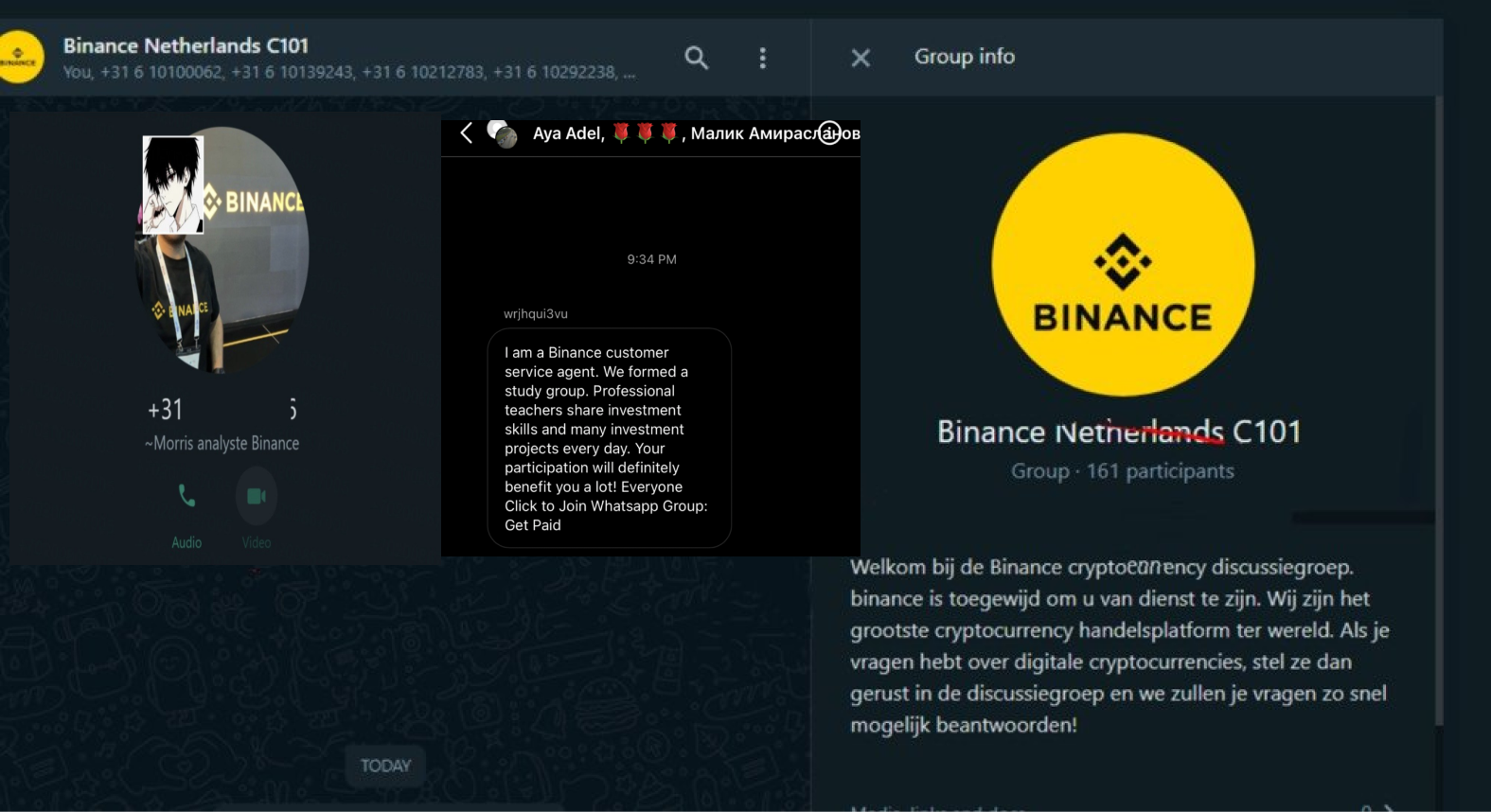
“Welcome to the Binance group where cryptocurrencies are discussed. Binance is committed to bringing you value. We are the world's largest cryptocurrency trading platform. If you have questions about cryptocurrencies, ask them in the group and we will try to answer them as quickly as possible. — Translation of the description of a group of scammers on WhatsApp from English.
Example 2: “Binance Trading Expert”
There are many fake profiles on social platforms like Instagram that claim to be associated with or work for Binance. For example, in this example, the scammer specifically added the line @binance to his profile description. Note that the description also contains a lot of "buzzwords" such as "trading expert" and "investment specialist."
Unfortunately, attackers often use our influence and reputation in the cryptocurrency world—a sector trusted by millions of users around the planet—to prey on unsuspecting victims. Binance employees are strictly prohibited from trading or offering investment advice. Don't trust "Binance employees" posing as trading or investment gurus. For our partners and influencers, we carefully review all of their content for accuracy, but their views and opinions may not reflect our views.
An easy way to spot a fake Instagram profile is to compare the number of followers with the number of likes and comments on posts on it. If you see a significant discrepancy, such as 25,000 followers but only 100 likes and two comments per post, then the profile is most likely fake.

Other examples
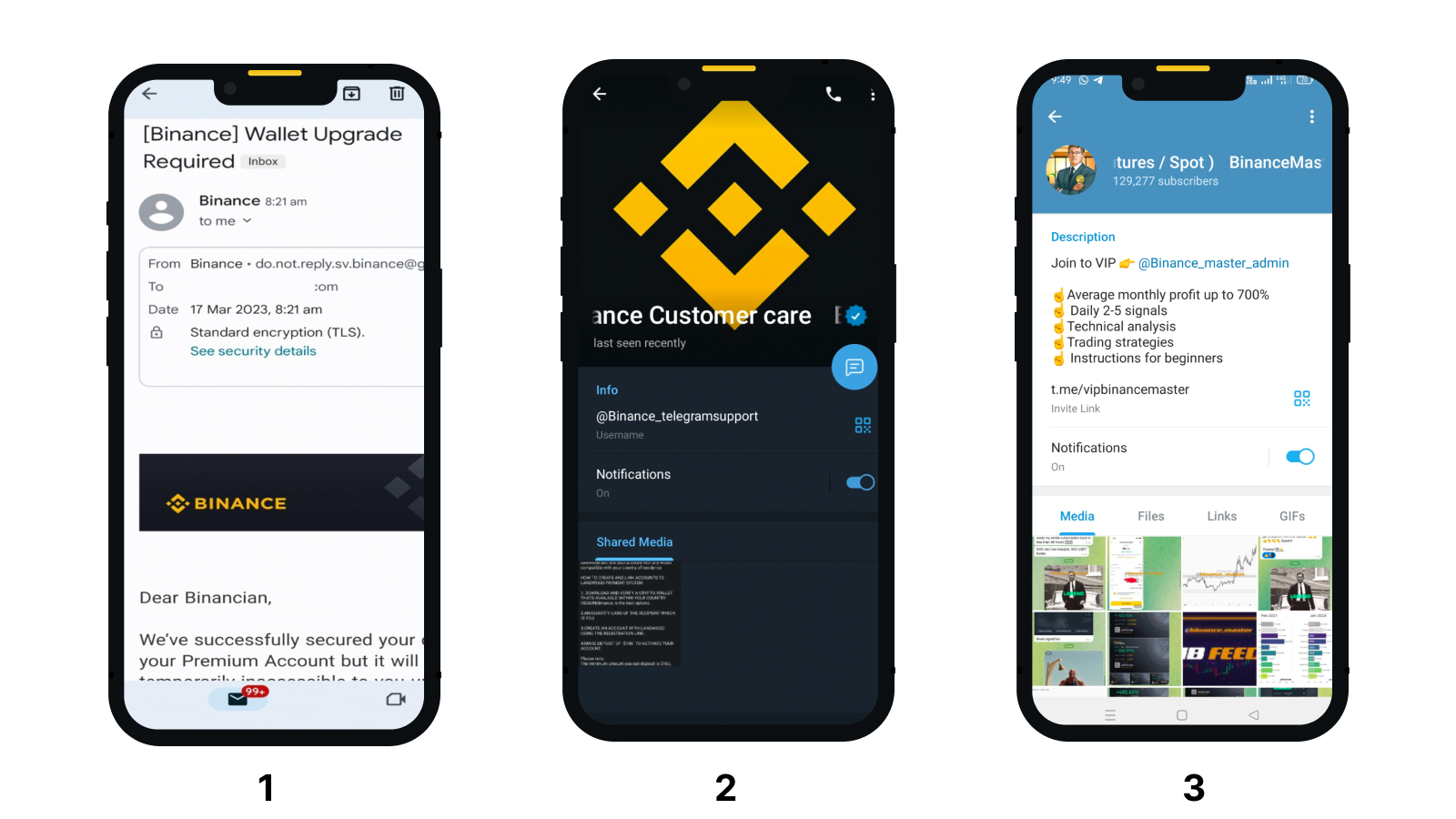
Wallet update. The user receives a fake email from Binance from the address do.not.reply.sv.binance@gmail.com, which asks him to “update the application.” You may notice that the domain of the email address is gmail.com and not the official binance.com.
Binance Customer Support. This scammer is trying to trick the user by posing as a Binance customer support employee under the alias “Binance Customer Care”.
Binance VIP Team: This scammer is offering fake crypto investment advice by posing as a Binance employee who is part of the Binance VIP Team, our benefits program for institutional and professional traders with high trading volumes.
Tips to Protect yourself from Imposter Scammers on Binance
Beware of people claiming to be Binance employees
Do not trust anyone who poses as a “Binance employee” and contacts you by phone or through social channels such as Telegram, WhatsApp, Instagram, etc. Our employees never try to contact a user themselves through unofficial channels to give them an investment recommendation, offer participation in a drawing or account unlocking services.
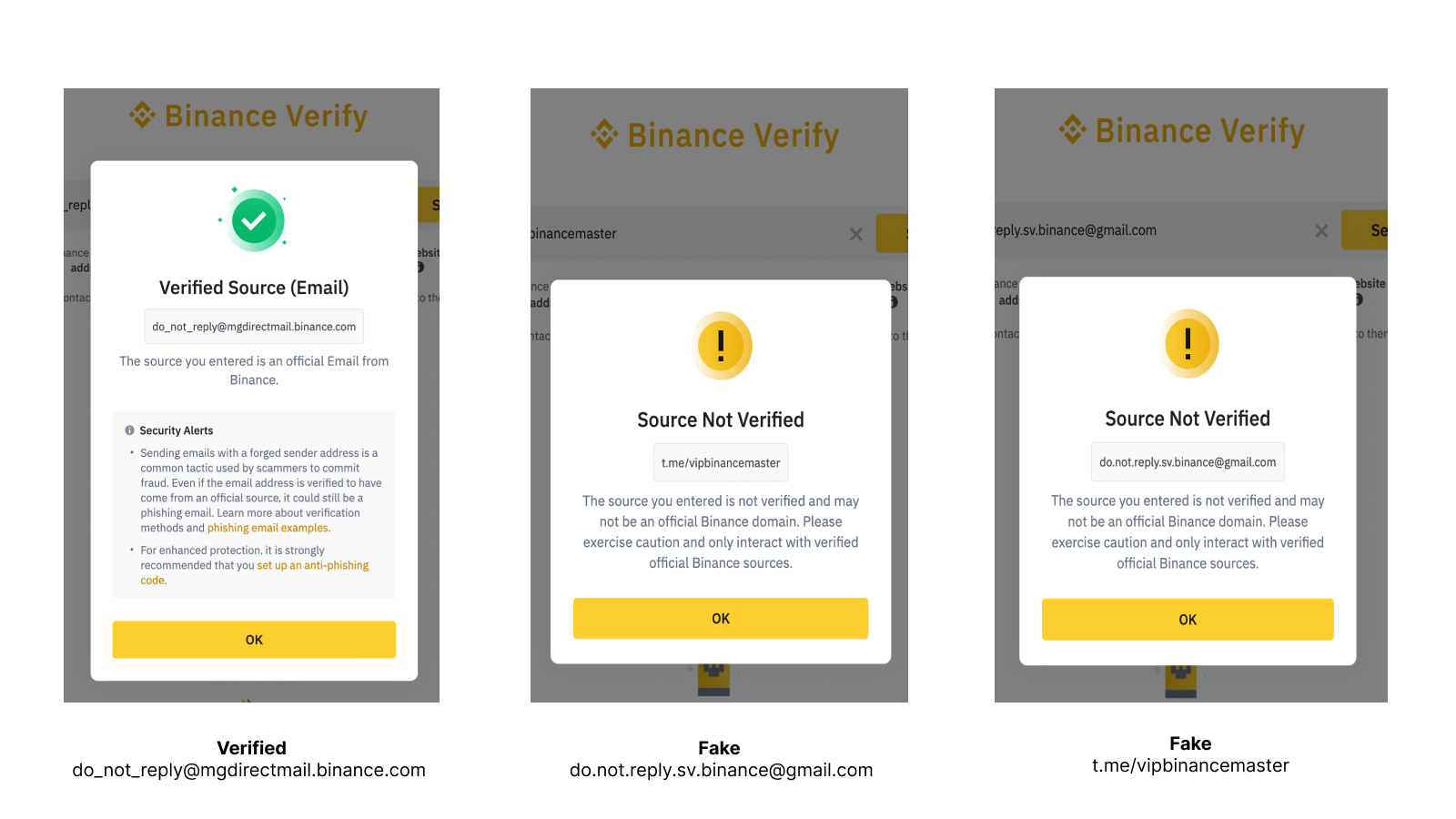
Pay attention to the username and email address, especially the domain name at the end. To verify the authenticity of email addresses and web links, use the Binance Verify website. You should be careful even with verified links. If the source of the link is not confirmed, you definitely shouldn’t click on it.
Protect your personal information
To protect yourself from possible fraud, it is essential that you keep your personal information, including your travel and purchase history, and contact details, secure.
As mentioned in this article, scammers looking for new victims often use the dark web to purchase personal information stolen from careless owners.
If you have become a victim of scammers
If you fall for a scam, beware of further attempts at deception by the same scammers and do not carry out any withdrawal or transfer operations initiated by strangers.
If you have become a victim of criminals posing as Binance representatives, it is recommended that you contact your local authorities for assistance. If your Binance account has been hacked, please report it immediately using the instructions in How to Report Fraud to Binance Support.
We also encourage all users—both new and old—to review our series on combatting crypto scammers to better prepare for common threats.
Additional Information
(Blog) How to Recognize a Scam: A Complete Guide to Identifying the Most Common Cryptocurrency Scams
(Blog) How to Recognize a Scam: Crypto Investment Scams to Watch Out For
(Blog) How to recognize a scam: the main signs of an impostor scam
Risk Warning and Disclaimer: The following materials are provided “as is” without warranty of any kind for general reference and educational purposes only. This information should not be considered financial advice or a recommendation to purchase any specific product or service. The value of digital assets may be volatile, increasing the risk of loss of investment. You are solely responsible for your investment decisions. Binance is not responsible for your possible losses. This information does not constitute financial advice. Please see our Terms of Use and Risk Disclosure for details.