


Ethereum ushered in a new era on Thursday (April 13). The Shanghai upgrade Shapella was officially launched at 6:30 am Beijing time when the main network reached Epoch 194048 block, announcing that validators have been able to withdraw ether from the beacon chain and bring new functions to the execution and consensus layers. As of Thursday's Asian market, 320,000 ethers were waiting to be unstaked and lined up for withdrawal. As the sell-off hit, ether decoupled from Bitcoin and fell to $1,904.
According to Token Unlock's real-time data, after the upgrade is completed, the expected withdrawal amount in the next 8 hours is 124,000 Ethereum. Currently, there are still 320,000 Ethereum waiting for withdrawal, with a value of approximately US$559 million.
Currently, the total staked amount on Ethereum has dropped to 17.84 million, and the annualized rate of return on stake is 5.05%.
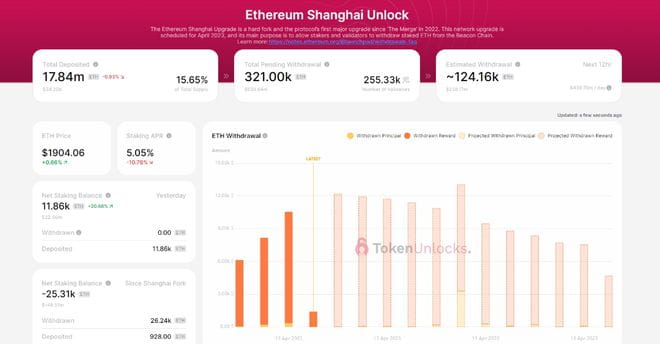
When the Ethereum price was officially upgraded, it once fell to nearly $1,900, but then rebounded quickly, reaching a high of $1,930.37 at around 07:30. At 09:30, Ethereum fell back to $1,904 again, decoupling from Bitcoin.

To complete the Shanghai upgrade feat, about 4,000 people attended the Shapella mainnet viewing party hosted by Ethereum Cat Herders. In the live broadcast, Vitalik Buterin, co-founder of the Ethereum blockchain, said: "We are at a stage where the most difficult and fastest part of the Ethereum protocol transition is basically over. There are still very important things to do, but those very important things can be done safely at a slower pace."
He said that how the expansion after the Shanghai upgrade can make transactions faster and cheaper will be the next problem to be solved by the blockchain. "If we don't solve the expansion problem before the next bull run, we know that people will have to pay $500 in transaction fees. On the other hand, if we don't have Verkle Trees before the next bull run, then things may be bad."
In recent months, analysts in the digital asset market have widely speculated whether the Shanghai upgrade would be a catalyst for a price rally or a crash: Would its success boost market sentiment, or would stakeholders collectively redeem their ether and rush to sell their holdings?
When Ethereum went through a "merge," an upgrade that quickly switched its old consensus mechanism from proof-of-work (PoW) to proof-of-stake (PoS), the project introduced a new type of "validator" to keep the blockchain running. The so-called proof-of-stake mechanism is similar to the proof of equity of traditional assets, which relies on shareholders to make deposits or purchase stocks to provide interest or dividends.
But this also means that crypto mining is no longer as profitable on Ethereum. Although the PoS consensus mechanism reduces Ethereum's energy consumption by 99%, developers also believe that the network will be more secure and more decentralized under PoS.
Ben Edgington, product lead for Teku, an Ethereum client at ConsenSys, explained: “Our goal has always been to have Ethereum be an army of tens of thousands of independent node operators, with the client being the software that runs the blockchain. I believe we have designed a protocol to do this, and I think it’s a big step forward from PoW.”
Vitalik Buterin wrote in a November 2020 blog post that PoS will lead to "greater concentration of wealth in the long run." This is because in the PoS mechanism, you only need ether to stake, and you can earn more ether by staking. In PoW, you can still earn ether, but you need external resources to do so. So in the long run, Buterin believes that PoS token distribution has the risk of becoming increasingly centralized.
This is also the key point of criticism, because once more funds are controlled by centralized institutions, the so-called decentralization will become a utopia.
In order to participate in the block validation process and secure the Ethereum network, validators must "stake" at least 32 ETH by sending them to a smart contract where the funds are locked. The more ether a validator stakes, the more likely they will be responsible for proposing a "block" of data transactions to be confirmed on the blockchain. When a validator proposes a block and it is approved by other validators, the validator will receive additional rewards.
The reality is that not everyone has that much ether to stake, especially the required 32. Therefore, liquidity staking providers emerge as an alternative, where users who want to participate in the staking process can contribute any amount of ether they want, and the third-party provider will stake that ether and collectively run validators on behalf of the clients.
Lido is the largest provider of liquidity staking, controlling about 23% of all staked ether. Coinbase, Kraken, and Binance are some of the largest cryptocurrency exchanges in the world, controlling another 22% of staked ether.
There are a number of ways that validators can unstake, though the two main types of unstakes are partial and full withdrawals. A partial withdrawal is when a staker takes out the rewards they earned from staking, but is left with the original ether staked. Independent stakers running their own validators must migrate their credentials to the 0x01 withdrawal credential. Without it, partial withdrawals will not happen automatically.
When the upgrade is triggered, partial withdrawals become available, allowing users to immediately receive their long-awaited rewards. However, Ethereum can only process 16 partial withdrawal requests in a time slot, which occurs every 12 seconds. Depending on the number of requests that will occur, the withdrawal queue may take hours.
"In the first few epochs, there will most likely not be any partial withdrawals because the first few hundred validators are all 0x00," said Barnabas Busa, a DevOps engineer at the Ethereum Foundation. This is because those are the genesis validators who joined the network when the beacon chain went live, and therefore have old withdrawal credentials set up. Long-term Ethereum advocates may be more interested in continuing to protect the network than cashing out.
In terms of full withdrawals, stakers also redeem their original principal. This went live at the same time as the upgrade, allowing validators to completely unstake their 32 ether and any rewards they have accumulated. By exiting the chain, validators stop participating in the block validation process and stop contributing to network security.
Full withdrawals do not happen automatically, so validators who want to exit must send a message to the blockchain to be added to a queue, and the staking service issues withdrawals of staked ether on its own schedule. Coinbase said earlier that they will begin processing withdrawal requests from its stakeholders about 24 hours after the Shanghai meeting. Lido said that stakeholders will not be able to retrieve their withdrawals until the protocol undergoes another upgrade in May.
Here is CMTrade’s daily cryptocurrency technical analysis:
Bitcoin
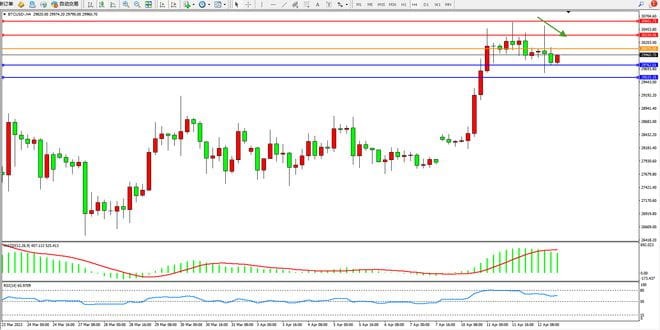
Looking at the 4-hour chart, the high-level bearish momentum is slowly sorting out and the market is shrouded in bearish sentiment. It will continue to slowly decline in the short term.
Resistance: 30334 30601
Support: 29762 29525
Trading strategy: Bearish below 30075, target 29762 29525
Ethereum
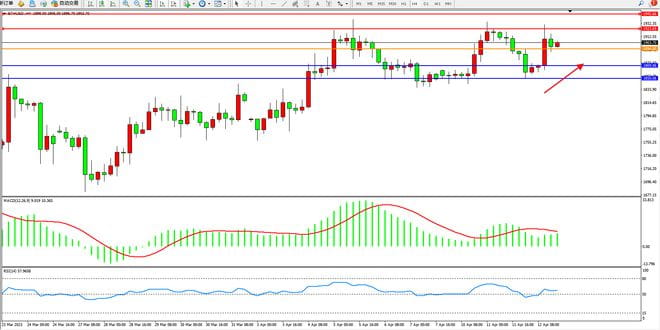
Looking at the 4-hour chart, bullish momentum is fluctuating at a high level, the market is bullish, and there are signs of continued rise in the short term. The MACD indicator is in the bullish area and maintains consolidation, while the RSI indicator is weak and hovers on the side of the 50 balance line.
Resistance: 1923 1945
Support level: 1869 1850
Trading strategy: Bullish above 1894, target 1923 1945
Thank you for reading, see you next time!