Author | Shang Xuan, Wu Shuo Podcast Host, former BitMEX analyst
This article reflects the author's personal views and does not represent Wu Shuo's opinions and positions.
This article attempts to think about the uniqueness of BLAST’s operating strategy and $BLUR’s analysis and airdrop predictions from the perspective of a secondary participant, and whether it is worthy of active participation.
Let’s put the conclusion first. Blast is a first-tier ecosystem and is worthy of attention and participation:
Strong gene for troublemaking: From BLUR’s points system to BLAST’s cross-chain lock-up and developer airdrops, the fact that its strategies have been widely copied by peers is the greatest proof of its success.
The cake is big: there is a strong KOL network and a capital accumulation of US$1 billion+
Proven: The BLAST team has a track record of success. Strong execution ability, excellent understanding of market demand, and top-level VC support.
At the same time, BLUR is a cost-effective golden shovel that can kill two birds with one stone:
BLUR is the absolute leader in NFT platforms on Ethereum
OpenSea’s primary market valuation in the 2022 bull market was $13.3 billion, and now BLUR’s FDV is only $2 billion
The implicit BLAST airdrop value of BLUR accounts for more than 30% (staking time is sensitive)
BLUR has no selling pressure from miners in the short term
The spoiler who muddies the waters
In the last cycle, because the status of VC was still very high and the number of public chains was still very small, everyone tacitly understood the logic of cutting leeks. In the game between retail investors, project parties and the ecosystem, retail investors are severely cut off. User incentives often only exist in defi mining supported by the ecosystem. It is common to see people stumbling just because of the arrival of blue-chip projects and the release of "ecological funds". What now? Rabby currently supports 140 EVM chains alone, not including cosmos, BTCL2, and the new narrative restakened roll ups that make it easier to issue coins. I sincerely wish investors and infrastructure project parties good luck.
For Reference, there are 196 countries in the world
Therefore, this cycle has caused a surplus on the supply side, which means that the cost of "customer acquisition" has increased significantly, and the summer of retail investors has arrived. At this current market node, Leek users who have survived FTX and LUNA know very well what they are here to do in the crypto world—they are not here to overthrow Wall Street, nor are they here to promote decentralization. I am. He's here to make money. Obviously, in a highly homogeneous infrastructure, compared with scalability and low gas fees, who can better design incentives and operating ecology to generate wealth creation effects and sustainably make the cake bigger is more important. important.
Among the new public chains, Berachain may be the best at sustainability and game theory, but BLAST really has a lot to like in terms of gameplay:
1. BLAST’s investment lineup spans the halls and kitchens, including Paradigm, which can provide support and endorsement in technological innovation and security, and a strong KOL lineup such as egirl Capital and loomdart.
2. Use cross-chain lock-up to "deceive" a large amount of TVL that cannot be mined, sold or withdrawn. This means that users who mine BLAST will be “forced” to continue looking for new projects to interact with after the BLAST mainnet is launched.
3. The team has always made innovative attempts in distributing chips and has had a significant impact on the industry. BLUR created a points system that is now used by project parties. Blast used cross-chain lock-up airdrops to ignite the market's gameplay and enthusiasm. In addition to the commonplace cross-chain staking that has TVL and the power of continuous interaction and developer airdrops on the first day, Blast’s chip distribution this time is also unique in that the tokens will be distributed 3 months after the mainnet goes online. Rather than the traditional old-fashioned strategy of issuing coins first and then listing them online, this is probably a good move.
4. Focus on building an application ecosystem. I really appreciate the focus and structure of Blast. Through well-known developer airdrops and hackathons, I discover and incubate new projects that have not yet issued coins in the early stages. Coupled with the liquidity of US$1 billion+, the strong network of KOLs and the support of VC institutions, the projects launched by Blast are likely to have one or two explosive points similar to Friend Tech.
BLAST’s expected valuation and airdrop calculations
According to existing public information, we know that there are four ways to obtain Blast airdrops, namely developing projects on Blast to obtain rewards, brushing points on BLUR, staking BLUR, and locking positions on the Blast cross-chain bridge.
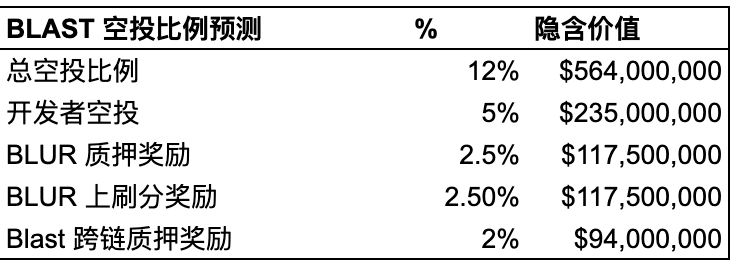
Referring to BLUR's TGE, Blast's initial circulation and airdrop probability will also be 12%; among them, the brushing reward on BLUR will be consistent with BLUR's staking reward, and developers will receive half of the airdrop reward, and finally cross-chain Pledge. The following is the airdrop ratio and distribution that I think is highly likely:
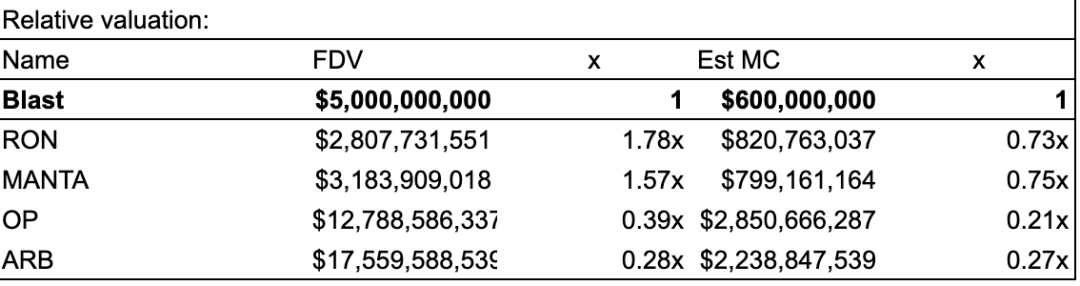
I think BLAST is conservatively valued at $5 billion. If we refer to the current TGE ratio between mainstream and BLUR, BLAST’s initial circulation will be around 15%, with an implied MC of US$600 million, placing Blast’s market value ranking at 50–100 in the entire market. Irresponsible blind guessing, the valuation of Blast is most similar to RON, which is also an application-to-public chain ecosystem and has some similar backgrounds. The upper limit should probably be half of Arb. After all, Blast does not have the technology and L3 premium.
Currently, Blast is valued at US$3 billion on the pre-market trading platform Aevo, and the price fluctuates mainly between US$3 billion and US$10 billion.
Blast’s current price support is based on the following:
● Blast’s TVL has ranked 6th in the entire network and 2nd in L2.
● Blast has acquired 120,000 users and may become the L2 with the most daily active users.
● The probability of operational innovation and application explosion on Blast is high.
TVL
Blast's TVL currently stands at $1.3 billion, second only to Solana and 50% more than both Polygon and Avalanche. This ranks 6th among the current smart contract platforms. Although it may not be meaningful to define market value by TVL, this level of TVL will support the market value to a certain extent.
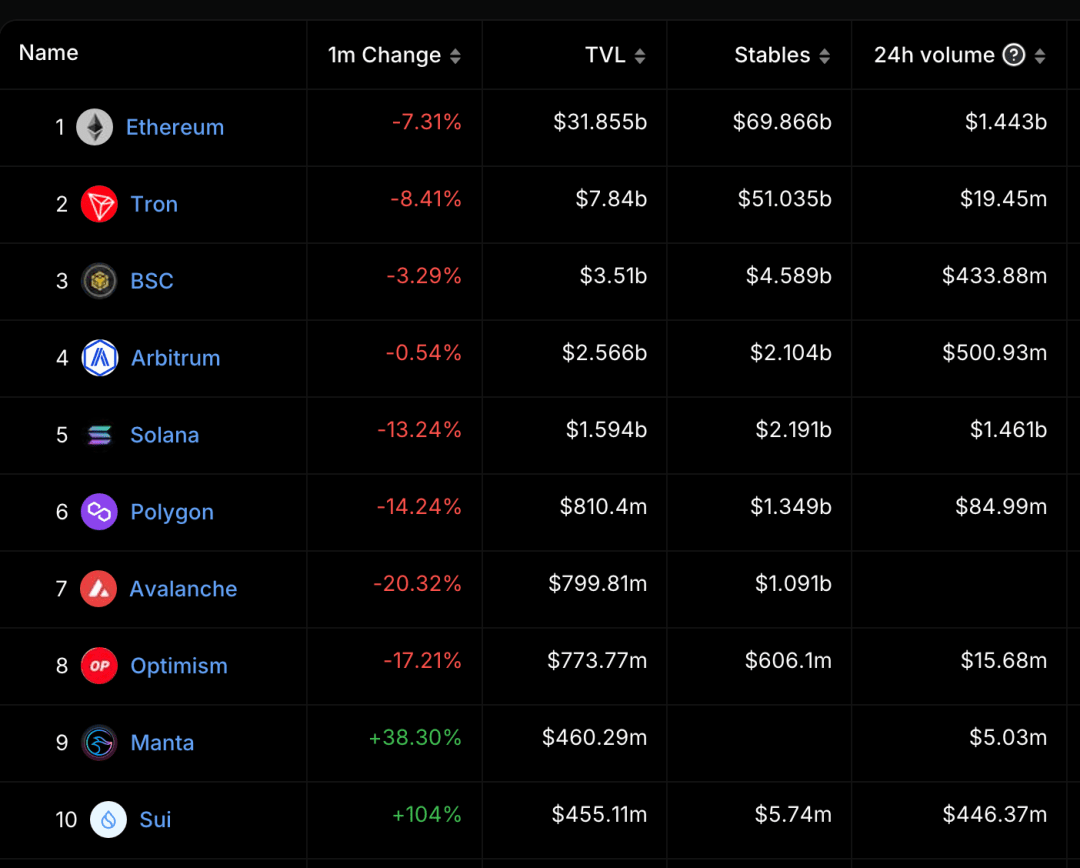
Currently, the amount of Blast locked up is the sixth in terms of the number of Blast users.
The number of Blast users is also at the top of the market. It is conservatively estimated that the number of daily active users after Blast is launched will be more than 120,000. Because there are 120,000 cross-chain locked wallets alone, blast will continue to be locked for two months after it goes online, so it will actively interact to gain additional income. Each wallet needs to be certified by Twitter, and multiple wallets can earn points. There are no special rewards. We can estimate the number of wallets as a relatively safe number of daily active users after Blast is launched.
If the above assumptions are true. Taking into account the current market environment, Blast will have more daily active users than Optimisim, more than Aavalanche, more than Base, and slightly less than Arbitrum. This is further evidence that Blast's valuation isn't too low.
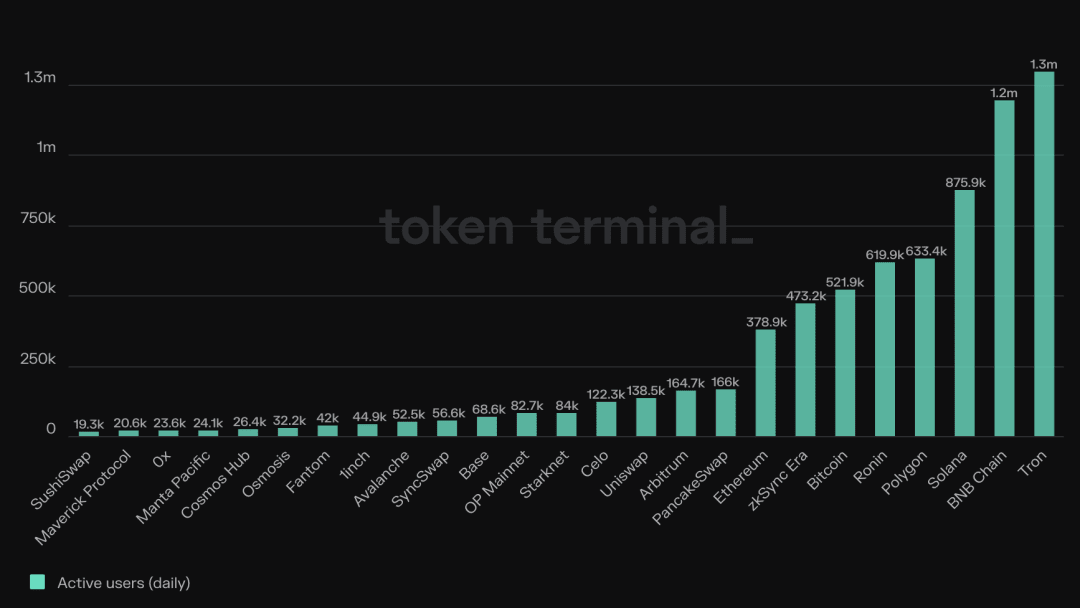
Blast’s daily active users are conservatively expected to be between Celo and Uniswap
Can projects on BLAST generate user stickiness?
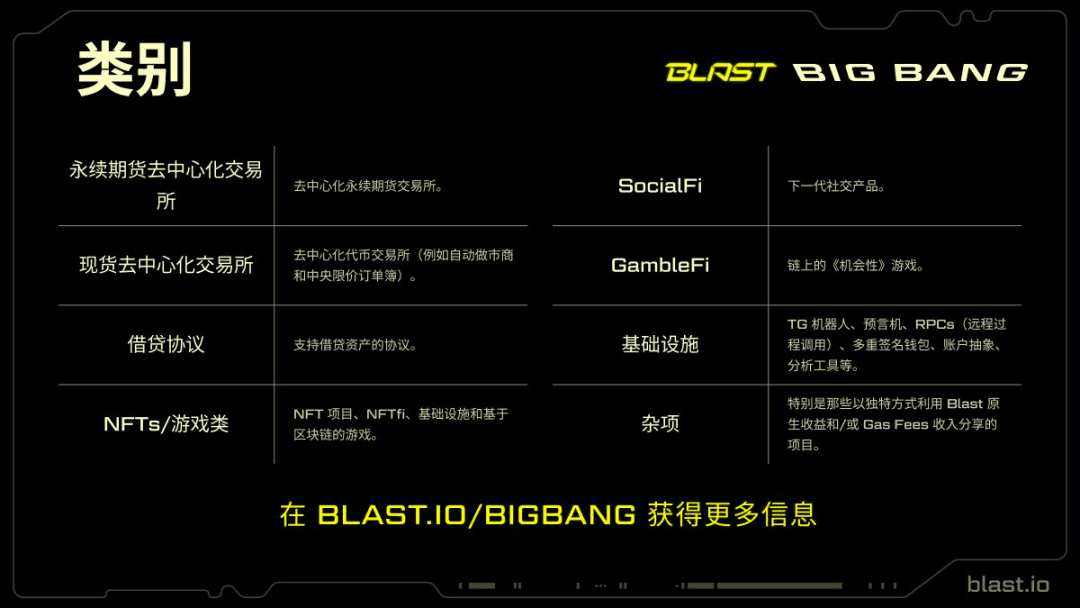
Also being warmed up with Blast cross-chain points is the launch of the test network on Blast and related ecological projects and the anticipation of airdrop incentives. Let’s take a look at some of the more interesting and popular new projects and tipping points we’ve seen so far:
● NFT projects come to Blast to issue coins
Since a large portion of Blast’s beneficiaries are old players in the NFT community, the support and relevance of NFT on Blast should be very high. I look forward to the linkage between NFT projects/communities and Blast.
ByWassies is an OG NFT project on Ethereum, with a floor price of 0.9eth. It is relatively well-known among degens in the Ethereum community. It focuses on crypto native culture. It has been confirmed that it will issue coins on blast and will issue tokens to blast/friendtech users. airdrop.
● Best places in Gamblefi
Blast’s emphasis on gamification, its huge KOL matrix, and its native yield design all make Blast the best growing soil for gambling projects.
Among them, Fantasy.top is a project that has received widespread discussion and praise in the testnet stage. It cleverly combines Sorare and Friend.tech. Players can increase the influence of KOLs by buying KOL cards. Thereby making profits, the gameplay is similar to fantasy sport. This project has touched the pain points of many players and added another innovation to the way of speculation.
In addition, Blur's native revenue can support lossless gambling/new creation. In the last cycle, Luna also tried to build a launchpad through UST's 20% revenue, and the effect was not bad.
● High volatility violent (profit) opportunities
Due to Blast’s participation and KOL lineup, and the TVL is large enough, there will definitely be many hot new opportunities on Blast, such as Thurster, which focuses on fair launch, has announced several cooperative coin issuance project parties, and has a strong lineup of backers , including Loomdart, CBB, DCFgod, Not3Lau, etc.
Risk points of Blast: (cannot be ignored)
● Blast’s cross-chain bridge risk is the multi-signature wallet.
● The risk of rugs on Blast may be higher, because projects that receive airdrops may be more short-sighted and run away after cheating the airdrop.
● If Blast’s pie cannot be enlarged through innovative applications, the currency price will inevitably go south like BLUR due to too much selling pressure and no new players will enter the market.
The implied airdrop value in BLUR
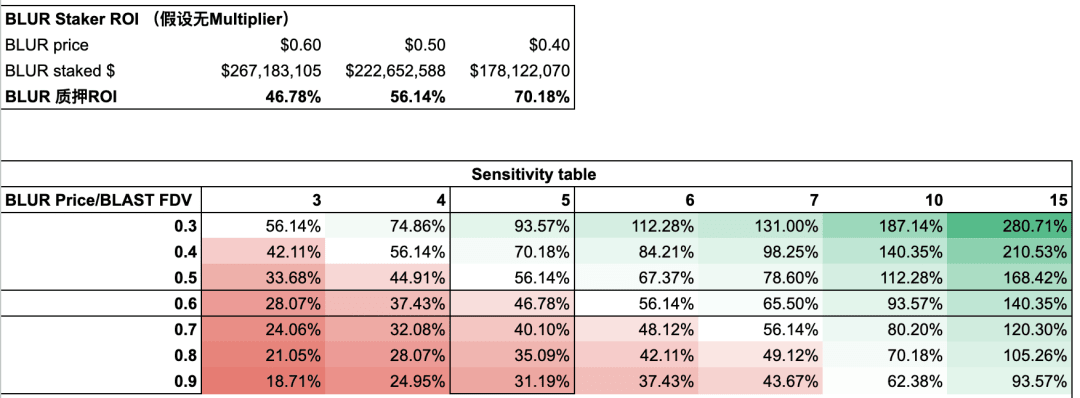
It is difficult to accurately calculate BLUR’s staking rewards because airdrop staking. Blur’s airdrop rewards largely depend on the time of staking. The longer the time, the higher the multiplier of points. The staking length of other stakers needs to be considered. Therefore, the following is a simple estimate without taking into account multiples, and is only used to determine the price support of BLUR in anticipation of the airdrop given to BLAST.
0.3 will be a strong support for BLUR’s currency price, because the hidden value in Blast can basically cover the cost of Blur. At the same time, we see that the current currency price of 0.6 is relatively reasonable. If the activity of NFT continues to decline, 0.6–0.7 will also be a great hedging resistance for BLUR.