
As the 2024 Bitcoin halving approaches, investors are wondering what the potential impact will be on the price of BTC.
By examining the fee-return ratio and historical accumulation and distribution cycles, valuable clues can be obtained about Bitcoin’s future price trajectory.
BTC’s Fee Return Ratio
The fee-to-reward ratio is an important metric that reveals the proportion of transaction fees relative to the total miner reward for miners. This represents the sum of block rewards and transaction fees.
The ratio provides insights into the financial sustainability of the Bitcoin network. It shows the extent to which transaction fees contribute to miner revenue. As the block reward decreases over time due to Bitcoin halving events, transaction fees become a more important source of revenue for miners.
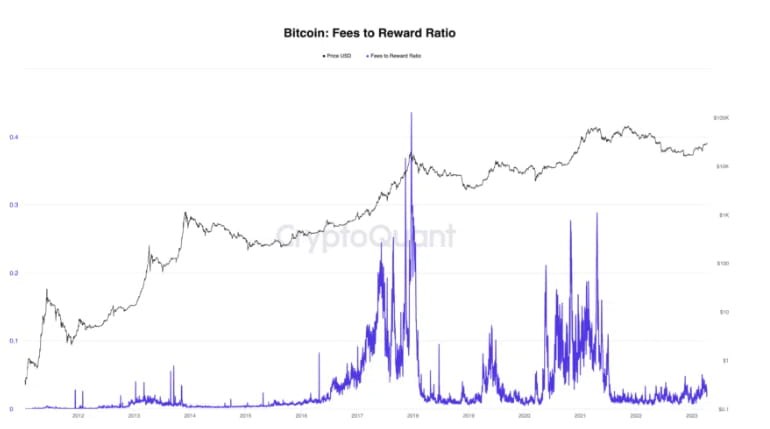
A higher fee-to-return ratio indicates that transaction fees account for a larger proportion of miners’ revenue. This is critical to maintaining the security and stability of the network when block rewards are reduced.
On the other hand, a lower ratio indicates that miners are more dependent on block rewards for income.
The relationship between cost and price
The return on fees ratio may have an indirect relationship with the price of Bitcoin.
A higher percentage indicates that the Bitcoin network is healthy and sustainable, which could increase investor confidence and demand for BTC, ultimately pushing up its price.
Conversely, a lower fee-to-return ratio could indicate a greater reliance on block rewards for miner income. As block rewards decrease over time due to halving events, a lower ratio could raise concerns about the long-term sustainability of the network.
Assume that miners’ revenue is not enough to cover their operating costs. In this case, they may be forced to sell their BTC holdings to make ends meet. As a result, the market selling pressure increases and may cause the price of Bitcoin to fall.
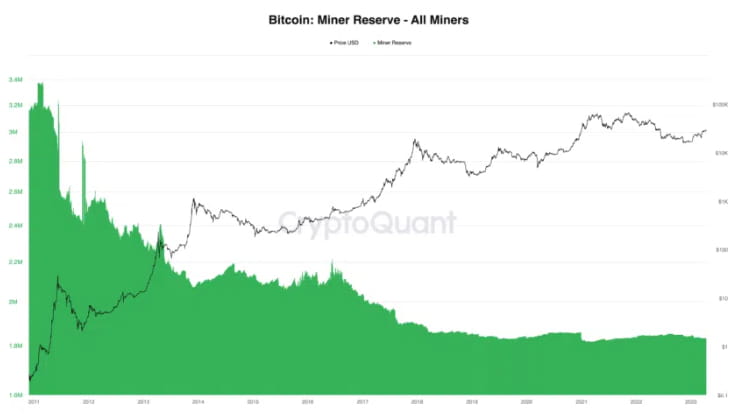
It’s important to note that the fee-to-return ratio is only one of the factors that influence the price of Bitcoin. Other factors such as market sentiment, macroeconomic conditions, and regulatory developments can also play a significant role in determining the price of BTC.
Bitcoin Price Prediction for 2024 Halving
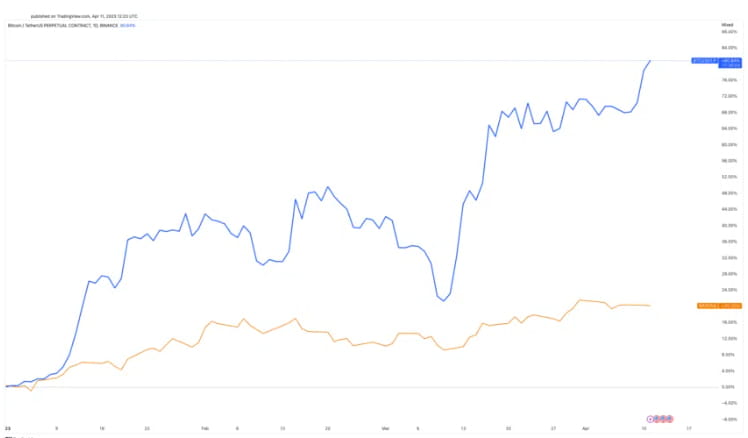
Bitcoin’s performance at the start of 2023, with a year-to-date gain of 84%, and weakening correlation with the Nasdaq 100, sets the stage for interesting on-chain analysis ahead of the 2024 halving event.
As the return on fees ratio begins to surge again, this could be a sign that the market has entered another accumulation cycle. This is reminiscent of the accumulation cycles in 2019 and 2020, when the ratio surged ahead of major price increases.
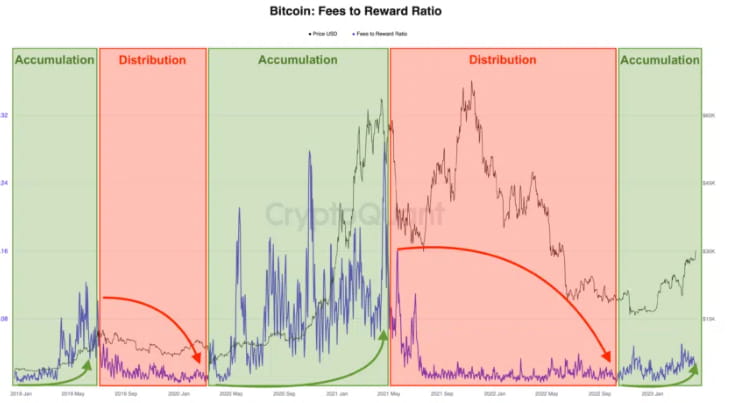
The current price trajectory suggests Bitcoin could reach $46,092 by summer 2023, according to the 2019 model.
However, the real target lies in the upcoming halving event, scheduled for April 6, 2024, which will further increase Bitcoin’s scarcity by reducing the block reward from 6.25 to 3.125.
After reaching a target price of $46,092, it is conceivable that Bitcoin could reach a valuation of $100,000 after the 2024 halving event, as the reduced block rewards increase BTC’s scarcity and could drive up demand.