

Xiao Feng shared five key trends in the Crypto industry, namely industry compliance, Bitcoin's second-layer protocol, Hong Kong's open policies and token economics, and ChatGPT.
Speaker: Xiao Feng, Chairman of Wanxiang Blockchain and HashKey Group
Compiled by angelilu, Foresight News Researcher
At the "FORESIGHT 2023" annual summit co-organized by Foresight Ventures and Foresight News, Xiao Feng, Chairman and General Manager of Wanxiang Blockchain and Chairman of HashKey Group, delivered a speech on the theme of five key words for 2023.
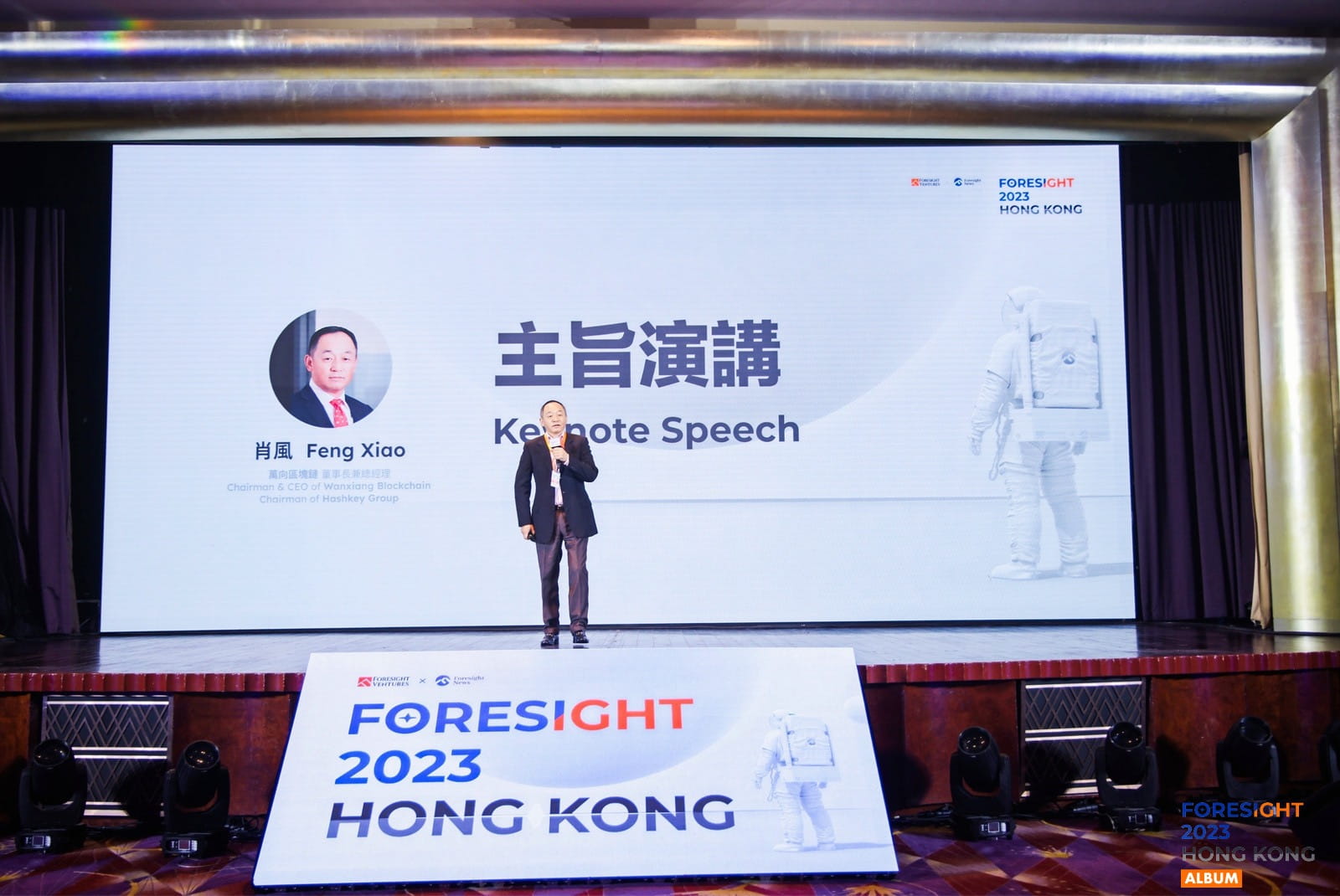
The following is a summary of the full speech:
The topic I will share today is the five key words of Blockchain in 2023, and talk about my sharing on future trends.
First of all, the first keyword is industry compliance. In recent months, the U.S. Securities and Exchange Commission (SEC) and the U.S. Commodity Futures Trading Commission (CFTC) have taken a series of very strict regulatory measures. I think we should not underestimate the measures taken by U.S. regulators, because this basically represents that national regulators may take the same measures in the future, which also means that this is the beginning of compliance in the Crypto industry. We should think about how to take the path of compliance. There are many technologies to evade regulation, but a strong 10 trillion market requires strong sociality and influence. This is also the reason why HashKey could have established an exchange many years ago, but we chose to spend two years applying for a license in Hong Kong.
The second trend is Bitcoin's B to BTC. Since last year, especially in the second half of the year, there has been a very new development trend that deserves everyone's attention, Bitcoin's second-layer network, which will lead to a huge expansion of the Bitcoin network. Before, Bitcoin could not run in smart contracts, so there would be many deficiencies in the application layer, and the development of Bitcoin would also be subject to many restrictions. In fact, Bitcoin's second-layer network has always existed, including the lightning network. The lightning network has developed relatively slowly. When we laid out the Bitcoin lightning network a few years ago, we thought that although we had not made money, we had always insisted on doing it for one purpose - to create credibility. When you work diligently and conscientiously as a node on it for four or five years, without any bad records, and your node operation quality is also very high, then after 8 or 10 years, you may be the node with the best reputation in the Bitcoin lightning network.
Therefore, when the Lightning Network is widely used, users will choose the nodes with the best reputation on the network, which is a role we want to play. We believe that the future of Bitcoin's Lightning Network is a new payment and settlement system based on the global network, where people around the world can complete their payment needs peer-to-peer. The booming development of these second-layer protocols will eventually redefine what Bitcoin is. Will Bitcoin always be digital gold? I believe this is a huge opportunity to explore the value of Bitcoin.
The third trend is Hong Kong. Since the Hong Kong SAR government issued a policy statement on virtual assets at the end of October last year, Hong Kong has returned to the core position of the Blockchian market on behalf of Asia. Everyone has begun to focus on Hong Kong, and regulatory authorities have continuously launched many major initiatives. The Hong Kong SAR government is very serious about building an international virtual market center. This is a strategic move of the Hong Kong SAR. Yesterday, the Financial Secretary of the Hong Kong SAR government, Paul Chan, also wrote his own article on the construction of encryption in Hong Kong. Hong Kong first started with legislation. Last year, in a new law and amendment to the Anti-Money Laundering Ordinance, a given legal framework was issued for virtual asset centers and virtual asset service providers, so that everyone can clearly know what rules, boundaries, and conditions you have for doing this in Hong Kong. There is also a related law being drafted, which is about stablecoins. The Hong Kong Economic and Trade Administration plans to submit the draft law to the Hong Kong Legislative Council at the end of this year, and then it is expected that the Legislative Council will pass it and implement it in Hong Kong at the end of this year or early next year. Hong Kong has huge opportunities in Asia.
The fourth point is token economics. I have seen that the practice of DeFi in the past few years is actually building a global, decentralized financial market system. This bear market actually proves that DeFi is successful. You have seen that a lot of things have happened recently, but in fact, the places where the problems occurred are all centralized. Why are decentralized protocols such as Uniswap not in trouble when they are all doing leverage, lending, and trading? Decentralized protocols are governed by blockchain, proved by blockchain, and expressed by blockchain, so as to be fully transparent, open, and transparent. To date, no network has established a decentralized financial system in such an open and transparent environment like blockchain. Although there have been problems with well-known trading platforms recently, no matter how many problems you list, in the end you will find that these have nothing to do with blockchain technology, but with morality and self-discipline. Whether it is misappropriation of customer assets, manipulation of market prices, or profit transfer, they are all criminal means in the traditional financial market. Blockchain technology is precisely used to prove innocence. Users prove that they do not hold your assets, prove that there is no false increase in assets, and prove that you have not manipulated assets. So when this famous trading platform collapsed, the remaining CeFi trading platforms all provided blockchain-based asset certificates. This is not enough. If you want to do CeFi and be a licensed exchange, then you need a set of laws to restrain yourself. Moral constraints alone are unreliable. This is why we need to accept supervision. We need to truly accept these very effective mechanisms to prevent moral risks in the current financial market.
Back to the topic of token economics, the token models in the basic protocol and the application protocol are different. For example, Bitcoin and Ethereum are basic protocols with only one token model. However, when building your own commercial applications based on Bitcoin and other basic protocols, the single economic model is invalid. So what kind of token model does the final application layer protocol need? In fact, there will be three tokens. There are three token models for the complete Web3 application layer. I will give a 30-minute speech at the end of the summit on the afternoon of the 15th. I will introduce three types of tokens. The first token is NFT, the second is a functional token, and the third is an equity token, a security token. Web3 application layer tokens should have all three aspects. If you want to really run a good Web3 business application, you must consider these three factors. They must be designed very well and very sophisticatedly, so that the business can be successful.
The last keyword is ChatGPT. I found that blockchain is actually the distributed ledger of AGI. What AGI means is also an opportunity trend. Professional knowledge can be mass-produced, which also means that knowledge is worthless and depreciates. We know that to become an expert, there is a 10,000-hour theorem. You need to go through 10,000 hours of professional training before you can become an expert in a certain industry. Now you don’t need it, you can still increase it according to this industry, because GPT-4 has increased your 10,000 hours of training. Imagine that there were only 10,000 people in the world who were experts in this industry, and now suddenly there are 1 billion people who are experts in this industry, and they can reach more than 85% of the level of this industry. Is the value of this industry increased or decreased? The total value may increase, but the knowledge content is actually reduced, because ChatGPT can create this knowledge very cheaply.
After that, intellectual property rights should be self-managed and self-proven. The best way to self-manage and self-proven is blockchain plus NFT. In the Internet era, there are many laws in various countries about the protection of personal data. In many places, individuals have partial ownership of their own data, partial income rights, portability rights, and the right to be forgotten. Are these laws effective? Has anyone done it? —— Invalid, it can't be done. But once you use blockchain, your data is yours, stored in your digital wallet, and the digital wallet is built and managed by yourself. The property is in your wallet and managed by you, not in the bank, so technology can bring these changes. In the future, the entire knowledge production system, knowledge management system, knowledge authorization system, and knowledge trading system in the world will undergo very big changes. Now GPT-4 has 100 trillion parameters, while the parameters of the human brain are between 210 trillion and 240 trillion. We believe that GPT-5 may be able to achieve 200 trillion. When it evolves to that time, a new round of intellectual property registration, management, protection and trading systems must be allocated.
So I will share these 5 key words and talk about my understanding of future trends. Thank you everyone.

