


Original author: BTX Research
Original source: BTX Capital
01 Key content
On the Beacon Chain, there are approximately 562K+ validators staking more than 18 million ETH.
Liquid Staking is the largest player on the market, accounting for over 6 million staked ETH and 33.3% of the market share.
We have considered the maximum selling pressure scenarios and calculated the potential selling volume. Our results suggest that maximum selling pressure could reach 284,400 ETH, equivalent to 5.27% of ETH’s 24-hour trading volume. However, taking into account factors such as liquidity, rates of return, and user staking, the selling pressure could be reduced to 59,391 ETH, equivalent to 1.1% of trading volume.
There is no need to worry about the long-term impact of Shanghai’s upgraded withdrawals on selling pressure on ETH. However, there may be more selling pressure in the first five days after the ETH Shanghai upgrade is completed.
02 What is Shanghai upgrade?
Ethereum developers have set a target date of April 12, 2023 at 10:27:35 PM UTC (April 13 at 6:27:35 Taipei time), during the 6209536th time slot. EIP-4895 is a key upgrade for ETH Shanghai upgrade. The Beacon Chain brings staking to Ethereum, but it is a one-way process, meaning validators can deposit ETH into the Beacon Chain but cannot withdraw it. With EIP-4895, the major improvement to the Shanghai upgrade, validators will finally be able to access and withdraw their ETH as well as any accumulated staking rewards.
As a new era of unlocked ETH approaches, cryptocurrency traders are paying close attention to how the market may respond. Some traders have speculated that there will be selling pressure once staked ETH is unlocked, while others believe the Shanghai upgrade will encourage more staking.
03 How do validators unstake their ETH?
For validators worried about selling pressure, there are two options for unstaking their ETH after the Shanghai upgrade. The first option is to set up a "withdrawal certificate", which will automatically cancel the staking rewards obtained by the verifier. The second option is to exit the beacon chain entirely, sending a voluntary message that removes the validator from the blockchain and unstakes all 32 ETH.
04 What are the two withdrawal types?
Partial Withdrawal: Balances above 32 ETH (rewards earned) will be withdrawn to an Ethereum address and can be used immediately. Validators will continue to be part of the beacon chain and validate as expected.
All withdrawals: Validators will exit and stop being part of the beacon chain. The validator's 32 ETH principle and any rewards will be unlocked and allowed to be spent once the exit and withdrawal mechanisms are completed.
05 How much ETH is staked on the Beacon Chain?
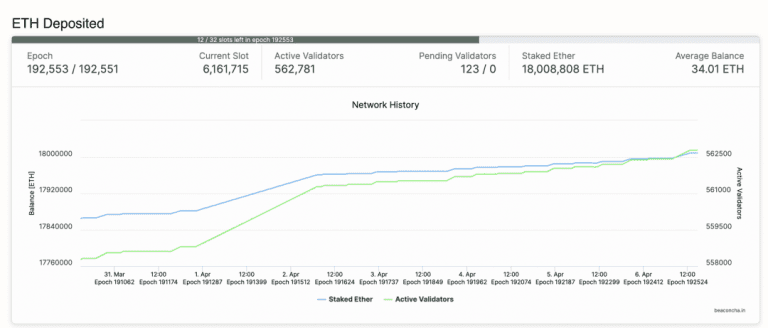
(Source: beaconcha.in, Date: 04/06/2023)
Approximately 562,000 validators have staked more than 18 million ETH. Setting up a validator requires 32 ETH and the average balance is now 34.01 ETH.
06 ETH pledge ratio
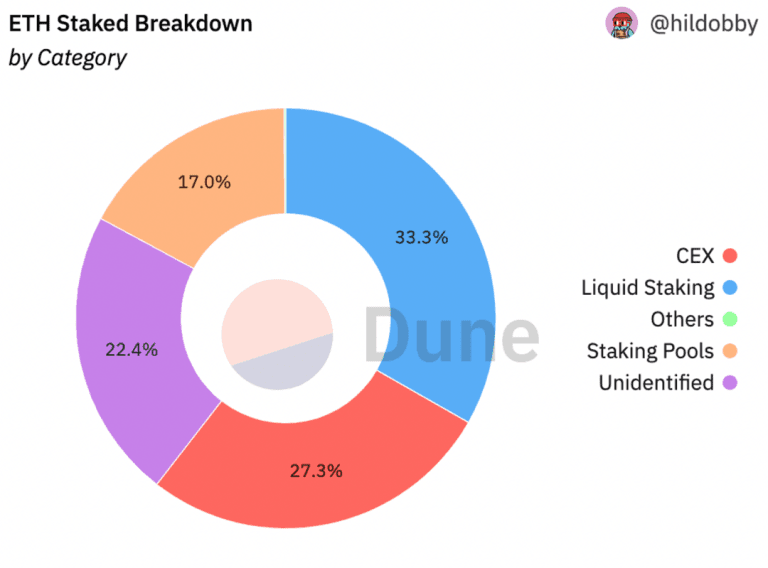
(Source: Dune@hildobby )
Liquid Staking is the largest player in the market, accounting for over 6 million staked ETH and 33.3% of the market share. Lido holds 93.78% of the liquid staking market, with 5,671,616 ETH already staked. Lido is a company that provides liquid staking services, providing users with stETH tokens representing ETH staked on its platform.
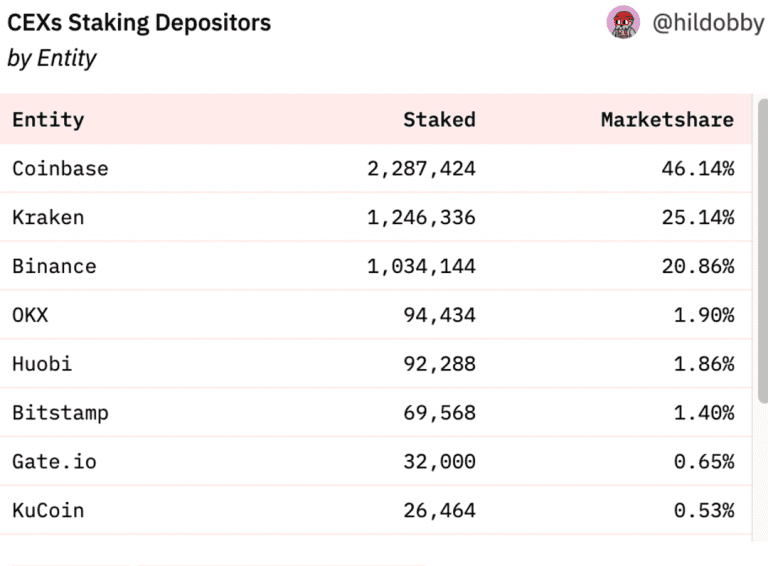
(Source: Dune@hildobby , Date: 04/06/2023)
In the staking market, the major exchanges are Coinbase, Kraken, and Binance, which together handle over 4 million ETH and account for approximately 27.3% of the market share. Among them, Coinbase and Binance provide liquidity to users through their cbETH and bETH derivatives.
About 22.4% of the market share is also held by unknown stakers. These may be individuals running nodes from home or smaller groups running private staking pools.
07 Liquid pledge vs non-liquid pledge
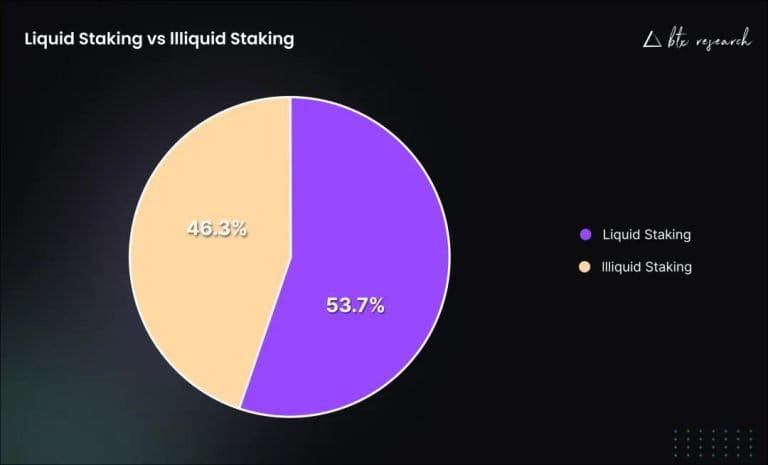
(Source:Dune, Date:04/06/2023)
The main components of liquid staking include Lido and centralized exchanges Binance and Coinbase, which account for 53.7% of the market share. On the other hand, the main components of illiquid staking include the centralized exchange Kraken and private staking pools, accounting for 46.3%. Liquid staking provides validators with liquidity mechanisms such as stETH, bETH, and cbETH. Therefore, 53.7% of users have already received liquidity for their staked and earned ETH, so the selling pressure on this segment should not be significant. Perhaps we should be more concerned about the selling pressure on the illiquid portion of 46.3%.
08 How many validators are profitable?
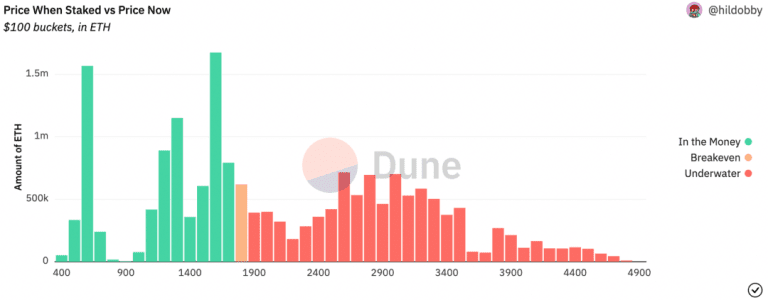
(Source: Dune@hildobby , Date: 04/06/2023)
Based on the data, we can observe that a large amount of staked ETH is concentrated in the price range between approximately $600 and $1,600.
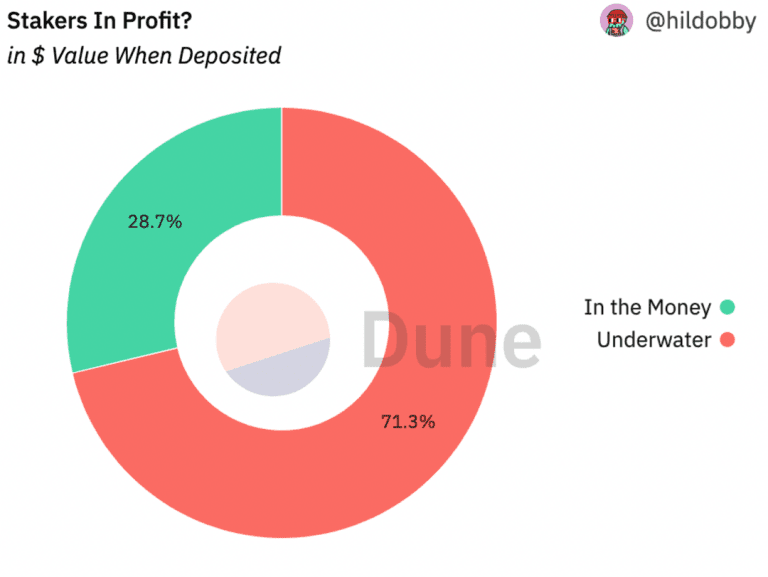
(Source: Dune@hildobby , Date: 04/06/2023)
Among all validators, 28.7% are profitable and 71.3% are losing money. Only 28.7% of validators are profitable, and those who do may have a strong incentive to withdraw their ETH gains and sell.
09 Estimated selling pressure
First, the ETH staked by the validator is divided into two parts to unlock: the principle part (32 ETH) is subject to a limited queue to withdraw the pledge, and withdrawal means the validator withdraws from the pledge; while the profit part can be withdrawn at any time After withdrawal, the validator still maintains the pledge status.
Full withdrawal amount per day
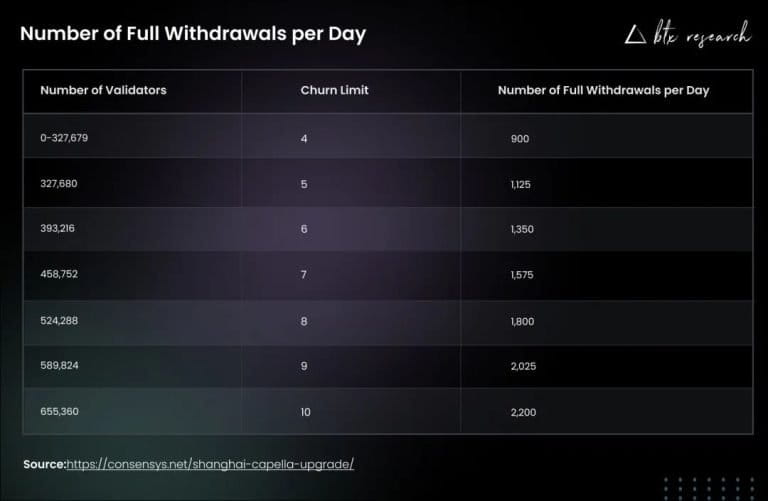
(Source: https://consensys.net/shanghai-capella-upgrade/)
There is a limited number of validators that can unstake each day. Currently, the hand-change limit is 8, and a maximum of 1,800 validators can unstake every day, which is equivalent to unlocking 57,600 ETH. For the profit part, since it can be withdrawn at any time, the limit is related to the number of blocks produced on the Ethereum chain, allowing approximately 115,200 validators to withdraw per day.
So, if full withdrawal requests hit the daily maximum, up to 1800 validators could theoretically complete a full withdrawal, while the number of daily profits and partial withdrawals would be 115,200 minus 1,800, or 113,400.
Data overview
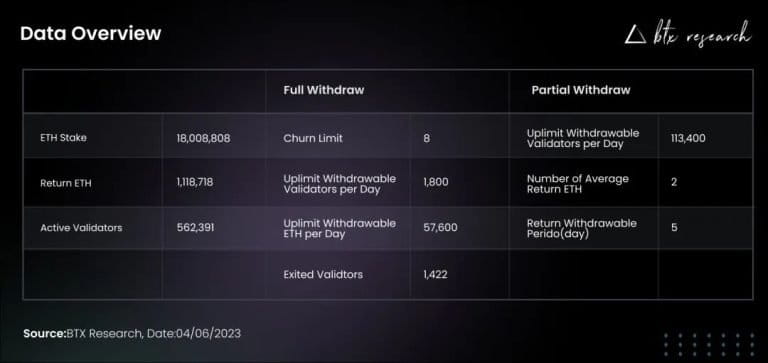
(Source: BTX Research, date: April 06, 2023)
We can start to calculate the selling pressure after the Ethereum Shanghai upgrade. Before making any estimates, we need to establish some assumptions, such as that all unstaking ETH will be staked as soon as possible and all profits will be withdrawn in a timely manner. First, let's consider the worst-case scenario, which represents the greatest potential selling pressure.
010 Theoretical maximum selling pressure
Theoretical results
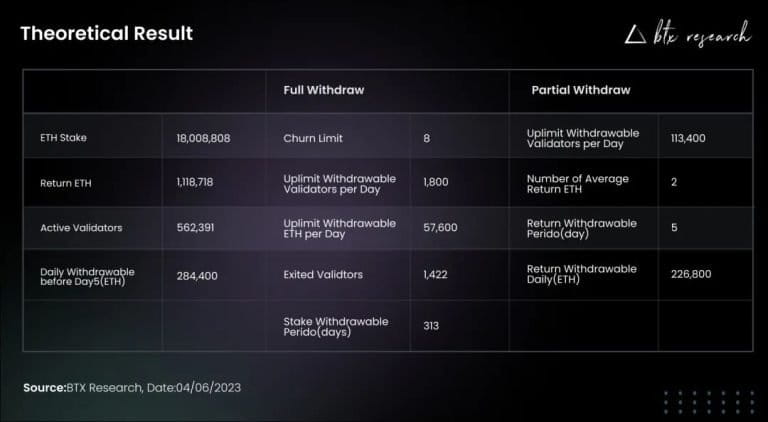
(Source: BTX Research, date: April 06, 2023)
By utilizing partial withdrawals to withdraw a portion of the profits, it is theoretically possible to withdraw 226,800 ETH per day within 5 days. Meanwhile, a full withdrawal would free up 57,600 ETH per day, taking 313 days to complete. Therefore, in the first five days after the Shanghai upgrade is completed, the theoretical maximum average selling pressure is 284,400 ETH per day, and assuming no new ETH is pledged, the entire release will take 313 days.
011 Better selling pressure situation
We need to consider that 53.7% of the ETH staked by validators already have some level of liquidity and does not need to be unlocked. Therefore, the selling pressure on some of the pledged ETH that has gained liquidity may have been partially released in advance.
better case
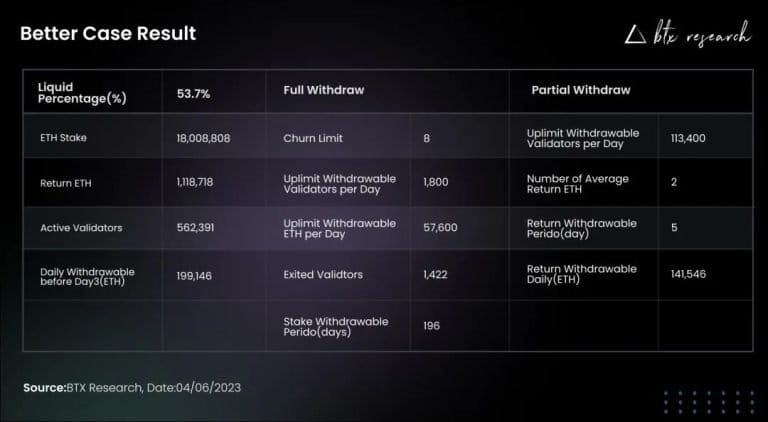
(Source: BTX Research, date: April 06, 2023)
Assuming that 30% of the 53.7% of validators will withdraw ETH and sell it, we can estimate the amount of ETH withdrawn via partial withdrawals to be 141,546 per day for 3 days. The full withdrawal portion remains at 57,600 ETH per day for 196 days. Therefore, in the first three days after the Shanghai upgrade was completed, the potential daily selling pressure was 199,146 ETH.
012 Consider the selling pressure of pledged profits
Consider the estimated results of staking profits
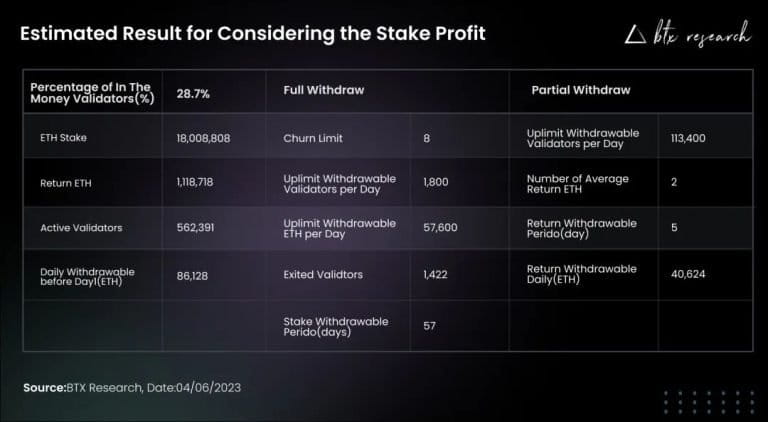
(Source: BTX Research, date: April 06, 2023)
From the previously mentioned data, we know that In the Money validators account for 28.7%. Combined with the previous selling pressure calculation, we can determine that the profit withdrawn via partial withdrawal is 40,624 ETH per day for one day. The full withdrawal portion remains at 57,600 ETH per day for 57 days. Considering that only 1,422 validators have exited so far, users who started staking ETH will need to wait at least 1.1 days before they can start withdrawing ETH. Therefore, the underlying selling pressure is 86,128 ETH on the first day after the Shanghai upgrade is completed, and 57,600 ETH on each subsequent day.
013 Consider user staking situation
Estimation results considering user staking situation
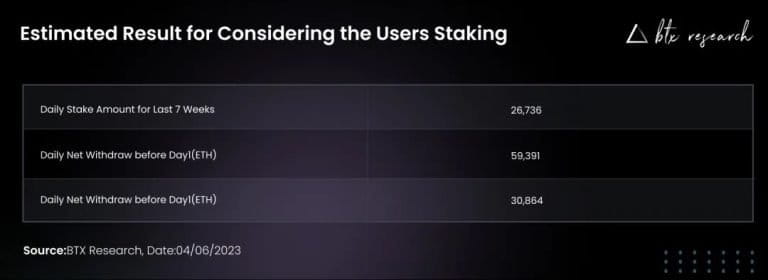
(Source: BTX Research, date: April 06, 2023)
If we take into account that after the Shanghai upgrade, users may be more willing to stake ETH due to the increased liquidity of staked ETH, and if validators maintain the average daily staking volume of the past seven weeks, then the selling pressure after the Shanghai upgrade may further reduce.
014 Conclusion
According to data from CoinGecko, ETH’s trading volume in the past 24 hours was 5,392,296 ETH. Considering the maximum selling pressure, the selling pressure ratio in the first five days was 5.27%, which is relatively large. If factors such as profits, liquidity, and user re-staking are taken into account, the early selling pressure may further reduce to 1.1%. Therefore, based on our estimates, there is no need to worry about the long-term impact of Shanghai’s upgraded withdrawals on ETH selling pressure. However, there may be greater selling pressure in the first five days after the Shanghai upgrade is completed.
In addition, due to the constant changes in the market, significant fluctuations or declines in the price of the Shanghai Upgrade on the day of the Shanghai Upgrade may cause investor panic. Additionally, market manipulators may take advantage of the Shanghai upgrade to sell their ETH holdings, which may increase the likelihood of massive selling pressure after ETH is unchained.
refer to
dune.com/hildobby/eth2-staking
(The above content is excerpted and reprinted with the authorization of partner MarsBit, original text link | Source: BTX Capital)
Statement: The article only represents the author's personal views and opinions, and does not represent the objective views and positions of the blockchain. All contents and opinions are for reference only and do not constitute investment advice. Investors should make their own decisions and transactions, and the author and Blockchain Client will not be held responsible for any direct or indirect losses caused by investors' transactions.
This article counts down to 3 days for Ethereum’s “Shanghai Upgrade”! An article to understand 13 key points first appeared on Block Guest.