
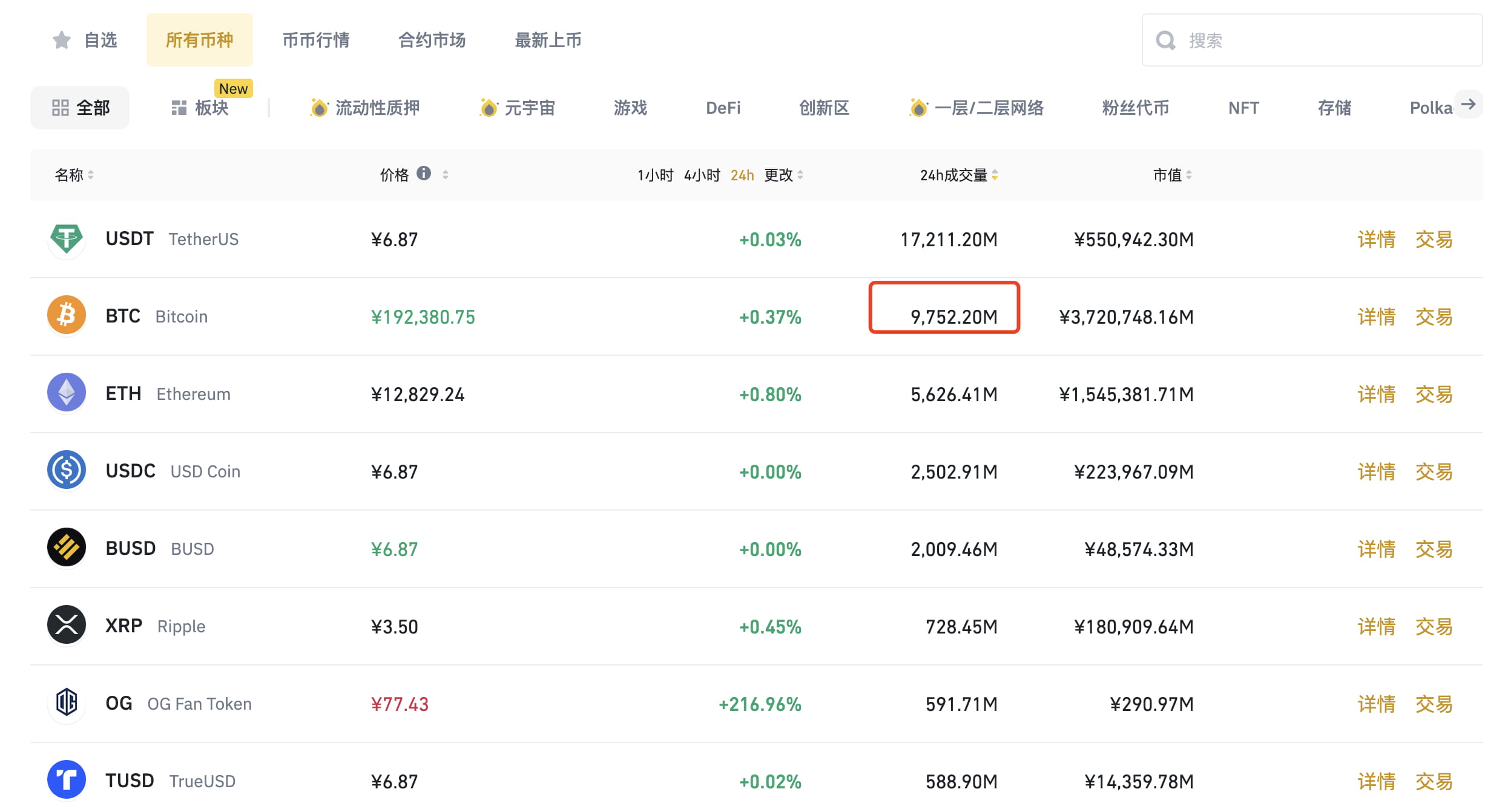
As of 20:33 on April 8, the transaction volume of Bitcoin was only US$5.68e.
Of course, it is affected by macro factors and Binance’s re-charging of Bitcoin transaction fees.
Once the financial market loses liquidity, it is like cooking without adding salt, running without drinking water, or forgetting to bring money for a treat. The situation will be very embarrassing!
There is one word we see and hear more and more often – mobility. In the contemporary economic discourse system, "liquidity" seems to be a magical and transcendent baton, flying up and down in everything from personal finance to global capital markets. What is liquidity? What characteristics does it have? Why is it so important in contemporary economic systems?
Considered extremely important to the health of financial entities. In the economic literature, liquidity refers to the ability of economic agents to exchange their existing wealth for goods, services, or other assets. Liquidity is considered in terms of flows and refers to the ability to realize these flows. Otherwise, the financial asset will lose liquidity, that is, it cannot be sold; assets that cannot be sold cannot be valued. Due to information asymmetry and market incompleteness, liquidity is often limited, resulting in varying degrees of illiquidity.
Even sudden liquidity shocks in a single market sector or in a single instrument can cause devastating disruptions in interconnected global financial markets. For example, in August 2007, as credit rationing hit the interbank loan market, money market liquidity fell sharply and the market began to reflect the tension. The two banks refused to lend to each other because of uncertainty about their exposure to structured products; because no one knew the amount of the exposure, liquidity in structured assets dried up, making it difficult to value them. Central banks were forced to inject liquidity into the market.
1. Reasons for the decrease in liquidity in the Bitcoin market
Policy factors: Governments of various countries have different attitudes towards cryptocurrencies, and the uncertainty of regulatory policies has had a huge impact on the Bitcoin market. Some countries have implemented strict regulatory policies that restrict the trading and use of cryptocurrencies, resulting in fewer market participants and thus affecting the liquidity of Bitcoin.
Lack of investor confidence: The recent sharp fluctuations in Bitcoin prices, coupled with the continuous negative news coming out of the market, have led to a setback in investor confidence. Investors are holding their currency on the sidelines, and transaction volume has decreased, further exacerbating the squeeze on liquidity.
Increasing competition: With the rise of other cryptocurrencies, Bitcoin’s market share is gradually being challenged. Some investors have diverted funds to other digital currencies, reducing trading activity in the Bitcoin market.
Increased miner costs: As the difficulty of Bitcoin mining increases, miners need to invest more resources to maintain operations. In the face of declining profits, some miners have chosen to exit the market, reducing the supply of new Bitcoins and further weakening market liquidity.
2. Coping strategies
Pay attention to policy developments: Investors need to pay close attention to changes in global cryptocurrency policies in order to adjust investment strategies in a timely manner. Understanding the regulatory attitudes and policy trends of various governments can help predict market trends and avoid risks.
Diversification: During a downturn in the Bitcoin market, investors can consider diversifying their funds into other cryptocurrencies or traditional assets to reduce risks. Maximize returns through rational allocation of assets.
Prudent investment: Investors should fully understand the risks of Bitcoin and follow the principle of risk tolerance
The short-term downturn is for the subsequent better climax of 100,000 US dollars.
Don't leave it when it doesn't work.
Adhere to fixed investment and long-term thinking
Optimists make money, pessimists make money