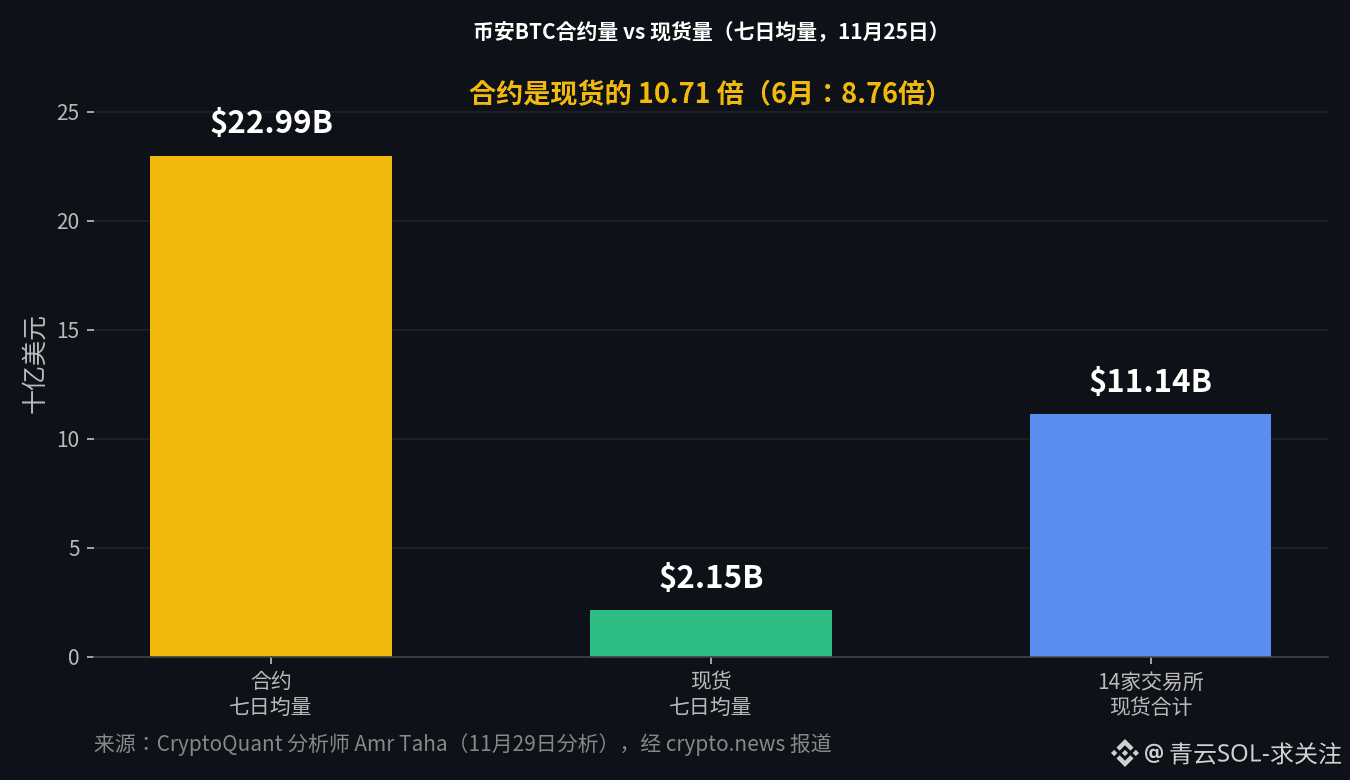
#币安合约量107倍于现货 🔥 Spot volume is only one-tenth of what’s supporting the price; the rest is contracts betting against each other
On November 29, CryptoQuant analyst Amr Taha published a set of figures: On November 25, Binance’s seven-day average $BTC futures volume was $22.99 billion, while spot volume was only $2.15 billion—futures volume was 10.71 times spot volume. In June, that ratio was still 8.76. It’s climbed a notch in five months.
Spot volume is shrinking; futures volume hasn’t shrunk much. Since June 7, Binance’s spot volume has fallen 28.8%, while futures volume is down just 13%. The futures volume on Binance alone exceeds the combined $11.14 billion in spot volume across 14 exchanges. With spot buyers sitting on the sidelines, leverage is in charge of the price. In the evening of November 29, Bitcoin plunged nearly $800 in one minute, liquidating $69 million in long positions—a chain reaction of futures contracts triggering liquidations in other contracts.
Bitcoin is now hovering around $60,240, having just reclaimed $60,000; on November 29, it dipped as low as $58,237. ETF outflows haven’t let up either: $5.78 billion has flowed out in November, with outflows continuing for eight consecutive trading days.
In my view, the first thing to watch in the short term is whether $59,000 holds. If spot volume doesn’t return, $60,000 won’t hold; any rebound will be driven by leverage, and leverage will accelerate the decline too. If support gives way, the next level to watch is $57,000. In the medium to long term, I still stand by one view: the ratio rising from 8.76 to 10.71 shows that as prices have fallen this time, spot buyers have been leaving while futures speculators keep raising their bets. For a bottom to hold, we’ll have to wait for spot volume to return or ETF outflows to ease.
Futures can determine the direction of a single day’s move, but they can’t determine the bottom of a market cycle. Without spot money coming back, everything above $60,000 is borrowed.