#usd1脱锚跌到094美元 🔥 Stablecoin loses its peg by 6%; project team takes a loss to rescue its loan, losing $19.3 million
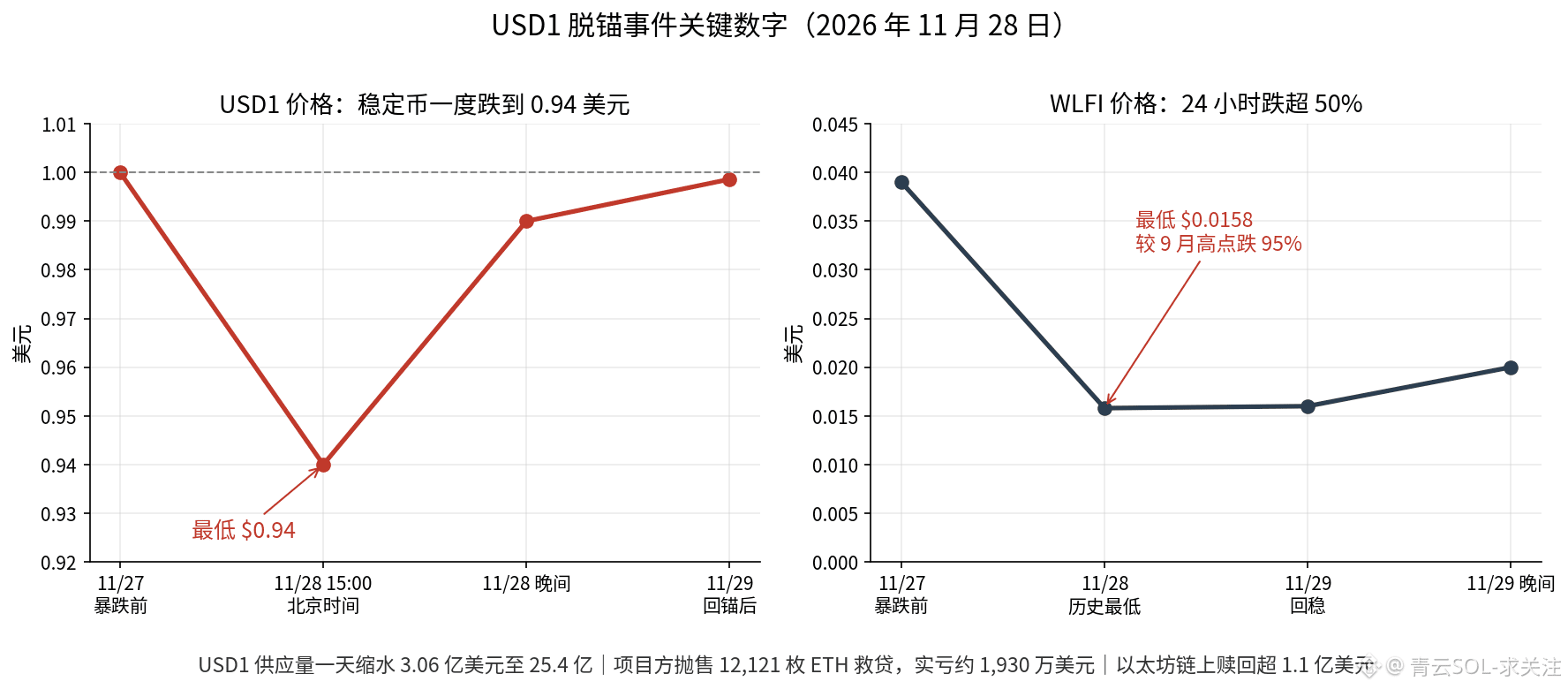
On November 28, USD1, the stablecoin from the Trump family’s World Liberty project, briefly fell to $0.94 on Binance—a 6% loss against its $1 peg. On the same day, the governance token $WLFI 24-hour fell more than 50%, hitting a record low of $0.0158. That was a 95% drop from its September peak of $0.33.
The trigger was on-chain. In April this year, the project team put up about 5 billion WLFI tokens as collateral to borrow around $75 million in stablecoins from Dolomite. When WLFI plunged, the collateral came under pressure, and the strategic reserve wallet had to take a loss: it sold 12,121 ETH for about $20.06 million to repay the debt. The ETH had been bought at an average price of about $3,244; it was sold for just $1,655, realizing a loss of roughly $19.3 million in one go. After repaying the debt, the team closed one position, bringing its liquidation price down to $0.00631.
On the USD1 side, redemptions on Ethereum exceeded $110 million in 24 hours, and its supply shrank by $306 million in a single day, leaving $2.54 billion. BitGo withstood the redemptions, while arbitrage traders including Jump Crypto stepped in, bringing the peg back to $0.9986. The project team stated that USD1 remains fully backed 1:1, and that WLFI is not included in its reserves.
In my view, this depeg is not the same as USDC falling to $0.87 in 2023. That time, a bank ran into trouble; this time, USD1’s own token crash undermined the project’s own lending positions. The underlying problem is borrowing against a governance token. In the short term, the peg has recovered and USD1 has survived. In the longer term, Justin Sun has already accused the project of insider circular lending and called for it to be delisted. A breach of trust cannot be repaired overnight.
A stablecoin’s peg depends not on slogans, but on reserves and risk management.