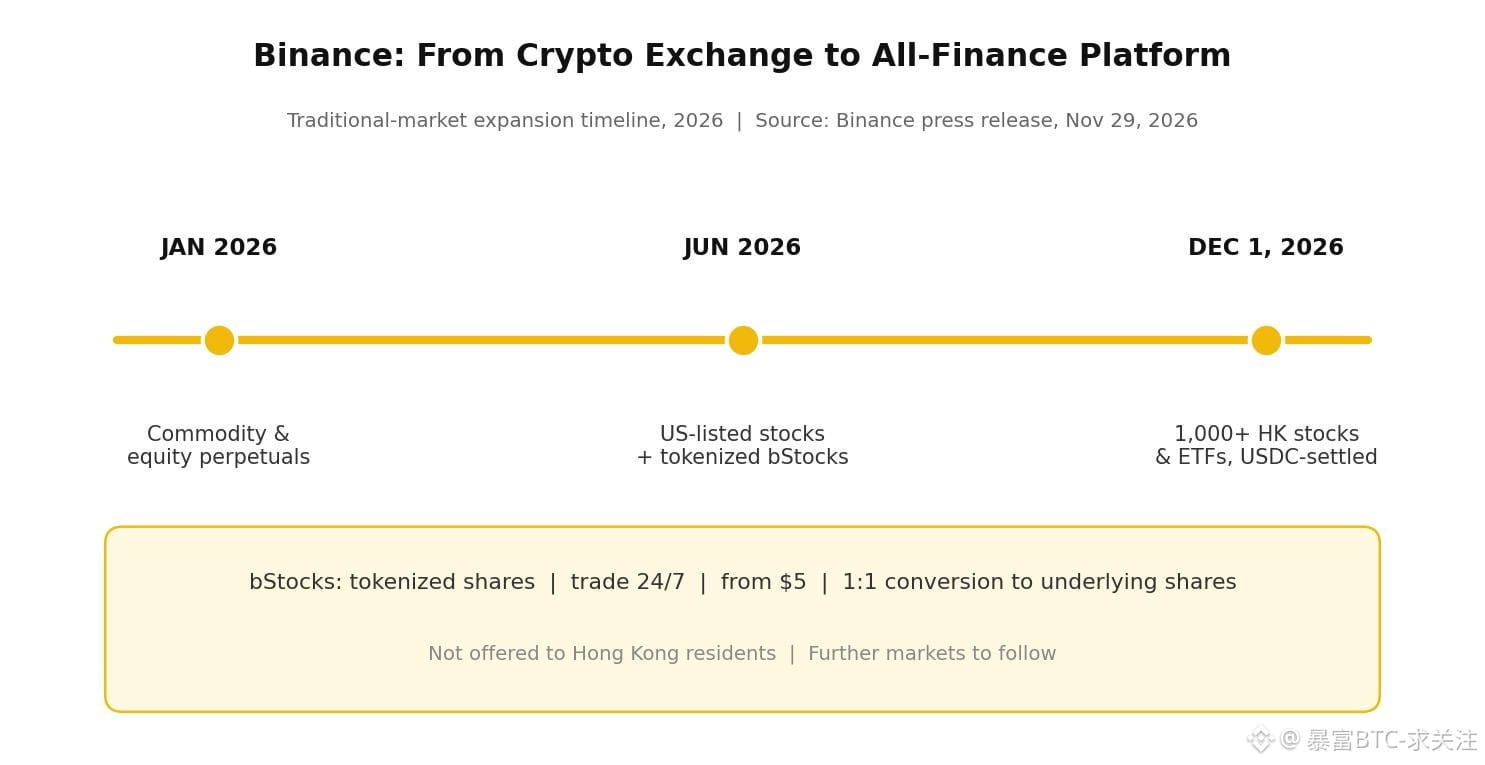
#币安12月1日卖港股 🔥 Over 1,000 Hong Kong stock and ETF listings can be bought directly with USDC—the exchange is becoming a brokerage
On November 29, Binance officially announced that starting December 1, more than 1,000 Hong Kong-listed stocks and ETFs will be available for direct trading on Binance, settled in USDC and held in the same account as crypto and U.S. stocks. Some Hong Kong stocks will also be available as tokenized securities called bStocks, trading around the clock with a minimum investment of $5 and freely exchangeable 1:1 for the underlying shares. There’s just one exception: the service won’t be available to the Hong Kong public. More markets are waiting in line.
This isn’t a sudden whim on Binance’s part. In January, Binance launched perpetual contracts for commodities and stocks; in June, it added U.S. stock spot trading and bStocks; on December 1, it’s Hong Kong stocks’ turn. In less than a year, Binance has gone from a crypto exchange to what it calls a “full-service financial platform.”
Zoom out, and Binance is far from the only one doing this. Kraken launched xStocks last June, bringing over 60 tokenized U.S. stocks to Solana for trading. Around the same time, Robinhood launched more than 200 tokenized U.S. stocks in Europe. Bybit and Coinbase are both pushing in the same direction. Traditional finance is moving in the opposite direction, too: Russia’s SPB Exchange will begin offering spot trading in Bitcoin, Ethereum, and USDT using rubles on December 1; Malaysia’s first spot Bitcoin ETF will list on December 2; and Switzerland’s first spot Bitcoin ETF was already listed on November 26. The walls on both sides are coming down faster than anyone expected.
The USDC angle deserves a closer look. Binance recently bought $100 million worth of Circle shares and signed a five-year partnership to promote USDC. Hong Kong stock trades will settle directly in USDC, effectively turning stablecoins from an instrument used within crypto markets into money for buying stocks. The next wave of stablecoin growth may come not from within crypto, but from the settlement layer for traditional assets. Whoever embeds stablecoins into stock trading first gets a ticket on board.
I see this in two ways. Over the medium to long term, I’m bullish on the direction. Exchanges have users, traffic, and systems that run 24/7; traditional brokerages can’t match their distribution capabilities. If tokenized stocks take off, holding crypto and stocks in one account will be an irreversible trend. Binance is simply taking it as far as it can. In the short term, though, don’t get carried away. First, 1,000-plus is the total number; only “some” Hong Kong stocks will be available for around-the-clock trading as bStocks, while ordinary Hong Kong stock trading will still follow Hong Kong market hours. Second, bStocks are certificates, not direct share ownership. They’re issued by a Binance affiliate under Abu Dhabi’s regulatory framework, and the specific rights will have to wait for the launch documents. Third, liquidity hasn’t returned to crypto yet: $BTC is currently around $60,000, and U.S. spot Bitcoin ETFs saw record net outflows of $5.78 billion in November. Selling stocks on an exchange won’t solve the problem of falling crypto prices. On launch day, December 1, watch two numbers: how many bStocks are actually included in the initial batch, and whether USDC volumes rise along with them.
Stay level-headed: “more than 1,000” doesn’t mean all of them can be traded 24/7. The 1:1 exchangeability is in the documents; redemption capacity depends on the issuer. But there’s no doubt about the direction: when exchanges start selling stocks and exchanges start selling Bitcoin, the only thing left between them is a license. $BTC $BNB