#币安12月1日上线1000只港股etf 🔥 The world’s largest crypto exchange is starting to sell stocks tomorrow
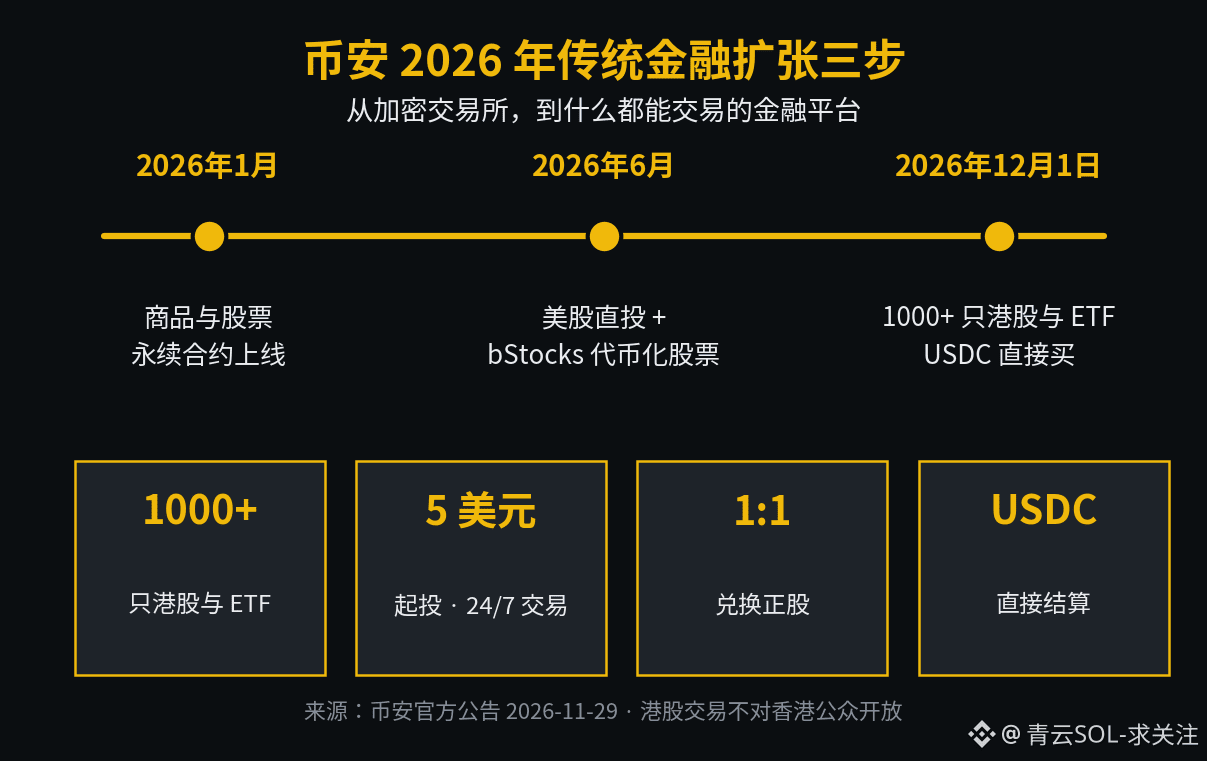
On November 29, Binance announced that starting December 1, more than 1,000 Hong Kong stocks and ETFs will be available on the Binance app. Users can buy them directly with USDC, keeping crypto and U.S. stocks in the same account. Some Hong Kong stocks will be offered as tokenized bStocks, tradable 24 hours a day, with investments starting at $5 and freely convertible into the underlying shares at a 1:1 ratio.
This isn’t a spur-of-the-moment decision. Binance first launched commodity and stock perpetual futures in January, then added direct U.S. stock investing and bStocks in June. Hong Kong stocks are the third step. The goal is stated plainly: to transform from the world’s largest crypto exchange into a financial platform where you can trade just about anything.
The timing is interesting. Bitcoin fell about 23% in November, U.S. spot ETFs saw net outflows of around $5.5 billion that month—a monthly record—and the Fear and Greed Index is at just 11 today, indicating extreme fear. The quieter the crypto market gets, the more exchanges need to find new sources of revenue. Rather than letting users’ USDC sit idle, they can buy Hong Kong stocks on the platform, keeping their money there.
There’s another factor worth mentioning: just a month ago, Binance was robbed of $6.3 billion, and withdrawals weren’t fully restored until November 26. Now, as it secures a sovereign license in Bhutan and rolls out Hong Kong stocks, it’s clearly trying to win back trust.
I don’t expect this to boost $BNB or the broader market in the short term. Hong Kong stocks are falling too, and bStocks just extends trading hours and lowers the barrier to entry. But over the long term, the endgame for exchanges is to become all-asset platforms. Whoever gets stocks, crypto, and stablecoins into one account first will secure an early foothold in the next bull market. Binance is making the right move; the real test comes after December 1: will there be genuine trading volume in the first week?
In a bear market, exchanges are even more desperate than retail investors to find a meal ticket.