
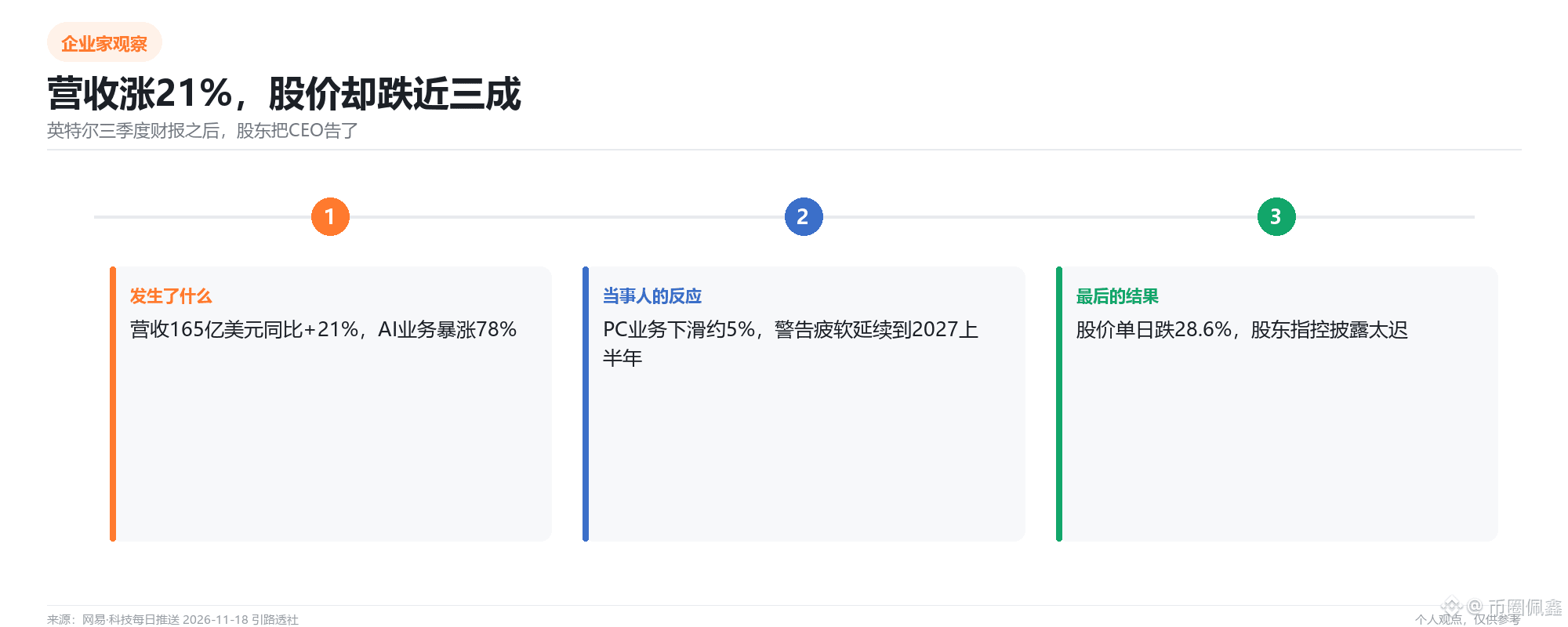

Revenue rose 21%, yet the stock lost nearly a third of its value in a single day, wiping out more than $100 billion in market capitalization overnight. This isn’t the opening of a crisis story—it’s the real scorecard recently delivered by a chip giant.
The company in question is Intel, led by CEO Lip-Bu Tan. Its third-quarter results looked impressive: revenue of $16.5 billion, up 21% year over year, while its data center and AI business surged 78%. But its PC business slipped about 5%, and the company added that “weakness could continue through the first half of 2027.” The next day, its stock plunged 28.6% in a single session. Soon after, a group of shareholders sued both the company and its CEO, centering their allegations on “disclosure delays”—claiming that management knew as early as July through October that demand was slowing and inventory was piling up, but failed to clearly inform the market in a timely manner.
After reading this story, what struck me most wasn’t how alarming the numbers were, but what it says about how to deliver good and bad news. More often than not, it’s not the bad news itself that destroys trust, but the fact that it was kept hidden for a while. The market can accept that you’re not selling well, but it’s much harder to accept that you knew and didn’t say anything. The same principle applies to investing and to how we conduct ourselves: the cost of being upfront in a timely manner is often far less than the cost of being found out.
Of course, there are hundreds of these “stock price drops, then a class-action lawsuit” cases in the U.S. every year. Having the CEO named as a defendant is practically standard, and the outcome ultimately depends on the courts. So I’d rather treat this as a case to observe than a definitive conclusion.
What do you think? A: Shareholders are making a fuss over nothing—suing after a stock drop is all too common. B: The disclosure was indeed too late, and that deserves scrutiny. C: What really matters is whether the business can turn things around. If you were a manager, would you deliver bad news sooner or later?
Follow me, and let’s make sense of business news together. These are my personal views and are for reference only.
#WriteToEarn #BinanceSquare