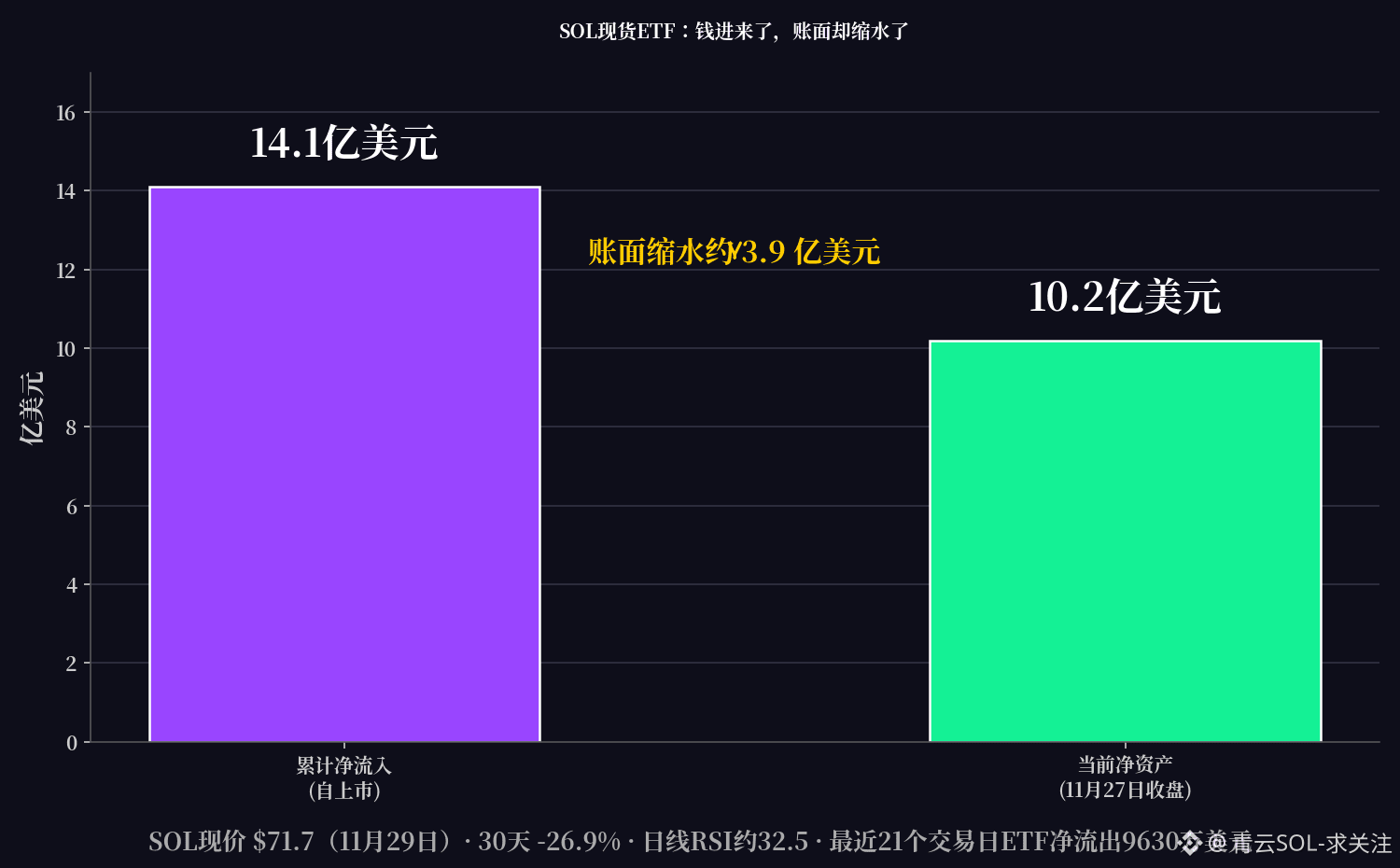
#soletf累计净流入141亿 🔥 Money is flowing in, the price is falling—$1.4 billion bought nothing but disappointment
As of the U.S. market close on November 27, spot SOL ETFs had seen cumulative net inflows of $1.41 billion, yet their total net assets had dwindled to just $1.02 billion. Nearly $390 million had already been wiped out by the drop in the token’s price. That day, SOL dipped as low as $69.12 on Binance, briefly falling below the $70 mark. It was trading at around $71.70 on the evening of the 29th, down about 27% over the month.
What stings even more is that this $1.4 billion is no longer fresh money. Over the past 21 trading days, SOL ETFs have actually seen net outflows of $96.3 million, including $9.9 million over the past five trading days and another $872,000 on November 27 alone. The money that poured in during the bull run in September and October is now all underwater.
Across the market, Bitcoin ETFs had recorded eight consecutive days of outflows by November 27, with November outflows reaching a record $5.78 billion for a single month. Ethereum ETFs saw nine consecutive days of outflows, including another $69.4 million on November 27. SOL is the only altcoin with positive cumulative inflows, but even that hasn’t been enough to support its price.
The technical picture is just as grim: SOL’s daily RSI is around 32.5, nearing oversold territory; the 50-day moving average at $87.71 and the 200-day moving average at $89.86 are both hanging overhead; and the seven-day low of $65.81 is right below. The Fear & Greed Index is at 11 today, marking its 17th consecutive day of extreme fear.
In my view, the first thing to watch in the short term is whether $70 holds. If it doesn’t, the next level to watch is the seven-day low of $65.81. SOL needs to reclaim and hold above $70 before a rebound is even on the table. In the medium to long term, the $1.4 billion base of ETF holdings shows that institutional interest hasn’t disappeared. But for a recovery, we first need to see Bitcoin ETFs stem their outflows and capital return.
ETFs can bring money in, but they can’t bring in a bottom. The money is here, but the bottom isn’t—that’s SOL’s situation right now.