For a proposal to shorten the execution delay for $AAVE governance, I’d first look at which safeguard is being removed. Markets like to treat “proposal passed” as meaning the change is already in effect. But the time between a yes vote and an actual contract change is itself a right: it gives people time to inspect the code, spot problems, and decide whether to keep their exposure.
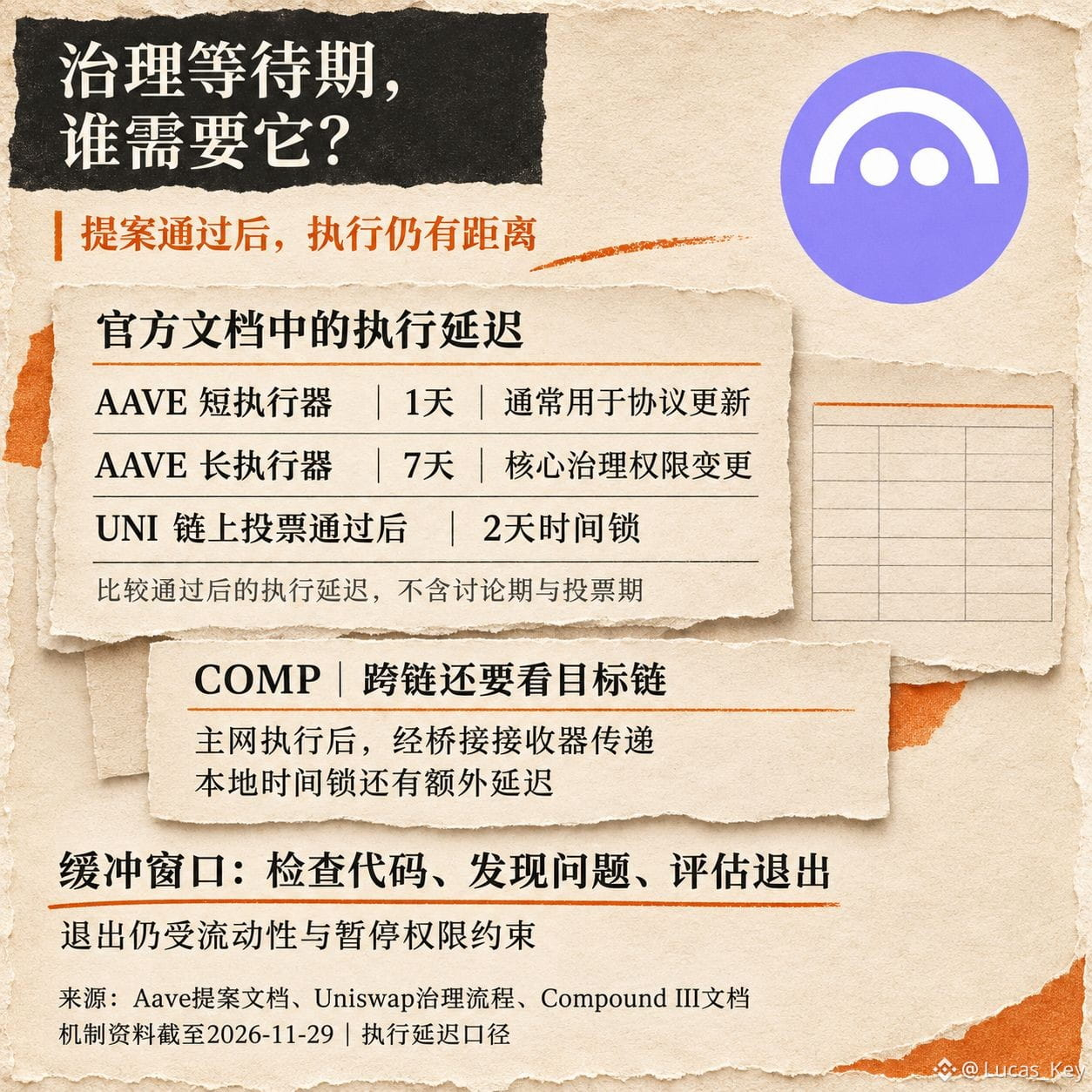
Aave’s official proposal documentation distinguishes between executors: the short executor, typically used for protocol updates, has a 1-day timelock; the long executor, which handles core governance permissions, has a 7-day timelock. $UNI ’s official governance process, meanwhile, retains a 2-day timelock after an on-chain vote passes. This comparison concerns the delay after a proposal passes—not the discussion period or the voting duration—and these figures should not be applied to every special permission.
Those who support shortening the delay aren’t just looking for convenience. Risk parameters may fail to keep pace with the market, and slow responses to vulnerabilities can turn waiting into a source of losses. The opposing side also has solid grounds: a successful vote proves only that the proposal met the vote threshold; it does not prove the proposal’s code is correct. Without a buffer, ordinary users may find themselves subject to the new rules before they’ve even understood the changes.
Compound III, associated with $COMP , highlights another detail: its official documentation says that cross-chain deployments also pass through a bridge receiver and a local timelock, adding further delays. Seeing “executed” on a mainnet proposal is not enough to conclude that the parameters have taken effect on the target chain. This is the last leg that often gets overlooked when comparing governance tokens.
I’m more in favor of designing routine upgrades separately from narrowly scoped emergency permissions. The value of a delay can be assessed by tracking when the proposal payload was made public, how long it spent queued, the execution transaction on the target chain, and whether any issues were found and addressed in the meantime. If nobody is monitoring things and there’s no effective response, simply waiting a few extra days offers little more than a sense of security on the calendar. An exit window also needs real liquidity and must account for the protocol’s pause permissions; you can’t assume that users can always get out.