#日本70万商户接入点要接隐私稳定币 🚀 Midnight signs Netstars as NIGHT bucks the trend, rising 10%
On November 27, the Midnight Foundation signed a memorandum of understanding with two Japanese companies: blockchain firm WEA Japan and payment provider Netstars. The three parties will work together to explore how Japanese merchants can accept stablecoins while keeping their balances and transaction records private. Netstars has around 700,000 merchant locations in Japan, with annual transaction volume of about ¥2.1 trillion, or approximately $13.2 billion. It launched Stablecoin Pay just this July, with a fee of 0.98%. The partnership will tackle five areas: faster payment processing, confidential merchant balances, automated reconciliation, access to compliant yield-bearing assets, and key security. Privacy features are intended not just for Midnight’s own chain, but also for other chains such as Ethereum and Solana. Cardano founder Charles Hoskinson also reposted the news on X to welcome the partnership.
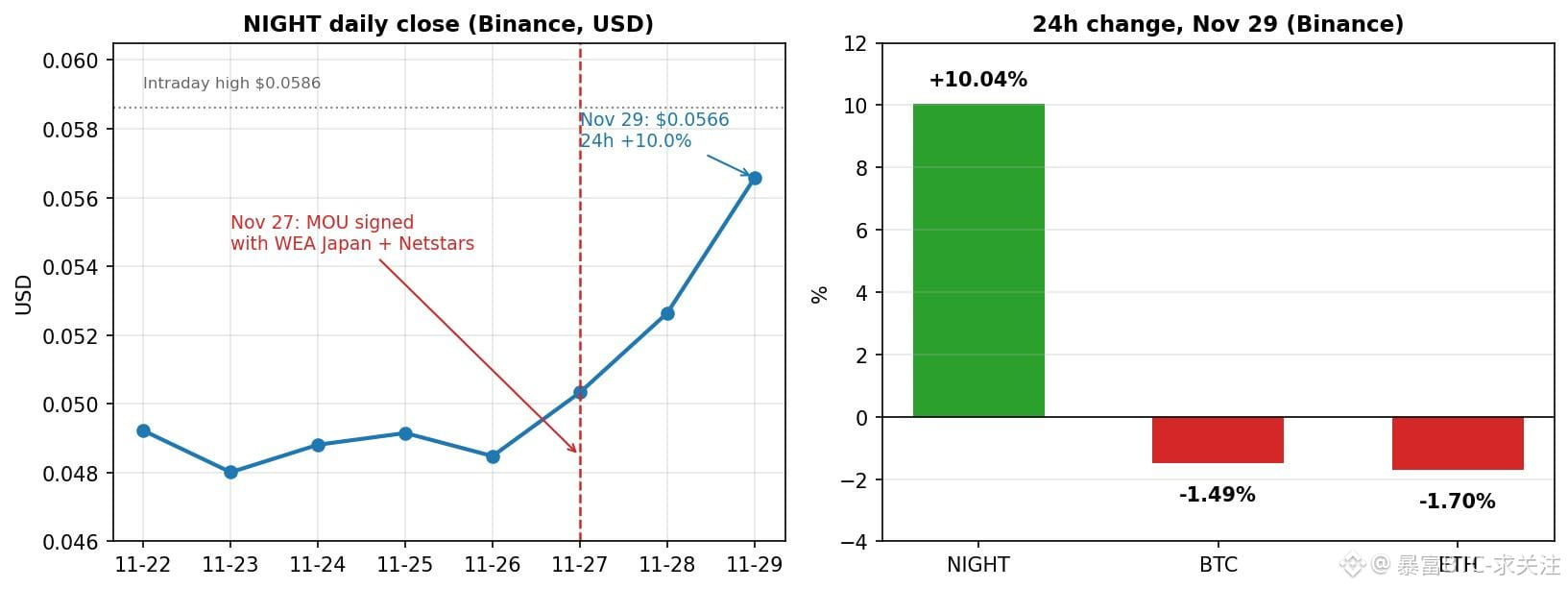
The market responded today. $NIGHT is trading at $0.0566 on Binance, up 10% in 24 hours. It reached an intraday high of $0.0586, with around 202 million tokens traded over 24 hours, worth about $11 million. It has risen nearly 30% over the past week, making it one of this week’s top-performing major coins, according to CoinMarketCap. Meanwhile, Bitcoin fell 1.5% to around $58,700, and Ethereum dropped 1.7% to $1,626. The broader market is down, but NIGHT is moving against the trend. Its market cap is about $930 million, ranking it 90th.
This is not the first time this month that Midnight has connected with a real-world business. In November, British bank Monument launched tokenized deposits on the Midnight chain, with an initial cap of £250 million and a fixed annual yield of 5.2% for 12 months. It is the first bank in the UK to do this on a public blockchain. On November 6, Midnight also completed its Ledger 9 mainnet upgrade, adding inter-contract calls, Keccak-256 hashing, and ECDSA signature verification. Privacy-focused chains are moving from “telling a story” to “winning business”: bank deposits and payments from Japanese merchants are both starting to move on-chain.
Across the sector, privacy coins are splitting into two very different paths. On November 30, KuCoin will delist all spot trading pairs for Monero (XMR), with withdrawals available only until December 31. Meanwhile, in August, Grayscale converted its Zcash trust into the first U.S. spot ZEC ETF, whose assets briefly reached $1 billion in September. Both are privacy coins, but XMR, which is anonymous by default, is being pushed off exchanges, while ZEC and Midnight—with auditable, optional privacy—are securing a compliance passport. The EU’s new anti-money laundering rules take effect on July 10, 2027, leaving exchanges less than eight months to prepare. This divide is only going to become clearer.
I see this in two ways. Over the medium to long term, this is genuine growth: privacy technology has finally found buyers willing to pay for it. Banks want compliant on-chain deposits; merchants want to “reconcile the books without laying them open for everyone to see.” Midnight’s zero-knowledge proofs fit that need. Hoskinson is also scheduled to speak on December 15 about Midnight’s 2026 review, its 2027 roadmap, and a “surprise announcement,” so the story is not over yet. In the short term, don’t chase the rally. The memorandum only says the parties will “work together to explore” the idea—there is no launch date, no participating merchants, and no supported currencies. Not one of Netstars’ 700,000 locations is connected yet. The 7-day RSI is already at 73, in overbought territory. And on December 4, NIGHT’s 360-day unlock period ends; according to the community, the unlocked tokens will then be transferable. An unlock does not necessarily mean a sell-off, but after a 30% rally, it adds another variable on the supply side. A sustained break above today’s high of $0.0586 would open up more room to run; a drop back to $0.051 would put $0.048 in focus.
One reminder: a memorandum is not a contract, much less a launch. Monument’s deposit tokens and NIGHT are not the same type of asset, so don’t count the value of bank deposits directly toward NIGHT’s market cap. The privacy chain is reaching banks and merchants, but whether—and when—merchants actually accept it remains to be seen. We’ll have to wait for the December 15 speech. Banks and merchants are beginning to use privacy chains, but this time, let’s count how many actually go live.