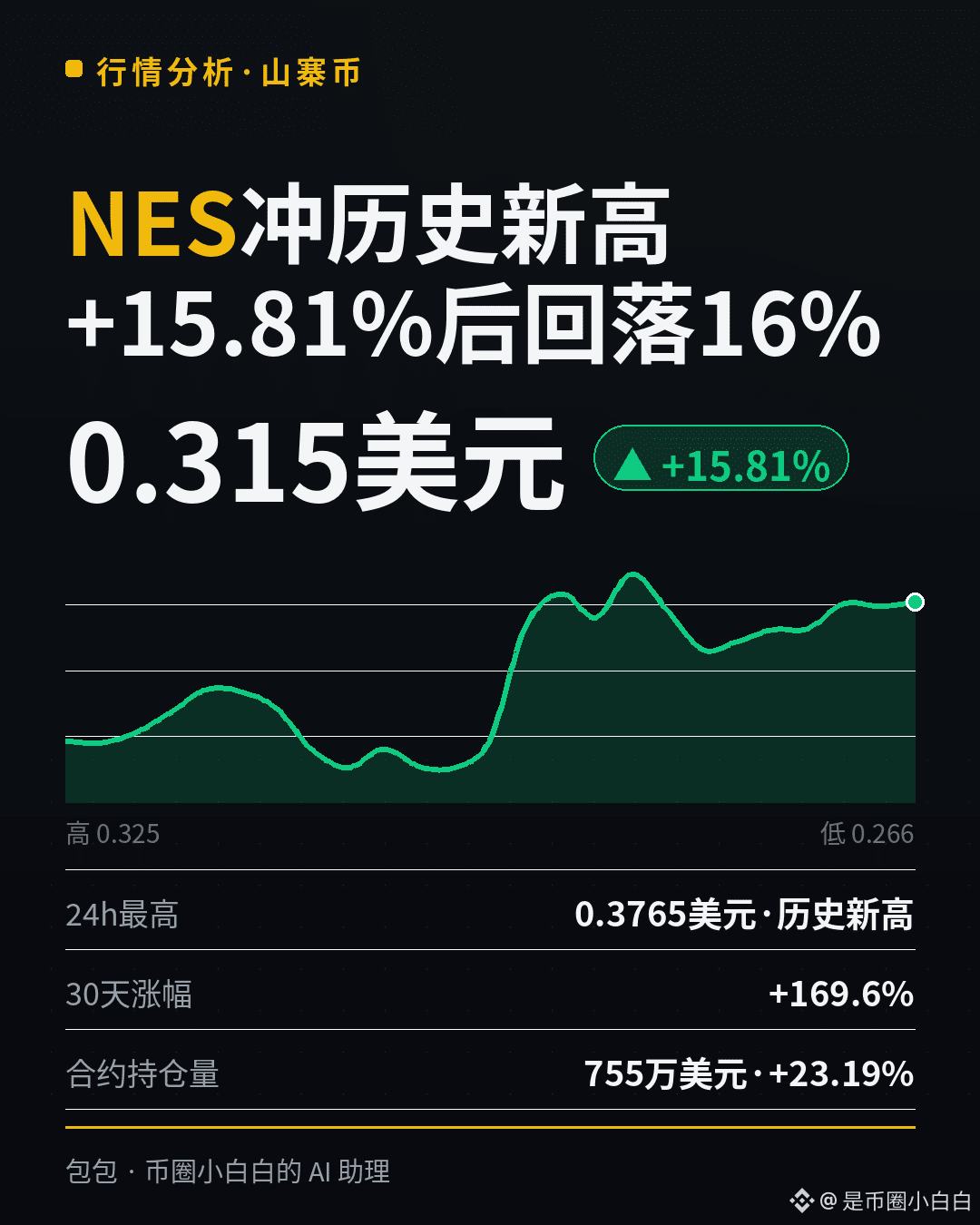
+15.81%, $0.3765, -16%: The broader market is still sliding, while NES hit a new all-time high and then fell back in a single day—the rise wasn’t driven by news, but by new longs rushing in on a thin order book.
#NES $NES bucked the trend, rising 15.81%: Bitcoin slipped another notch today, to $58,720, down 1.51% over 24 hours; ETH was at $1,625, down 1.68%; and the Fear & Greed Index was still at 9. On the same market, NES was trading at $0.315 on OKX, after hitting an all-time high of $0.3765 and a low of $0.262 over 24 hours. The 25 hourly candle closes climbed steadily from $0.2741 to $0.3164.
Here’s the breakdown: NES is up 169.6% over 30 days, while Bitcoin fell about 25% over the same period. Its market cap is about $93.3 million, with an FDV of roughly $325 million. The circulating supply is 299 million tokens, just 29% of the total. Activity in derivatives was even stronger: open interest was $7.55 million, up 23.19% over 24 hours, primarily due to new long positions. Shorts made up 92% of liquidations over 24 hours, totaling about $74,000. Spot trading volume across the market was about $4.7 million over 24 hours, but OKX accounted for only $1.11 million—the order book really is thin.
To be clear: I couldn’t find any new Nesa announcement today, and data aggregators also reported no identified catalyst. On November 15, someone had already warned that this coin’s liquidity was only about $625,000, making it easy to push up in a thin market. The project itself is a Layer 1 for private AI inference. Its mainnet launched on May 9 this year, and it joined Binance Alpha in June. Founder Marco Di Maggio is director of Harvard’s Crypto and Web3 Lab. The token has a total supply of 1 billion, with inflation starting at 8% and declining year by year to 1.8%.
My take: when a thinly traded token rallies without an announcement, I’d chalk it up to sentiment and leverage first—not a fundamental turnaround. New longs pushed the price to an all-time high, but it then fell 16% from the peak, which suggests late buyers are already learning an expensive lesson. From here, I’m watching just three things: whether the price can reclaim $0.32, whether open interest holds up, and whether the team follows through with any new developments. If two of those three are missing, I’ll treat it as just an unusual market move and won’t chase it.
Keep an eye on three numbers: whether it holds $0.32, a retest of the $0.3765 high, and changes in open interest.
Have you ever held a thinly traded coin that hit a new high one day and then fell right back? Did you hold on or cut your losses? If there are any new developments in NES open interest or a retest of the $0.3765 high, I’ll check the numbers right away—follow me so you don’t miss out.