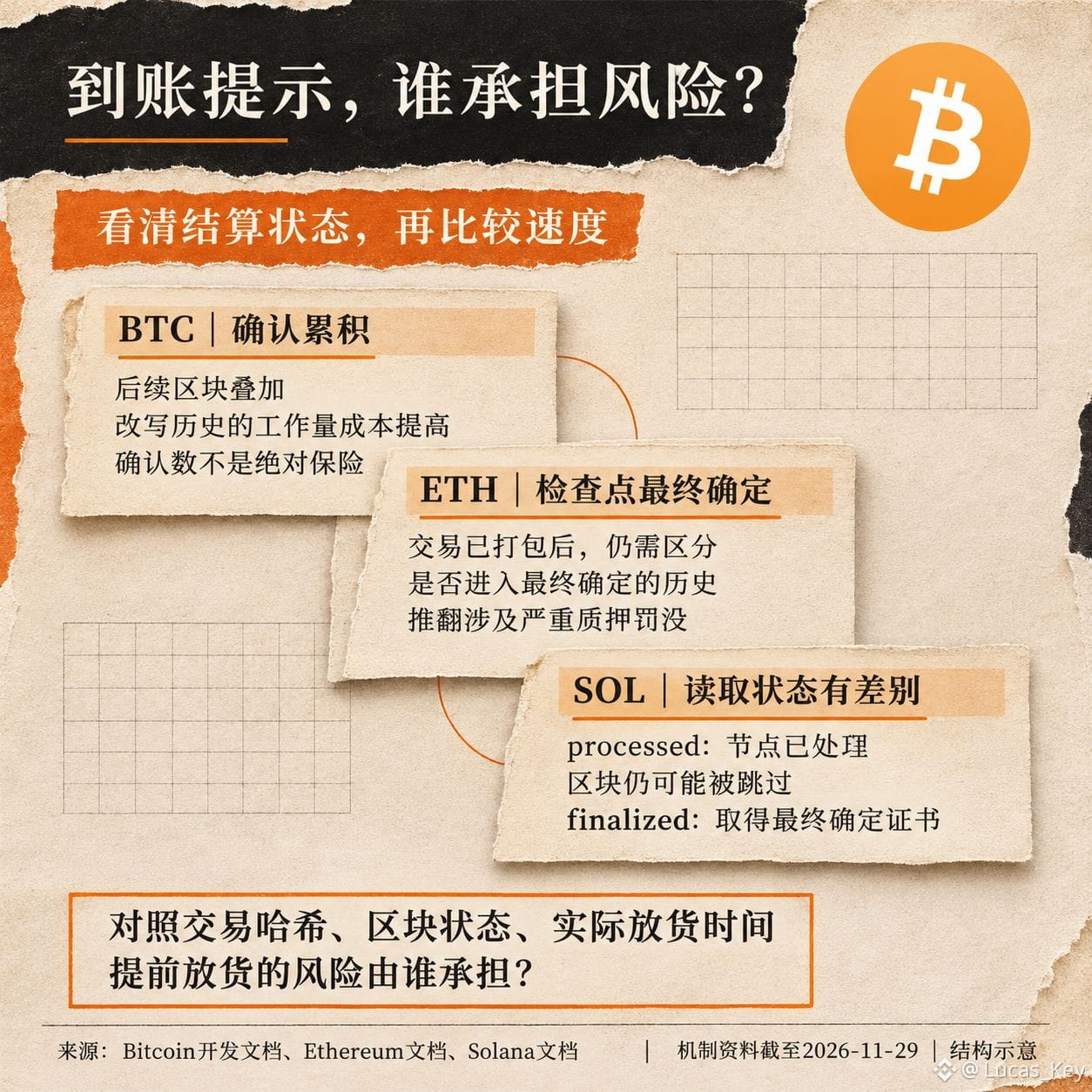
After a pop-up says your $BTC has arrived, is it safe to release the goods? I’d rather ask first: what does “success” actually mean—the wallet has detected the transaction, or the recipient has accepted the settlement risk? When comparing payment experiences across public blockchains, the waiting period is the part most easily hidden.
There’s a good case for instant payments. If every small payment has to wait for the most conservative status, the time and capital tied up can eat into its utility. Merchants can choose to accept limited risk in exchange for a faster, more convenient experience. The problem is that this risk should be disclosed, not quietly shifted to the recipient with a green checkmark.
Bitcoin’s developer documentation explains that as more blocks are added, the computational cost of rewriting an existing transaction increases. Confirmations build up a margin of safety; there is no absolute number that guarantees protection for every amount and every attack scenario.
$ETH uses a different mechanism: after a transaction is included in a block, you still need to distinguish whether it has entered the history of finalized checkpoints. Reversing a finalized block entails severe slashing costs for staked funds. Treating “included in a block” and “finalized” as the same thing makes the speed comparison look better, but changes the basis of comparison.
The official $SOL RPC documentation likewise distinguishes between processed and finalized: a block that a node has just processed may still be skipped. Which status an application chooses to read affects when users see a success message. So you can’t rank the security of three chains based only on which pop-up appears first.
I’m in favor of speed, provided the promise is clear. When evaluating a payment product, compare the transaction hash, block status, and actual time goods are released: if the page reports success first while the backend is still waiting for stronger confirmation, that time should count as risk borne by the merchant. If the service provider is willing to guarantee payment and compensate for failures, that’s an additional credit arrangement and should be priced separately from the chain’s own settlement capabilities.