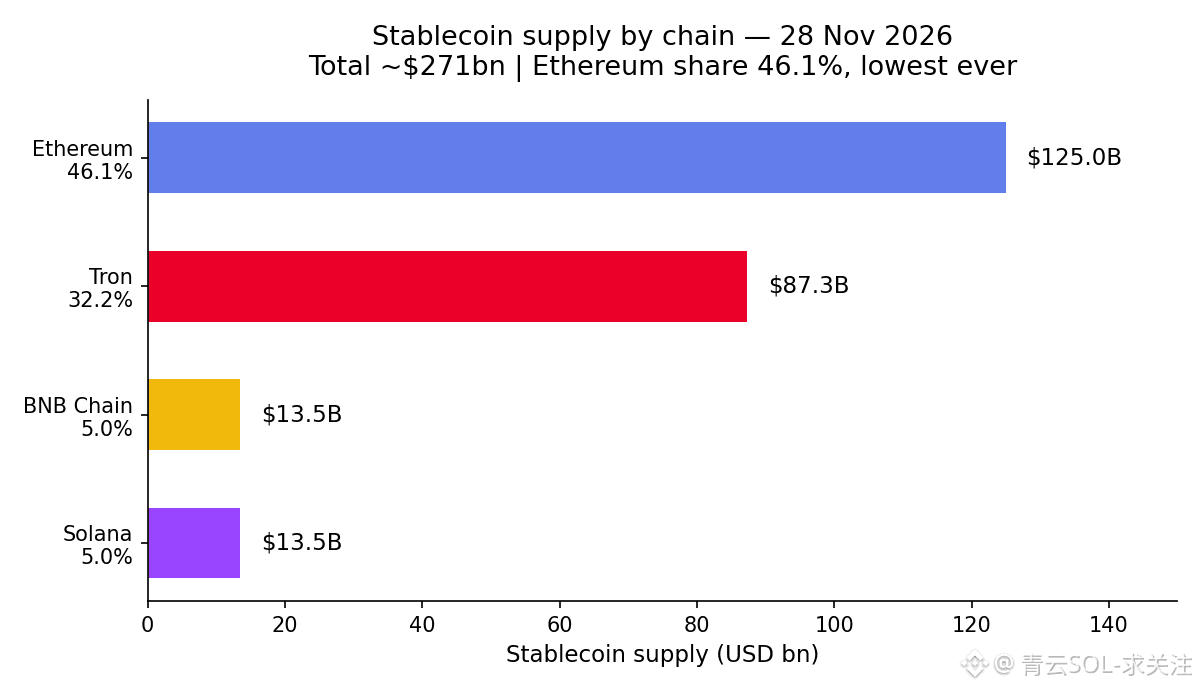
#以太坊稳定币份额创历史新低 🔥 The money is still on Ethereum, but its share has hit an all-time low
On November 28, data from Blockworks Data showed that stablecoins on Ethereum accounted for just 46% of the total market, a record low. The global stablecoin supply is about $271 billion, with roughly $125 billion on Ethereum. Tron came in second with $87.3 billion, or a 32.2% share, while BNB Chain and Solana each had about $13.5 billion.
The share has fallen this far not because there’s less money on Ethereum, but because money on other chains is growing faster. It’s been sliding since 2019, and Tron is steadily chipping away at what was once Ethereum’s stablecoin stronghold.
That same day, Vitalik Buterin threw cold water on the Glamsterdam upgrade on X: concerns that EIP-8037 could break some contracts are valid, and the upgrade shouldn’t be rushed. The cost of creating a new account is set to rise from 25,000 gas to 183,600—more than sevenfold. ChainSecurity’s assessment also makes the risks clear: of 200 issues, 24 require contract changes or migration, affecting bridges, wallets, exchanges, oracles, and staking. The Hoodi testnet fork has already been delayed, and there’s no date yet for mainnet.
$ETH is hovering around $1,645, and the Fear and Greed Index is at 11 today—still in extreme fear.
In my view, there’s not much to look forward to for ETH in the short term. A delayed upgrade, a shrinking share, and rock-bottom sentiment have all collided; if $1,600 doesn’t hold, $1,500 is next. But over the medium to long term, I still stand by one view: Ethereum’s real moat has never been its stablecoin share, but its role as a settlement layer that no one can bypass. A slow upgrade is better than an upgrade that causes problems.
You can win back market share, but broken contracts are what really hurt.