USD1 depegged—but seeing a low price doesn’t mean you can just scoop it up~
The people who made money had their setup ready in advance.
I was traveling again this time, so I missed out—and I hadn’t set aside funds in advance either. All I can do is envy them!
Yesterday afternoon (November 28), a major price gap opened up between USD1 on Gate and Binance.
The lowest trade on Gate was 0.8406, while Binance’s lowest price in the same minute was 0.963.
Subtracting those two lows gives a price gap of about $0.122, or more than 12%.
That cross-exchange price gap lasted only about 10 minutes.
Based on everyone’s analysis, it took around 2 hours for prices across the board to return to around 0.995.
Let’s break down the four strategies that worked at the time:
1/ Arbitrage across exchanges: You need funds ready on both sides in advance. The window was about 10 minutes, so transferring funds on the spot usually wouldn’t be fast enough. If deposits and withdrawals were suspended, your funds could get stuck;
2/ Buy the dip and wait for the peg to return: You need to be able to handle the price falling further, and it could take until after the weekend. Most holders would find it difficult to redeem at $1, and if the strategy failed, you’d be left holding it at a discount;
3/ Institutional redemption: You need to qualify as an eligible client, and it depends on whether the redemption channel is open. Without the required eligibility, you can’t use this route;
4/ Synthetic arbitrage: Go long BTC/USD1 and short BTC/USDT, betting on the price difference between the two quote currencies while also taking on funding costs and slippage.
There’s also an even more hands-off way to prepare: Many pros keep a short position by borrowing USD1. When it depegs, they simply buy it back to repay the loan—it’s a very comfortable setup.
You do have to pay borrowing interest continuously under normal conditions, but U1 has ongoing promotions offering boosted deposit interest.
So it’s worth waiting for a moment like this.
According to Lookonchain data, an institution withdrew about 43.26 million tokens from exchanges within an hour, then redeemed them through BitGo at $1 each.
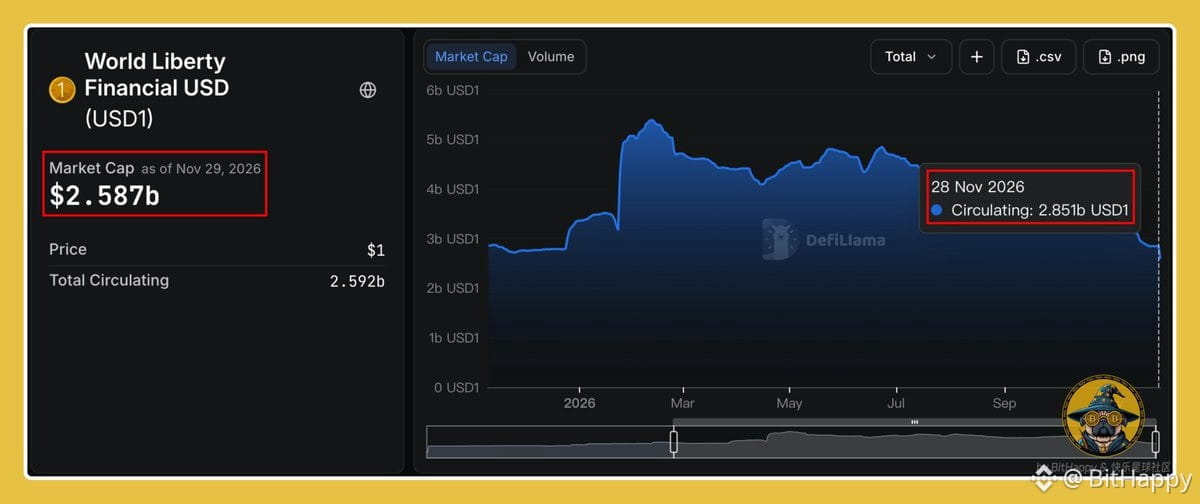
DefiLlama also shows that after the peg returned, the circulating supply fell from about 2.85 billion to around 2.6 billion—a decrease of approximately 250 million.
This opportunity has essentially passed. The only thing you can review and reuse is to have a plan ready before the next depeg.
The above is for informational purposes only and does not constitute investment advice.
BitHappy, evolving continuously