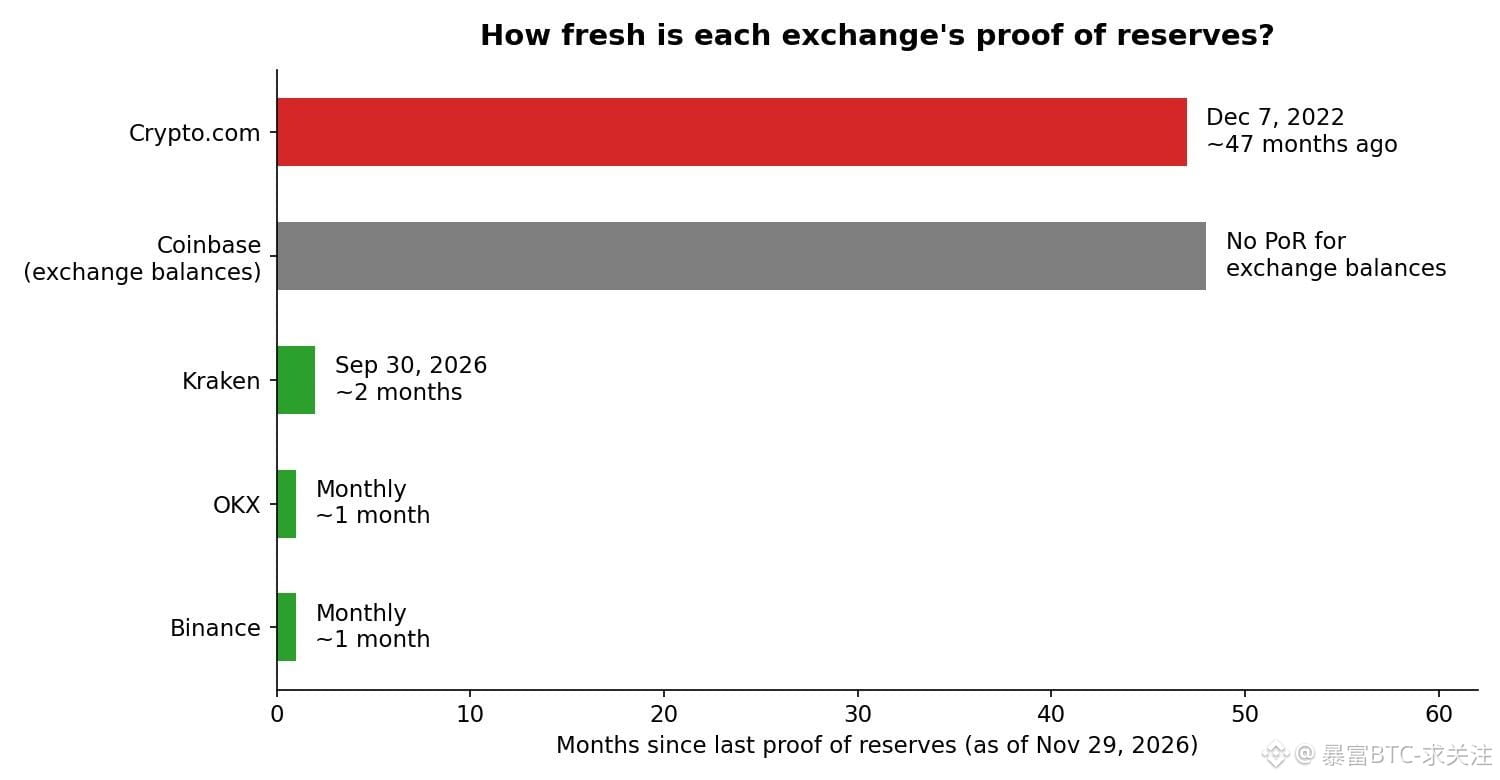
#Crypto.com’s Proof of Reserves Hasn’t Been Updated Since December 2022 🔥 Galaxy Research Head Goes Public With Questions: No Update in Nearly Four Years, Plus Complaints of Frozen Withdrawals
On November 29, Galaxy Head of Research Alex Thorn publicly questioned Crypto.com’s reserve transparency on X: the last time the exchange published a Proof of Reserves (PoR) was December 7, 2022—nearly four years ago. Also resurfacing that day was a user complaint: after successfully testing a withdrawal with $100, a user tried to transfer the remaining bitcoin but had their account frozen. Nearly $15,000 worth of BTC was held back, and the account still hadn’t been unfrozen after the user resubmitted identity verification. Customer support had not resolved the issue either.
The 2022 report itself was clear. A report issued by auditor Mazars on December 9, 2022, showed that as of December 7, Crypto.com’s reserve ratios were 102% for Bitcoin, 101% for Ethereum, and 106% for USDT, with all nine assets above 100%. But the report also spelled out its limits: it covered only nine assets—BTC, ETH, USDC, USDT, XRP, DOGE, SHIB, LINK, and MANA. The platform tokens $CRO and VET were not included. At the time, the company said they would be added later, but there has been no follow-up.
The problem isn’t that report; it’s that the clock stopped. After FTX collapsed in November 2022, Proof of Reserves became an industry standard for exchanges: Binance, OKX, Bybit, KuCoin, and Gate update monthly or periodically, while Kraken’s latest report is dated September 30, 2026. A review by the same organization on November 21 also found that Coinbase has no Proof of Reserves covering exchange customer balances—but Crypto.com is different in that it used to publish one, then stopped for four years. Its website still hosts the 2022 Mazars report, and its wallet addresses are public on Nansen: the assets are visible, but the liabilities aren’t.
This stands out even more against this month’s timeline. On October 29, Binance was hacked for $6.3 billion, the largest incident in crypto history. On November 28, CZ warned at Binance Blockchain Week in Bangkok that 5 to 10 hacks were already being reported across the industry every day, and that this could become a daily occurrence over the next 6 to 12 months. On November 30, U.S. Senator Blumenthal asked four companies, including Binance, Tether, and World Liberty Financial, to begin submitting records needed for a Senate investigation, with voluntary submissions due by January 4, 2027. Exchange treasuries are being put under the spotlight and examined one by one.
Crypto.com is no small platform. Founded in 2016, it holds a Malta MiCA license, is registered with the UK’s FCA, and has a raft of U.S. licenses. Even the arena in Los Angeles bears its name. It also had an incident in January 2022: 483 accounts bypassed two-factor authentication, resulting in about $34 million being stolen. The platform reimbursed users in full. After making those reimbursements, trust should have been renewed through more frequent attestations—not left frozen in 2022.
I see this in two time frames. In the medium to long term, there’s no middle ground on Proof of Reserves: since FTX, regular self-attestation has become a prerequisite for top exchanges. There’s a reason a platform that has gone four years without an update trades at a discount: the platform token $CRO is currently priced at $0.039, down 24% in 30 days and more than 95% from its November 2021 all-time high of $0.89. The market has already voted with its feet. In the short term, don’t rush to conclude that “something has happened”: one analyst’s questions and one withdrawal complaint don’t prove insolvency, and an account freeze could also be a compliance false positive. But the signals to watch next are concrete: will Crypto.com publish a new Proof of Reserves in response, and will similar withdrawal complaints become more frequent? The Senate submission deadline on November 30 is the next catalyst for the broader “exchange transparency” theme.
One reminder: Proof of Reserves is no cure-all. It only proves that assets covered on a particular date matched the liabilities on the books; it can’t reveal off-balance-sheet debt or loans from related parties. Conversely, wallet addresses on Nansen show assets, not liabilities. Real peace of mind comes from regularly updated attestations and the ability to withdraw your coins at any time.
A Proof of Reserves that hasn’t been updated in four years is an answer in itself—the moment an exchange stops updating, trust in it starts to trade at a discount. $CRO $BTC $ETH