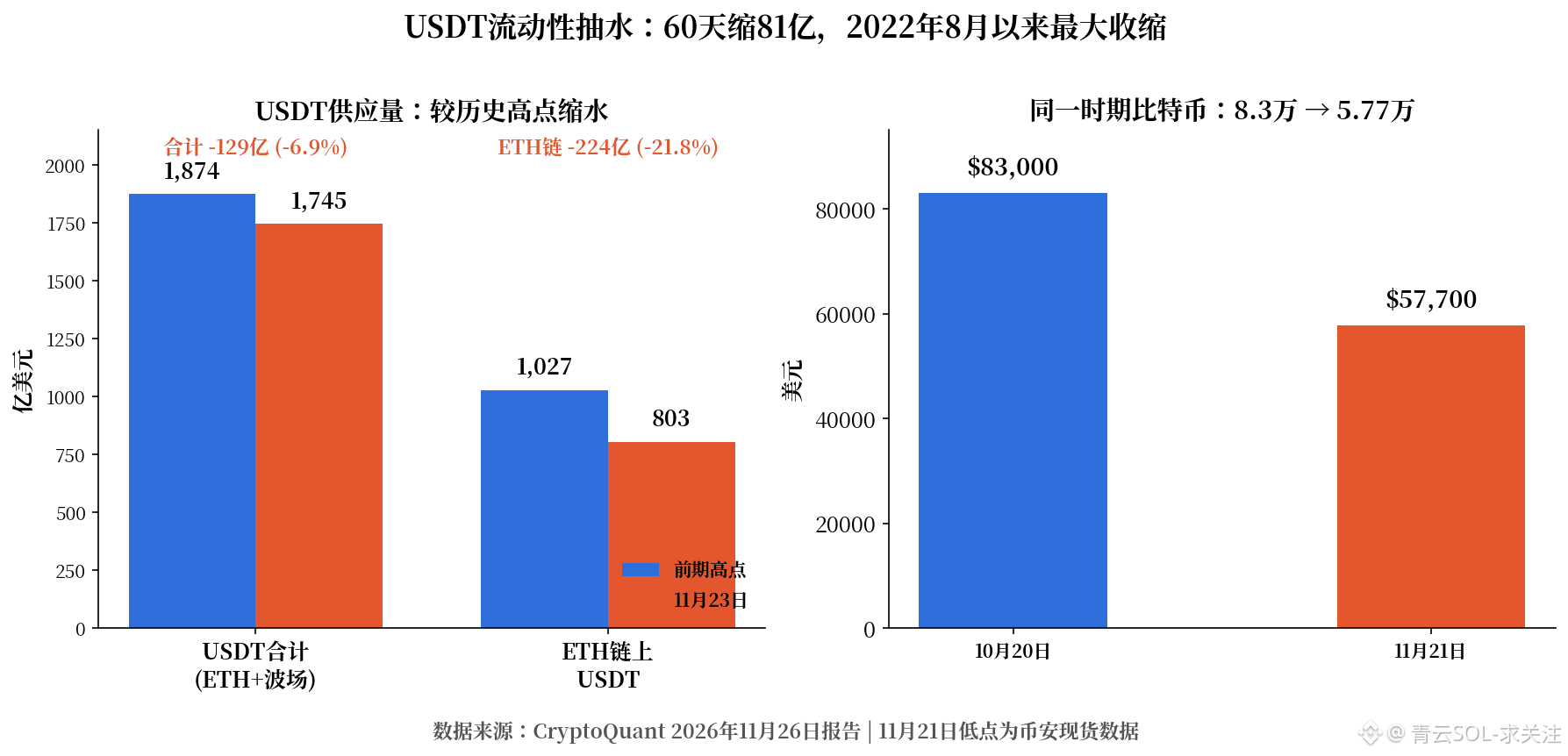
#usdt供应量60天缩水81亿 🔥 Money is flowing out. For a rebound to take hold, the market first needs a fresh injection of liquidity.
A November 26 report from CryptoQuant punctured an illusion: there’s less real money in the market.
USDT on Ethereum and Tron totaled just $174.5 billion on November 23, down $12.9 billion from its May 4 peak. Supply shrank by $8.1 billion over 60 days—the sharpest contraction since August 2022.
Almost all of the decline was on Ethereum: USDT on the ETH network fell from $102.7 billion last November to $80.3 billion, a drop of $22.4 billion and its lowest level since August last year. From October 9 to November 23, holders sent $11.65 billion back to Tether’s treasury and withdrew just $4.19 billion. Tether burned $8 billion in two batches, on November 2 and 20.
Bitfinex alone returned $6.66 billion, and Binance returned $3.71 billion. Together, they accounted for 89% of the total.
During this contraction, $BTC fell from $83,000 on October 20 to $57,700 on November 21. CryptoQuant reviewed the data going back to 2022: when USDT supply contracts, Bitcoin’s average 60-day return is -9.5%, and it falls 73% of the time. When supply expands, the average return is +7.6%. Since 2022, Bitcoin has hit 39 new highs—and not once during a period of USDT contraction.
I think a short-term rebound is possible, but don’t expect it to go far. Bitcoin is now hovering around $59,300, and the Fear and Greed Index is at 11 today, stuck in the extreme-fear zone between 10 and 13 for eight straight days. Watch for three signals of a genuine reversal: 60-day supply changes turning positive, USDT on Ethereum finding a floor, and treasury outflows exceeding inflows.
My medium- to long-term view remains unchanged: talking about a bull market before liquidity returns is empty talk. Once liquidity turns positive, it will eventually have to fill the space left by this downturn.
Without money flowing back in, any rally is borrowed time.