
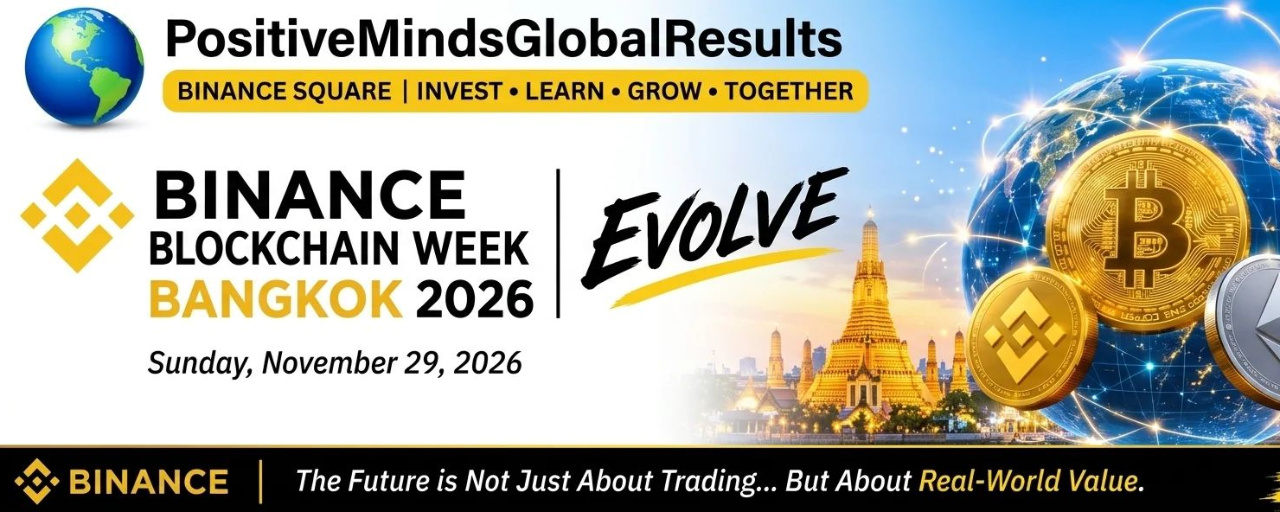

#evolveatbinanceblockchainweek 🌍 #PositiveMindsGlobalResults
BINANCE SQUARE | INVEST • LEARN • GROW • TOGETHER
Sunday, November 29, 2026
The true evolution of crypto will not be measured by how many people speculate on digital assets—but by how many people can benefit from the technology behind them.
BANGKOK SENDS A POWERFUL MESSAGE: CRYPTO IS EVOLVING BEYOND TRADING
Today marks the final day of Binance Blockchain Week 2026 in Bangkok, Thailand, where “EVOLVE” became more than just a theme—it reflected a broader vision of where the digital financial industry may be heading.
Held on November 28–29 at the Queen Sirikit National Convention Center, the event brought together thousands of participants, industry leaders, innovators and businesses to explore a future that extends far beyond cryptocurrency prices, trading strategies and market speculation.
The most important conversation was not simply about what crypto could be worth tomorrow.
It was about what blockchain could become in the real world.
From traditional finance and artificial intelligence to stablecoins, tokenization, cybersecurity and digital infrastructure, the discussions offered a glimpse into an industry attempting to redefine its role in the global economy.
And perhaps the biggest message from Bangkok is this: the next chapter of crypto may be built around utility, trust and adoption—not speculation alone.
1. TRADITIONAL FINANCE IS MOVING CLOSER TO BLOCKCHAIN
The boundaries between traditional finance and digital assets are becoming increasingly blurred.
Discussions involving major financial institutions, asset managers, exchanges and banking players highlighted growing interest in tokenized equities, real-world assets and more efficient settlement systems.
The financial industry is exploring a future where assets could be transferred, managed and settled through blockchain infrastructure, potentially making markets faster, more accessible and more efficient.
The possibility of financial markets operating beyond conventional trading hours could also reshape how investors interact with global assets.
However, innovation should never be confused with guaranteed benefits. Tokenization does not automatically provide legal ownership, liquidity or investor protection. The underlying structure, regulatory framework and rights attached to each asset will ultimately determine its real value.
The opportunity is significant—but so is the need for clarity.
2. AI COULD CHANGE HOW PEOPLE INTERACT WITH CRYPTO
Artificial intelligence is rapidly becoming one of the most influential forces shaping the digital economy, and its connection with blockchain could open an entirely new chapter.
AI-powered agents are being developed to monitor portfolios, analyses on-chain activity, identify risks and potentially execute transactions based on user instructions.
Imagine being able to explain your financial objectives in simple language while an intelligent assistant helps navigate complex blockchain systems.
That could remove some of the technical barriers preventing ordinary people from entering digital finance.
But as AI becomes more involved in financial decisions, a new set of questions emerges:
Who takes responsibility when an AI agent makes a costly mistake? How can users protect themselves against malicious instructions, manipulation or unauthorized transactions? And how easily can access and permissions be revoked?
The future of AI-driven finance will depend not only on how intelligent these systems become, but also on how safely and responsibly they are designed.
3. STABLECOINS ARE MOVING BEYOND THE CRYPTO MARKET
Stablecoins are increasingly becoming part of a broader conversation about global payments, financial settlements and cross-border transactions.
Discussions involving payment companies, stablecoin issuers, financial institutions and policymakers highlighted the potential for blockchain-based payment systems to reduce friction in moving money across borders.
For freelancers, international businesses, online merchants and families sending money overseas, faster and potentially more affordable transfers could offer meaningful advantages.
Yet speed alone is not enough. Reliability, transparency, regulatory compliance, reserves and consumer protection will be essential for stablecoins to earn lasting public trust.
Meanwhile, Binance's plans involving Bhutan's Gelephu Mindfulness City reflect the growing interest in establishing regional digital-asset hubs, while Thailand's evolving regulatory landscape illustrates how governments are attempting to balance innovation with financial oversight.
The message is becoming increasingly clear:
The future of digital payments will not be determined by technology alone. Trust, regulation and accessibility will matter just as much.
4. SECURITY COULD BECOME CRYPTO'S MOST IMPORTANT COMPETITIVE ADVANTAGE
Innovation can attract users. Trust is what keeps them.
Cybersecurity and industry-wide cooperation were among the most important discussions surrounding the event, particularly following recent security challenges and sophisticated social-engineering attacks.
Binance leadership highlighted the importance of strengthening internal security, responding quickly to threats and improving cooperation across the digital-asset industry.
The broader lesson is one every crypto platform should take seriously.
As institutional participation increases and more capital enters digital markets, security can no longer be treated as a secondary responsibility. Exchanges, blockchain developers, stablecoin issuers, institutional investors and regulators must work together to strengthen the ecosystem.
Proof of reserves, independent security assessments, transparent communication and effective incident-response systems will increasingly influence whether users are willing to trust a platform with their money.
In a world where cyber threats are becoming more sophisticated, the strongest platform may not be the one that moves fastest, but the one that protects its users most effectively.
5. THE NEXT BIG OPPORTUNITIES MAY NOT COME FROM TOKENS ALONE
Beyond Bitcoin, Ethereum, BNB and other established digital assets, the industry is increasingly exploring opportunities in decentralized infrastructure, AI, biotechnology, digital ownership and blockchain applications designed to solve real-world problems.
Discussions involving ecosystem builders, investment groups and technology companies reinforced the importance of supporting projects that deliver genuine value rather than relying entirely on hype.
Blockchain could eventually play a meaningful role in transparent aid distribution, digital identity, asset management, financial accessibility and more efficient business operations.
But there is an important distinction investor should remember:
A promising technology does not automatically make every project built around it a promising investment.
Long-term success will depend on adoption, sustainable business models, responsible development, strong security and the ability to solve problems that genuinely matter.
The next generation of successful projects may be those that people use every day without even thinking about the blockchain behind them.
THE BIGGER PICTURE: A NEW FINANCIAL ECOSYSTEM IS TAKING SHAPE
Perhaps the most important takeaway from Bangkok is that the next phase of cryptocurrency may not be defined by another bull market, a new token or a sudden surge in prices.
It could instead be defined by how successfully blockchain connects with traditional finance, artificial intelligence, global payments, businesses and everyday economic activity.
Asia is becoming an increasingly important part of this transformation, as countries and financial hubs compete to attract investment, technology, talent and digital infrastructure.
However, the road ahead is far from guaranteed.
Regulatory differences, cybersecurity threats, liquidity challenges, technological limitations and consumer protection concerns could all influence how quickly these ambitions become reality.
The industry has made progress, but the real test will be whether it can turn bold ideas into dependable services that people and businesses can genuinely trust.
FINAL THOUGHTS
Binance Blockchain Week 2026 delivered a message worth paying attention to: digital finance is evolving beyond its original identity as an alternative investment market.
The industry is moving toward a much broader vision—one that could bring together blockchain, traditional financial institutions, AI, global payments and real-world applications within a more connected financial ecosystem.
The biggest winners of this transformation may not necessarily be the projects generating the loudest headlines today.
They could be the builders creating secure infrastructure, the innovators solving real problems, and the companies earning public trust through transparency, responsibility and long-term value.
The future of Web3 will require more than technological breakthroughs. It will require discipline, accountability, accessibility and a commitment to putting users first.
Because the true evolution of crypto will not be measured by how many people speculate on digital assets—but by how many people can benefit from the technology behind them.
🌍 PositiveMindsGlobalResults
INVEST • LEARN • GROW • TOGETHER
Market Risk Disclaimer: This article is for informational and educational purposes only and does not constitute financial or investment advice. Digital assets, tokenized securities and AI-driven financial products involve risks, including volatility, regulatory uncertainty, liquidity limitations, cybersecurity threats and potential loss of capital. Always conduct your own research and assess your risk tolerance before making financial decisions.
#CryptoEvolution #Blockchain #Web3 #AI #Tokenization #DigitalFinance #BinanceBlockchainWeek #EvolveAtBinanceBlockchainWeek #PositiveMindsGlobalResults #InvestLearnGrow
