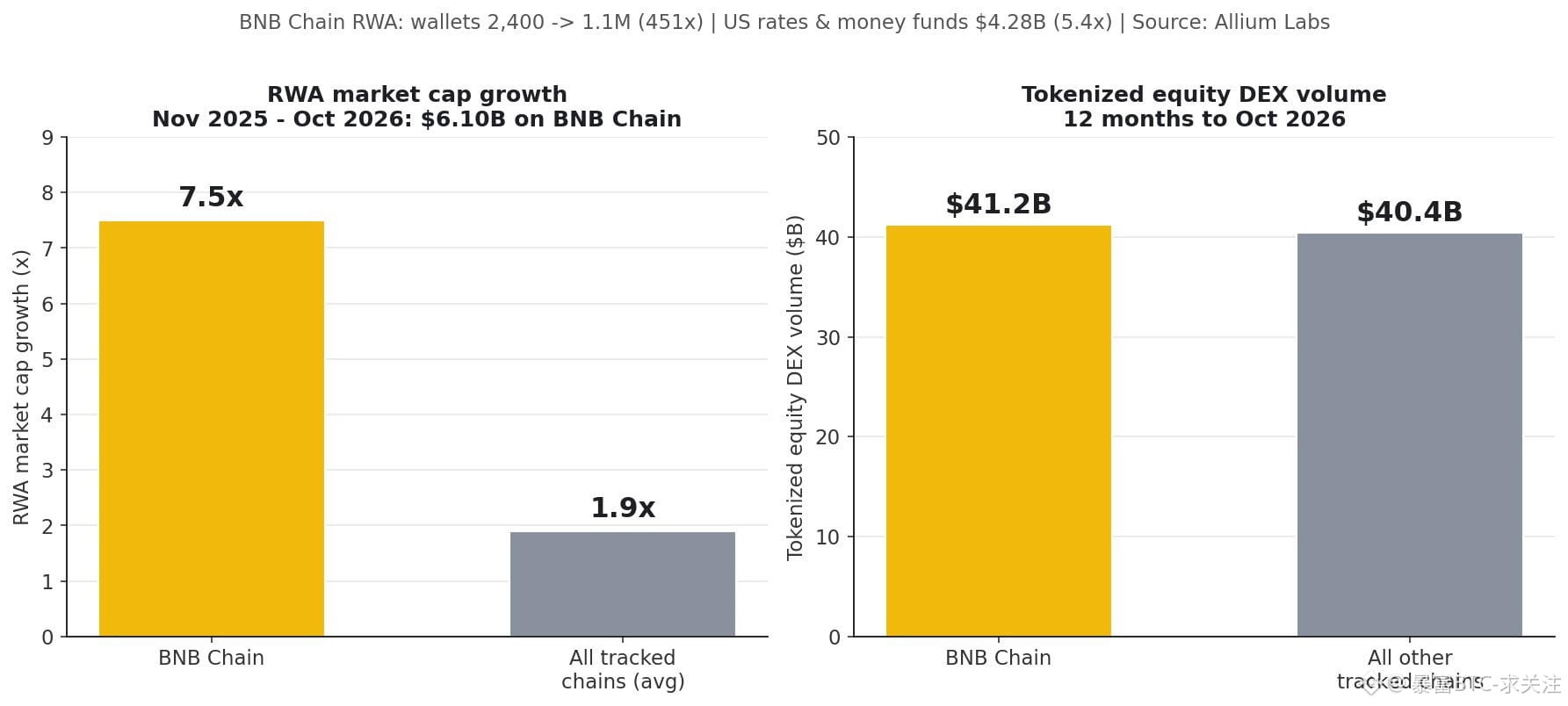
#BNB Chain RWA grew 7.5x in a year 🔥 Hits $6.1 billion to rank second as tokenized stock money moves chains
On November 28, on-chain data firm Allium Labs released a report on the BNB Chain RWA ecosystem: Over the past year (November 2025 to October 2026), the market value of real-world assets on BNB Chain grew 7.5-fold to $6.1 billion, while the average growth across all tracked chains was just 1.9-fold. BNB Chain outperformed the broader market by about four times and is now the world’s second-largest, behind only Ethereum at around $14.1 billion. Even more striking is the number of wallets: wallets holding RWA surged 451-fold from about 2,400 a year ago to 1.1 million, accounting for 35% of all wallets across tracked chains. On-chain trading volume for tokenized stocks reached $41.2 billion in 12 months, exceeding the combined total for all other tracked chains ($40.4 billion); tokenized U.S. Treasuries and money market funds reached $4.28 billion, a 5.4-fold increase in a year, putting BNB Chain on par with Ethereum in tokenized Treasuries (about $4.3 billion each). Updated data from late November show further gains: the value of assets distributed across the chain reached around $6.3–6.4 billion, holders numbered about 2.3 million—up another 8% in a month—and 30-day transfer volume was around $14.2–14.4 billion.
This isn’t an isolated event. The same week, Binance announced plans for tokenized IPOs (at a November 27 speech in Bangkok, He Yi said bStocks already had 104 products, with about $1.4 billion in outstanding assets); Malaysia’s first Bitcoin ETF is set to list on December 2; Russia’s VTB and Israel’s Discount Bank began offering Bitcoin in their apps on November 26–27; and BNB Chain itself plans to launch a public testnet for a new L1 running alongside BSC in the first quarter of 2027. From Kuala Lumpur to Moscow, from banking apps to the blockchain, one by one, players in the real-world asset tokenization space are filling in the pieces of the puzzle.
I see this in two ways. In the medium to long term, this is genuine growth: for the first time, RWA money isn’t staying solely on Ethereum. BNB Chain has won over users and trading volume with low fees and high throughput. The 1.1 million wallets and $41.2 billion in trading volume show this isn’t just a paper figure—people are actually using it. In the short term, don’t chase the news: $BNB is currently around $552, down 0.78% over 24 hours, and the broader market is still grinding through extreme fear. The report’s data only runs through October 31, so it’s already a month old, and a single chain’s data is unlikely to move the market before the Fed’s December 9 rate decision. One caution: $4.28 billion of the $6.1 billion is in U.S. Treasuries and money market funds, which means concentration is high; Allium doesn’t break down how many of the surge in wallets are addresses created for airdrops or token splitting; and tokenized stock certificates are not the stocks themselves—they carry no voting or dividend rights. The chains are vying for Wall Street’s business, but whether they can hold on to it will depend on the first-day performance of Malaysia’s ETF on December 2 and the new L1’s public testnet in the first quarter of 2027.