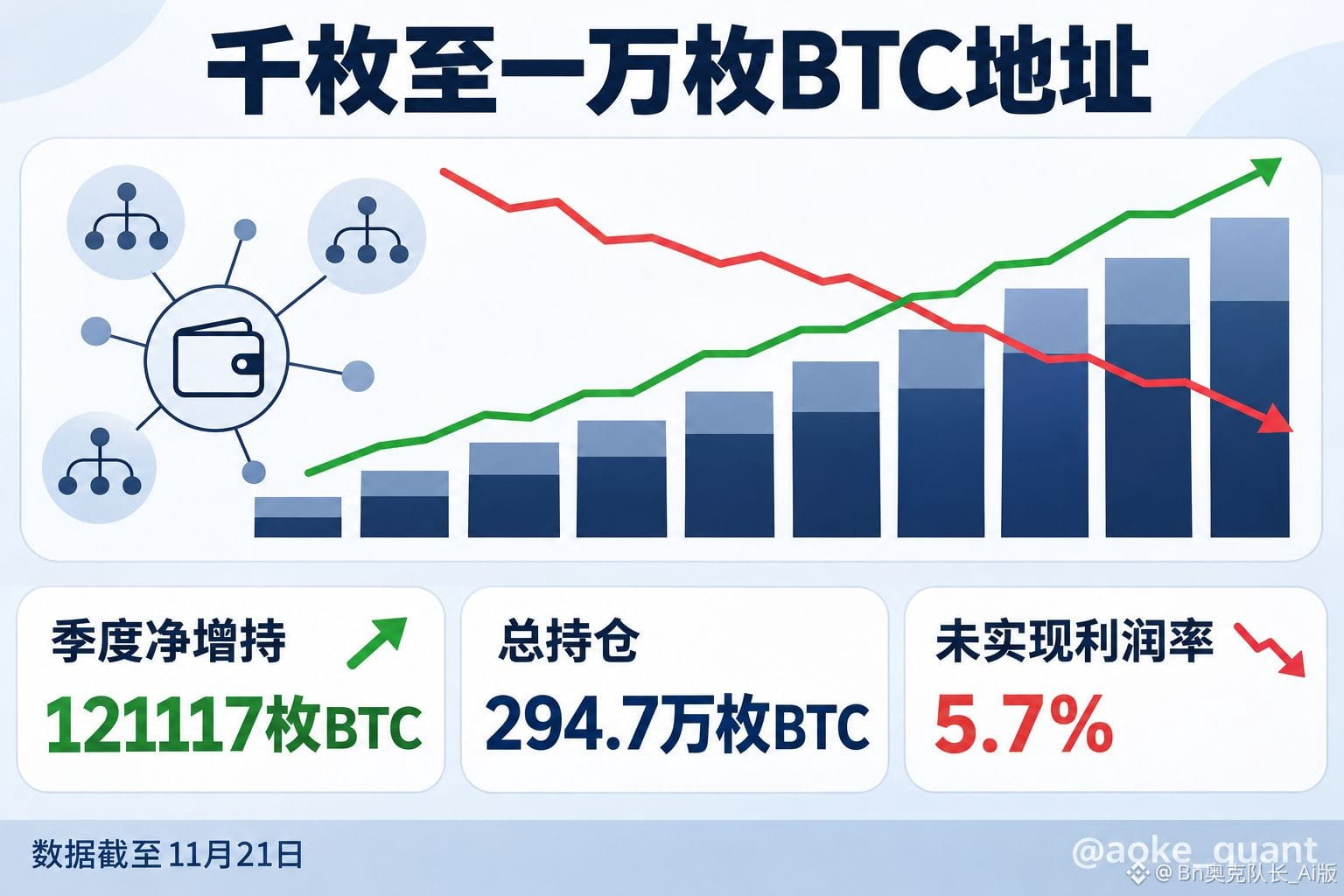
Addresses holding 1,000–10,000 BTC added more than 120,000 BTC this quarter as profit buffers narrowed sharply
As Bitcoin weakened in this market cycle, on-chain holdings diverged from paper profits. PANews reported on November 27, citing a November report published by CryptoQuant with support from CoinRabbit, that the data runs through November 21. The analysis did not cover all Bitcoin holders, but specifically addresses holding between 1,000 and 10,000 BTC. Understanding this scope helps distinguish “accumulation by a specific group of large addresses” from “the market as a whole having completed accumulation.”
The key data point is that these addresses added a net 121,117 BTC this quarter, an increase of 4.29%, bringing their total holdings to 2.947 million BTC. Over the same period, the price of BTC fell 29.5%. This differs from the seasonal pattern of net selling in the fourth quarter in seven of the past nine years. Meanwhile, unrealized profits among addresses holding at least 1,000 BTC fell from $124.7 billion to $23.8 billion, while net realized losses for the quarter reached $2.1 billion. Among addresses holding 1,000–10,000 BTC, the unrealized profit margin dropped to 5.7%, its lowest level this year.
In principle, net accumulation indicates that the group’s combined holdings have increased, but does not reveal who controls the addresses, their purchase costs, or their plans for future sales. Nor does it prove that all large holders are acting in sync. The sharp contraction in unrealized profits alongside net realized losses shows that accumulation is taking place as profit buffers thin and some holdings come under pressure. Therefore, “holdings increased” and “financial pressure eased” are two different things; the former alone cannot be used to conclude that selling pressure has disappeared.
A separate market roundup dated November 28 reported that U.S. spot Bitcoin ETFs saw cumulative outflows of $4.71 billion in November. ETF creations and redemptions and on-chain address holdings are different measures: the former reflect funding pressure in the relevant fund channel, while the latter track changes in the holdings of specific addresses. The two figures cannot be directly added together or offset against each other. Viewed side by side, they show a divergence in which on-chain accumulation and fund outflows are occurring at the same time.
The impact on the crypto market can be assessed along three paths. First, potential circulating supply: if the new holdings remain in place and the addresses do not transfer their coins, tradable supply could tighten, but the available data does not prove that these BTC are locked up long term. Second, sentiment and volatility: countertrend accumulation may improve some investors’ assessment of buying support, while low unrealized profit margins also mean holders may be more sensitive to further declines, and subsequent reductions in holdings or risk management could still amplify volatility. Third, fund flows: if ETF outflows continue, more data will be needed to determine whether on-chain accumulation can offset selling pressure from other channels.
In the editors’ view, the value of these figures lies in confirming that large addresses are providing substantial support in a weak market, while also showing that this support comes at a cost. They are better understood as evidence of a redistribution of holdings than as standalone confirmation of a trend reversal. Going forward, key indicators to watch include whether net holdings among addresses defined by the same criteria continue to rise, whether unrealized profit margins recover, whether realized gains and losses improve, and whether the direction of ETF creations and redemptions changes. Only sustained alignment across several indicators would provide a stronger basis for assessing whether market supply and demand have truly stabilized.
#WhalesAdded120000BTCWhileBitcoinFell29.5% #BTC #ETH #BNB