Alibaba is about to spin off its chip company and list it, and people online are calculating who’ll get rich. They’re focusing on the wrong thing.
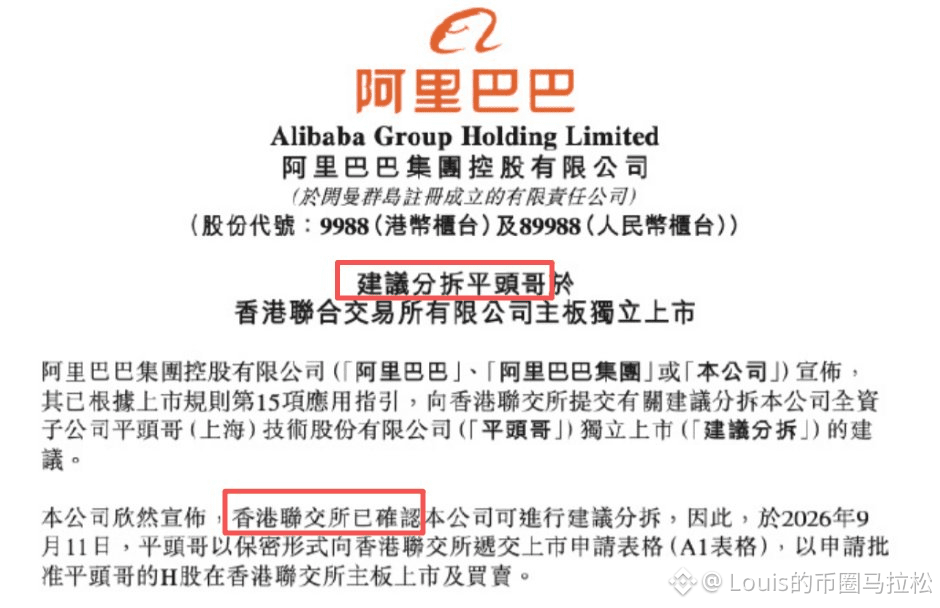
Let’s get the facts straight first. On November 10, Alibaba announced plans to spin off its wholly owned subsidiary, T-Head (Shanghai) Technology, for an independent listing on the main board of the Hong Kong Stock Exchange. T-Head submitted a confidential A1 filing on September 11, and the HKEX confirmed that the spin-off could proceed. After the spin-off, it will remain an Alibaba subsidiary, and it still needs approval from the Listing Committee and filing with the China Securities Regulatory Commission.
Founded in 2018, T-Head is a semiconductor platform whose product lines include the XuanTie RISC-V processor, the Yitian server CPU, and the Zhenwu AI chip. XuanTie chips have been licensed and shipped in a cumulative total of more than 3 billion units, while Zhenwu has served more than 650 enterprise customers.
On November 26, the founder appeared at T-Head’s offices. The timing is clear: the eve of the push to establish an independent valuation.
As for those equity incentive figures circulating online, there’s no public disclosure to back them up. Treat them as jokes.
What really matters is why Alibaba is spinning it off now. The earnings report gives us the answer:
Capital expenditure this quarter was RMB 50.477 billion, up 60% year over year; free cash flow was a net outflow of RMB 34.472 billion; AI cloud and computing revenue was RMB 60.973 billion, up 53%.
Revenue is accelerating, while cash is flowing out. The group is struggling to shoulder this capital-intensive strategy on its own, and needs a second financing channel. The spin-off is primarily a financing move, not a move to hand out money.
The second reason is to change the valuation benchmark. T-Head was previously buried inside Alibaba Cloud, and the market treated it as a cost center, valuing it using a blended multiple for e-commerce and cloud. Once spun off, it can be valued as a semiconductor company—two completely different ways of doing the math.
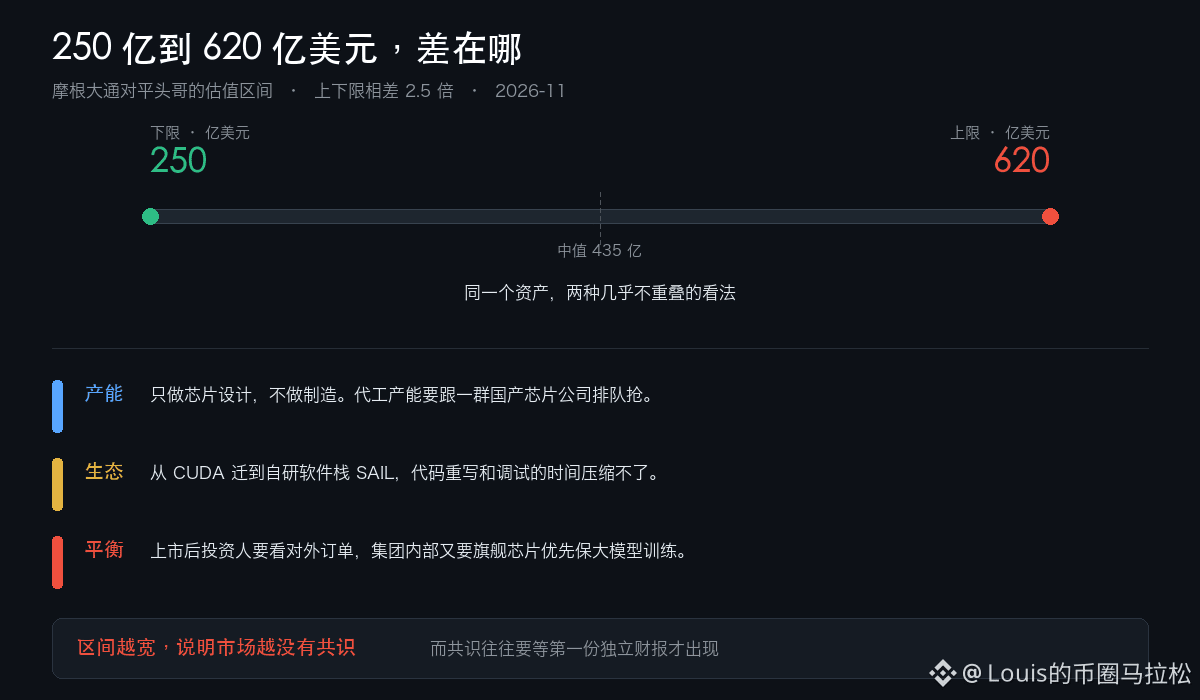
But the market itself hasn’t made up its mind either. JPMorgan’s valuation range is $25 billion to $62 billion, with the high end 2.5 times the low end. The disagreement comes down to three things: T-Head designs chips but doesn’t manufacture them, so foundry capacity must be fought over; migrating from CUDA to its proprietary software stack, SAIL, requires code rewrites and debugging that can’t be rushed; and after listing, investors will want to see external orders, while the group will want its flagship chips prioritized for training large models.
One more thing: this is bigger than many people think.
Compare it with the batch of US-listed mining companies pivoting to AI and it becomes clear: on one side, a chip division is being spun off and listed independently; on the other, mining facilities are being converted into AI data centers, with long-term contracts to rent out computing capacity. The moves are opposite, but the logic is the same—computing power is shifting from an internal cost item for corporate groups to an asset that capital markets can value on its own.
Computing power used to be a line item for depreciation in the financial statements. Now it wants to become a price.
What I care more about is this: when the first standalone earnings report comes out, will the market narrow that $25 billion-to-$62 billion range?
$BTC $BNB