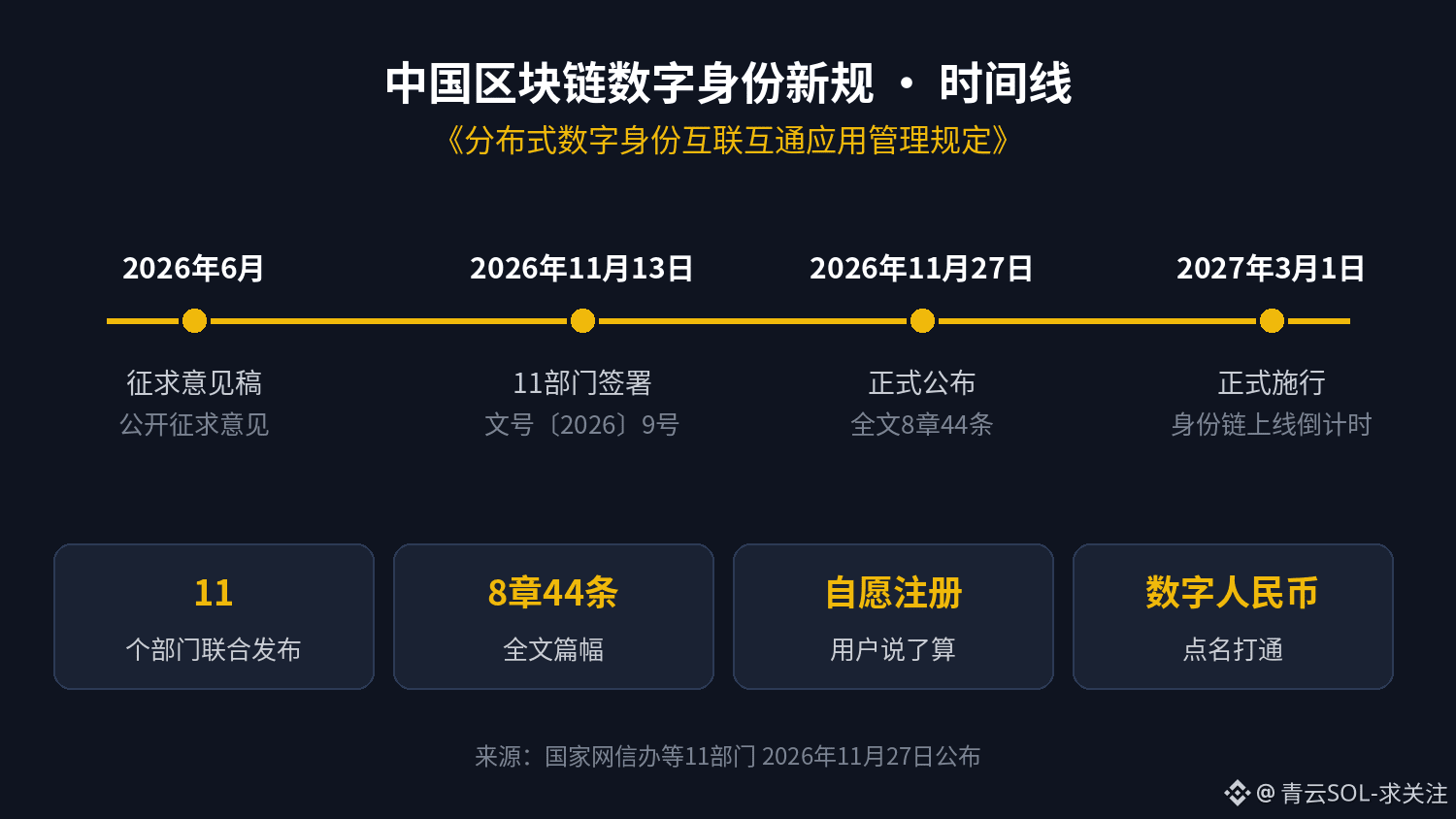
#中国区块链数字身份新规 🔥 11 government departments join forces to make it official: blockchain is written into national identity infrastructure for the first time
On November 27, the Cyberspace Administration of China, together with 10 other departments, officially released the Provisions on the Administration of Distributed Digital Identity Interconnection and Application. They will take effect on March 1, 2027, and consist of 8 chapters and 44 articles.
This is no ordinary industry document. Registration is entirely voluntary; users decide for themselves when to use their identity and when to stop. Operators are prohibited from using authentication data to build user profiles. Identities will run on an “identity chain,” underpinned by the national blockchain network, and operators must be authorized by the Cyberspace Administration of China. Individuals, businesses, and organizations—as well as devices and physical objects—can all be put on the chain. There will even be dedicated overseas versions for residents of Hong Kong, Macao, and Taiwan, as well as foreign nationals. The document also specifically calls for integration with the digital yuan.
The significance becomes clear when you compare this with the past: over the last few years, blockchain in China has mostly been limited to pilot projects and small-scale consortium chains. This time, 11 ministries and commissions have signed on together, including the People’s Bank of China and the Ministry of Public Security. In effect, blockchain has been formally incorporated into the country’s national identity infrastructure.
But the market is still moving in the opposite direction: $BTC is hovering around $60,000, the Fear and Greed Index is just 10, and money is still flowing out of ETFs.
In my view, this news won’t move the market in the short term, so don’t expect it to rescue prices. Over the medium to long term, though, this is the real deal—once a national-level on-chain identity system is up and running, narratives around verified identities, the digital yuan, and RWA will finally have somewhere concrete to take root. My view is that before March 1, 2027, we’ll see a batch of pilot program participants and operators announced. That’s the catalyst worth watching. If nothing has been implemented by then, this positive news will be moot.
Coin prices fall on sentiment; infrastructure is built to last a decade. Those desperate to turn things around watch the price. Those who stick around watch the road ahead.