#68亿美元期权到期日 🔥 The biggest pain point is $70,000, $10,000 above the current price, and the volatility curve has inverted
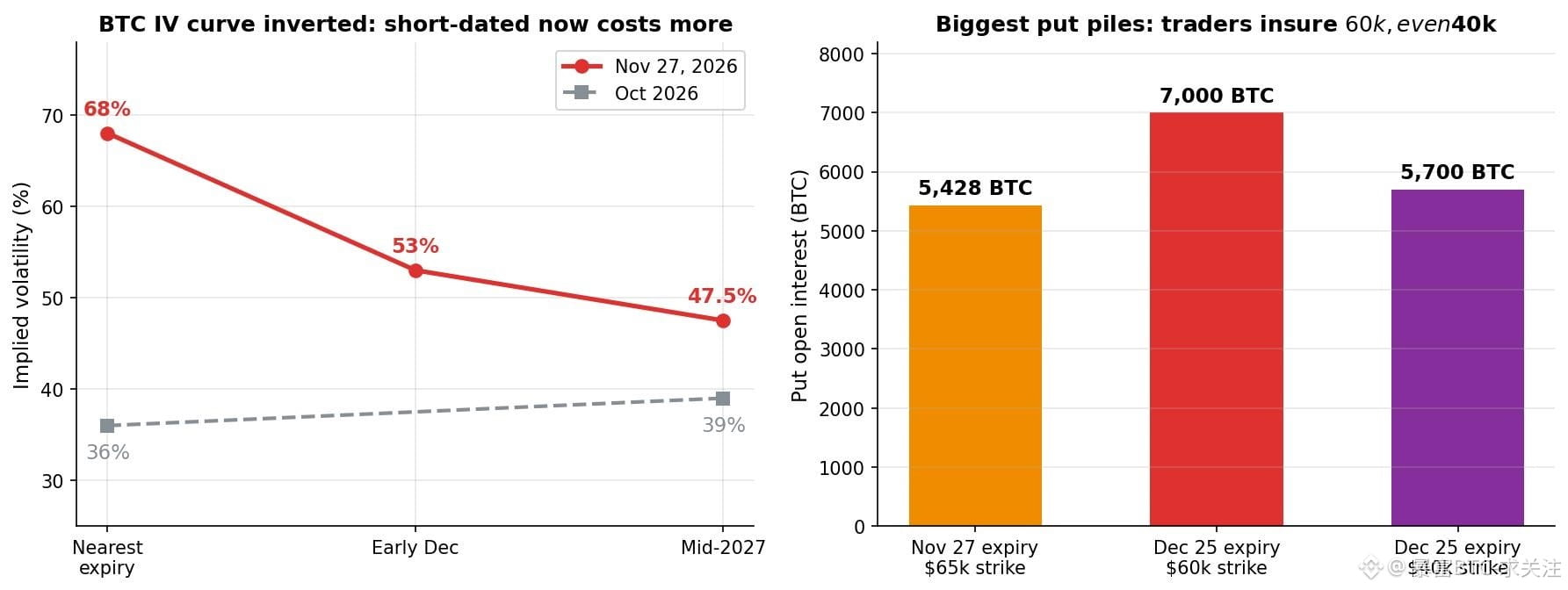
At 8 a.m. Eastern Time on Friday, November 27, about $6.8 billion in Bitcoin options on Deribit will expire and settle. Around 110,000 BTC—one quarter of all Bitcoin options open interest on Deribit—are involved, making this the largest options settlement before year-end. The settlement price is hovering near $60,900, while the “max pain” price for these contracts—the level at which options buyers as a whole would lose the most—is $70,000, more than $10,000 higher. At the October expiry, the settlement price was less than $2,000 away from max pain. This time, the gap has grown fivefold. Put options are in the lead: the put/call ratio for this expiry is between 0.79 and 0.94, depending on the data source, but all figures are far above October’s 0.55. The strike price with the most concentrated open interest is $65,000, with 5,428 BTC in put options worth about $328 million.
What’s more telling is what happens after expiry. The options market’s volatility curve has inverted: implied volatility for the nearest-expiring options has surged to around 68%, compared with about 53% in early December and just 47% to 48% by mid-2027. October’s curve was still normal—36% for near-term options and 39% for longer-dated ones, with volatility rising further out. Now it’s the opposite: traders are willing to pay the highest price for volatility over the next few weeks. Deribit’s DVOL index has climbed to 55.45, up from 38 in October; it had been fluctuating between 34 and 43 for the past few months. The inverted curve sends a clear message: the market expects the biggest moves to happen soon, not next year.
The two biggest near-term events both have dates. The first is the Fed’s rate decision on December 9. On Kalshi, contracts pricing in a 25-basis-point rate hike are trading at 93 cents, while those betting on no change are at just 5 cents; the odds of another hike in January are also 56%. The Fed’s quiet period begins after Friday’s close. On Thursday night, BitMEX co-founder Arthur Hayes issued a blunt warning: if there’s no dovish turn before the quiet period begins, the most liquid crypto assets could be sold off first this weekend. The second event is the December 25 Christmas expiry, involving about $10 billion and 164,800 BTC—larger than this one. The two biggest clusters of puts are at $60,000 (about 7,000 BTC) and $40,000 (about 5,700 BTC).
This isn’t an isolated event. U.S. spot Bitcoin ETFs saw record outflows of $5.78 billion in November. On Black Friday, Bitcoin plunged $3,000 in the first half-hour after U.S. stocks opened, falling below $59,000, while the Nasdaq rose 1.58% over the same period. CoinGlass’s liquidation heatmap shows short liquidations piling up above $64,000 and long liquidations below $57,000. CryptoQuant data shows that coins held for one to three months are now down an average of 25.8%—these highly active short-term holders are taking losses and holding on.
I see this in two time frames. Over the medium to long term, the options market’s pessimism isn’t a death sentence in itself. CryptoQuant CEO Ki Young Ju estimates that about $16 billion in potential short liquidations are clustered between $60,000 and $100,000. If the price really moves higher, forced short covering could give it another boost. Bitcoin was still at $57,300 on Wednesday and rebounded to as high as $61,900 on Friday. In the short term, though, don’t rush to buy the dip. Before the December 9 rate decision, the inverted volatility curve shows traders buying insurance for the next ten days. With Bitcoin around $59,300, the first support level is the 24-hour low of $58,900. If that doesn’t hold, watch $57,300 and November 21’s $55,000; to the upside, first look to $60,300, then the liquidation-heavy zone around $64,000. CryptoQuant also offers a firm benchmark: the network-wide average cost basis is about $53,100. If the daily close falls below that before the Christmas expiry, it would mean those buying insurance got it right.
One balancing point: max pain isn’t a price target; it’s simply a calculated level and doesn’t predict market direction. Put/call ratios vary from 0.79 to 0.94 across data sources, so don’t treat them as precise figures. Options expiry itself doesn’t create a directional move either. After $6.8 billion in options expire, the real tests will be December 9 and December 25. The options market has already bought its insurance. With Bitcoin around $59,300, the next ten days will show whether that insurance was unnecessary or well bought. We’ll know on December 9. $BTC $ETH