#USDT60天缩水81亿美元 🔥 The fastest liquidity drain since August 2022—Bitcoin’s rebound is missing the most critical thing
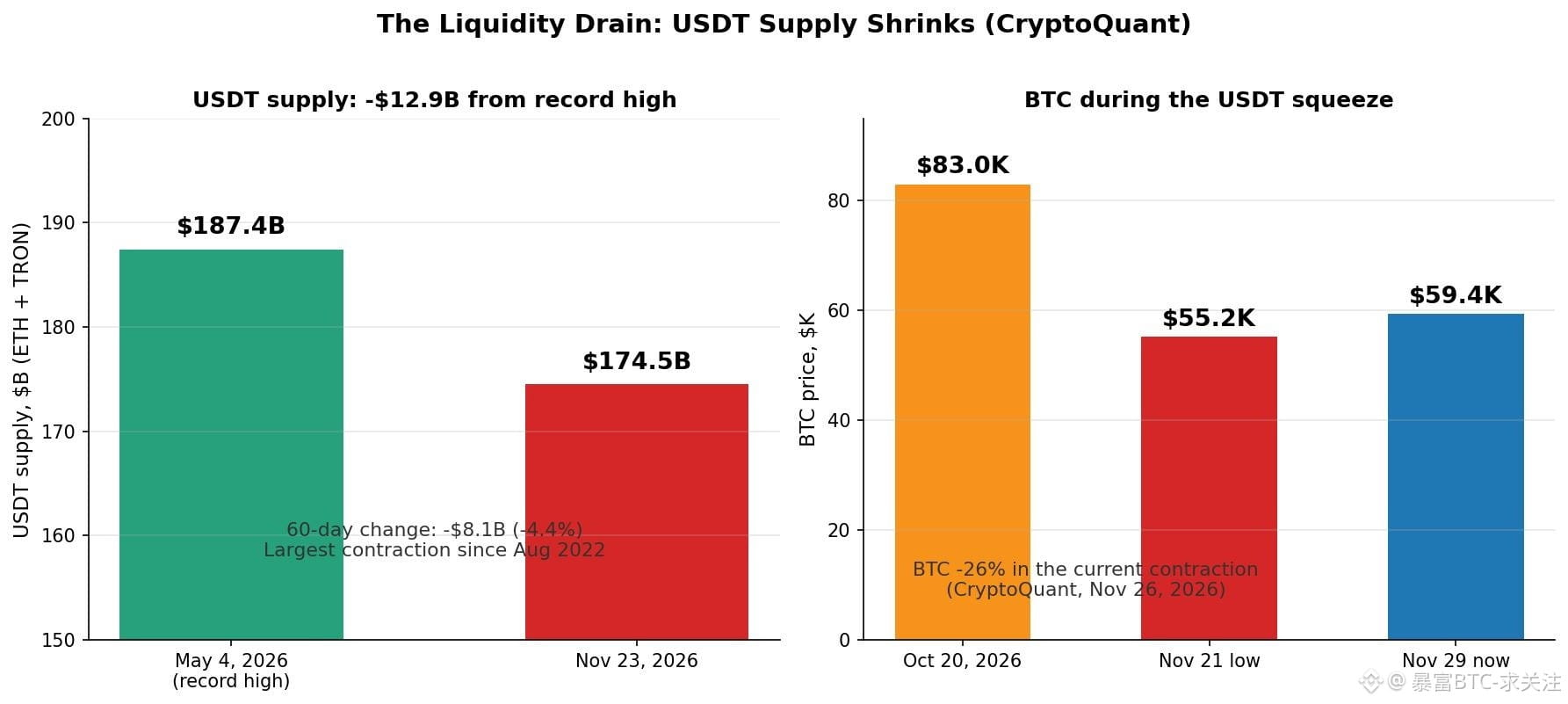
On November 26, CryptoQuant’s weekly report gave Bitcoin’s rebound a new diagnosis: it’s not that nobody is buying; there are simply fewer dollars in the market available to buy crypto. Over the past 60 days, the combined USDT supply on Ethereum and Tron has shrunk by $8.1 billion, a decline of 4.4%—the fastest contraction since August 2022. As of November 23, the two chains held a combined $174.5 billion in USDT, $12.9 billion below this year’s May 4 record high of $187.4 billion, a drop of 6.9%.
Almost all of the shrinkage took place on Ethereum. Over the 60 days, USDT on Ethereum fell by $8 billion, down 9.1%; Tron lost only $50 million, essentially unchanged. Ethereum now has $80.3 billion in USDT, $22.4 billion below its November 2025 peak of $102.7 billion, a decline of 21.8% and its lowest level since August 2025. The on-chain data show exactly where the money went: from October 9 to November 23, holders sent $11.65 billion in USDT back to Tether’s treasury address on Ethereum, while the treasury issued only $4.19 billion in new tokens, for a net withdrawal of $7.46 billion. Tether also burned $8 billion in two batches: $4 billion on November 2 and another $4 billion on November 20. Ethereum’s USDT supply consequently fell from $88.3 billion to $80.3 billion. Who paid it back? Bitfinex alone returned $6.66 billion, or 57.2%; Binance returned $3.71 billion, or 31.9%—together, the two exchanges accounted for 89% of the total withdrawals.
This isn’t an isolated event. Stablecoin market capitalization shrank by $14.8 billion in November alone, and has fallen by more than $20 billion so far in 2026. U.S. spot Bitcoin ETFs saw net outflows of $5.78 billion in November, setting a monthly record; Ethereum ETFs also saw $1.36 billion in outflows. Money is flowing out of funds, and dollars are flowing off-chain too, leaving Bitcoin caught in the middle. It’s currently at $59,400, down 0.85% over 24 hours, and grinding between $58,900 and $60,300.
CryptoQuant also looked back at the historical data: since 2022, the 60-day change in USDT has been negative on 23% of days. On those days, Bitcoin’s average 60-day return was -9.5%, and it fell 73% of the time. When USDT was growing, the average return was +7.6%, and returns were negative just 42% of the time. More painfully, Bitcoin has closed at a new all-time high 39 times since 2022, and not once did it happen during a period of USDT contraction. In the current contraction, Bitcoin has already fallen 26%, from $83,000 on October 20 to a low of $55,000 on November 21. The last time liquidity drained this quickly was August 2022—the final stretch of the bear market.
I see this in two time frames. Over the medium to long term, liquidity contractions are cyclical, not permanent: Tether can reissue the USDT it has burned at any time, and once net issuance from the treasury turns positive, the money will return. CryptoQuant offers three signals to watch: the 60-day change turning positive, supply on Ethereum stabilizing, and the treasury issuing more USDT than it takes back. Before all three signals appear, it’s too early to talk about a reversal. In the short term, don’t be fooled by a one-day bounce—without new money coming in, a rally won’t hold. Bitcoin is currently at $59,400. The first support level is the 24-hour low of $58,900; if that doesn’t hold, watch $55,000, the November 21 low. To the upside, first watch $60,300, then $62,000. Ahead of the Fed’s December 9 rate decision, what the market lacks isn’t confidence—it’s dollars.
One point of balance: USDT being returned doesn’t mean the money has disappeared. Burning tokens is just an accounting operation by Tether; the treasury can reissue them at any time. Some of the funds Binance returned were simply transferred between Ethereum and Tron, rather than actually withdrawn. Liquidity comes slowly and leaves quickly, but when it returns, it doesn’t give advance notice either. Bitcoin has hit 39 new all-time highs, none during a period of USDT contraction—the rebound can wait, but anyone waiting needs to see the dollars come back first. $BTC $ETH