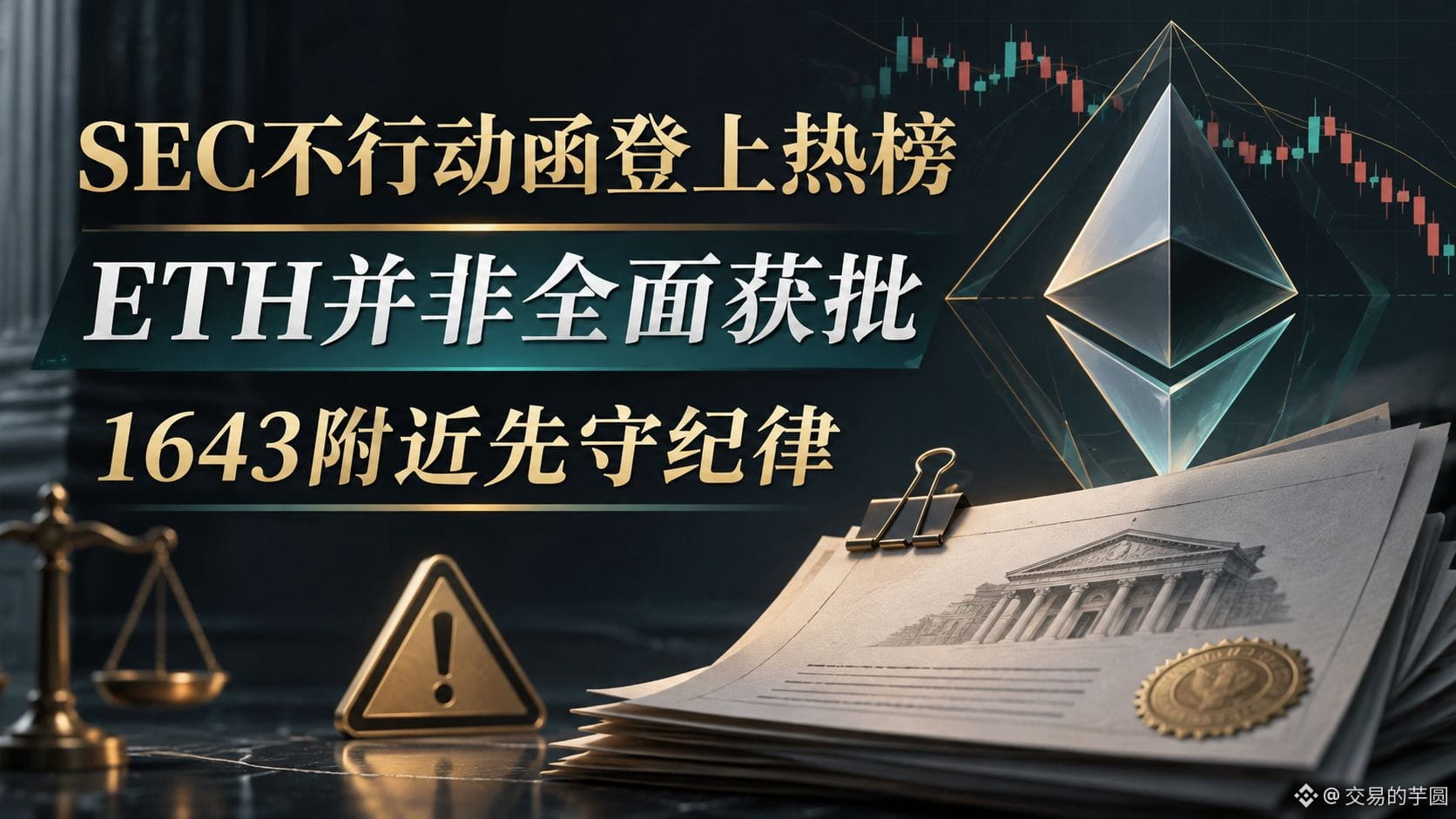
SEC No-Action Letter Trends|No Direct Approval-Related Boost for ETH|Stay Disciplined Around 1640
My stance is to watch cautiously and not interpret a regulatory letter concerning a specific project as a blanket pass for the entire Ethereum ecosystem. Among the trending topics on Binance Square, #SECIssuesNoActionLetterOnMoleculeModel ranked in the top ten, and ETH also appeared in the six-hour trending search. Interest is indeed rising, but trading decisions should start with the scope of the original letter.
On November 24, the SEC’s Division of Corporation Finance responded to a letter from Molecule AG: based on the facts and conditions described in the request, if LabsCo issues and sells Project Tokens as described, the Division would not recommend that the Commission take enforcement action over an unregistered offering under Section 5 of the Securities Act or a failure to register under Section 12(g) of the Exchange Act. The SEC’s original text also states that the conclusion could differ if the facts or conditions change; this is only the staff’s position on recommending enforcement action, not a final determination of the tokens’ legal status, and certainly not approval of all DeSci token offerings. “Would not recommend enforcement” and “formal approval” are two different things.
Why should ETH traders pay attention? If more on-chain research projects can find clearer compliance pathways, that could eventually increase demand for smart contracts, settlement, and custody. But whether that demand accrues to Ethereum mainnet, and whether it can generate sustained fee revenue and demand for ETH, still needs to be demonstrated by on-chain data. The letter itself does not change ETH supply, staking parameters, or the network upgrade schedule. Converting regulatory expectations directly into short-term ETH upside skips several intermediate steps of verification.
The market reaction also does not support chasing the price. At the time of the check, Kraken ETH/USD was around $1,643, with the rolling trading range opening around $1,661, reaching a high of $1,674, and a low of $1,633. The price remained below the open, suggesting that trending-topic discussion has not yet translated into a clear buying advantage for ETH. 1633 is the recent low, 1661 is the range open, and 1674 is the upper boundary; these are levels to watch, not guaranteed support or resistance. If the price breaks below 1633 on high volume, the bearish view strengthens. If it reclaims 1661 and holds on a retest, then watch whether 1674 can be decisively broken. If the regulatory scope is later expanded more clearly and on-chain activity improves, I would revise my current cautious view.
If I were trading it myself, I would stay out for now. The only direction I would consider is a leveraged-free spot position to test the long side, with an initial position no larger than 1% of total capital. The entry trigger would be a four-hour close above 1661, followed by a pullback that holds 1661, with no new security incident. If those conditions are not met, I would remain in cash. After entry, the first target would be 1674, where I would take half off; I would hold the rest toward 1700 and take another half off near that target. The stop would be below 1632. If the price loses 1633 on a four-hour basis or macro risks suddenly worsen, I would close the entire position early. If it rallies directly without a pullback, I would not chase it. There is no point in writing a plan that cannot be executed and calling it profit; first, preserve a workable exit route.
#SECIssuesNoActionLetterOnMoleculeModel #ETH
The above is solely my personal market observation and does not constitute investment advice.