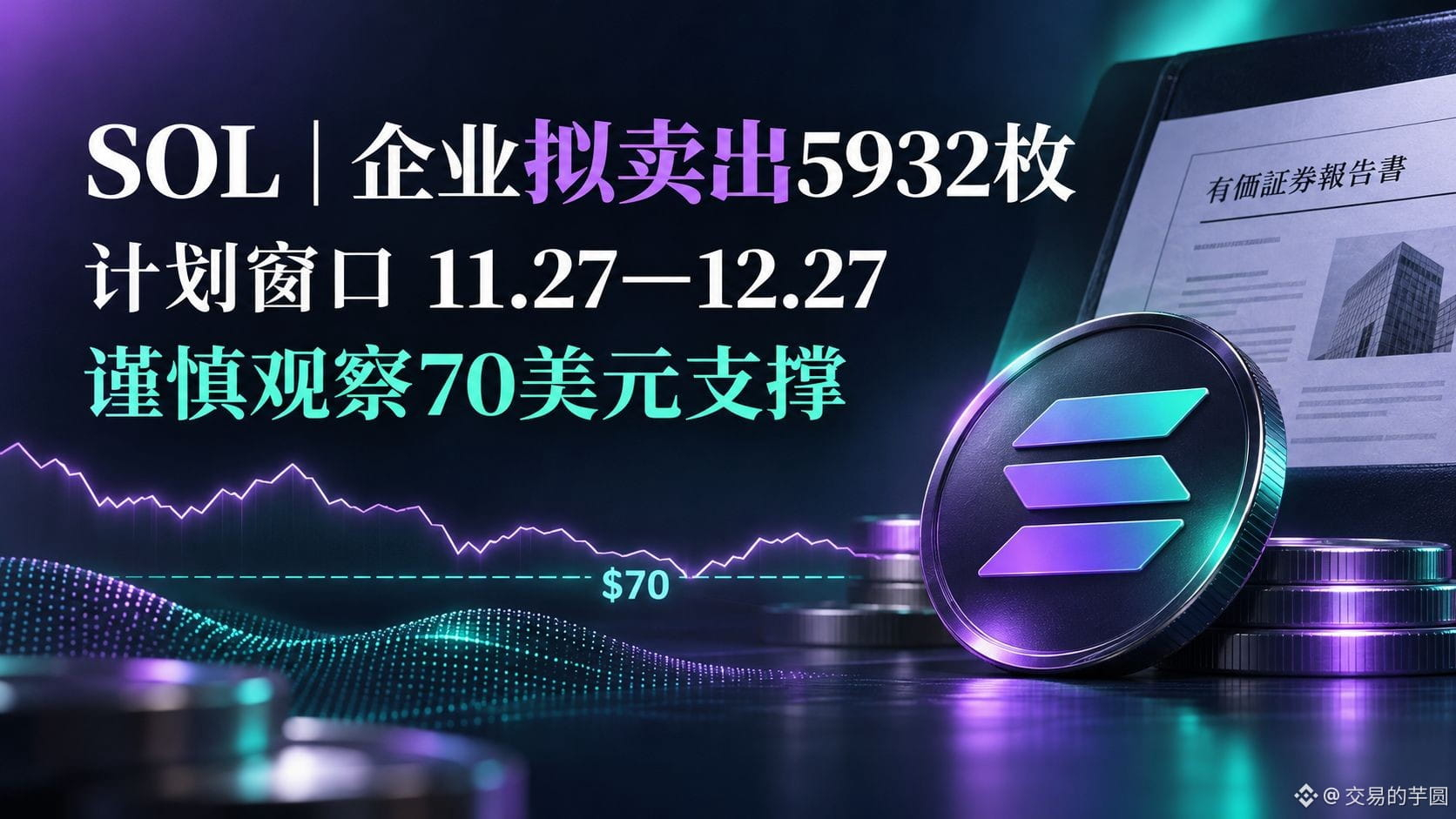
Cautious on SOL | enish plans to sell 5,932 tokens | First, see whether $70 holds
My stance is to wait and watch. I wouldn’t interpret one company’s plans to dispose of its holdings as a capital flight from the entire Solana network. The exact topic now appearing on Binance Square is #EnishPlansToSell5932SOL. What’s worth discussing is how corporate funding needs could translate into potential spot supply—not turning “plans to sell” into “has already sold.”
On November 27, the official disclosure from Japanese-listed gaming company enish stated that its board had decided to sell all 5,932.0586 SOL it holds. The planned sale period is November 27 to December 27, and the sale will be executed through domestic Japanese exchanges. The final sale price has not yet been determined, and the company will announce the completion of the sale afterward. The company also decided to conditionally withdraw its 50 million yen contribution to SBI Crypto Fund I, but the fund operator has not yet approved this, and neither the refund amount nor date has been determined. These are two matters at different stages. Original disclosure: https://japanir.jp/wp-content/uploads/2026/11/3667-20261127-01.pdf
The mechanism by which this could affect SOL is specific: a company that was previously a holder could become a seller, increasing expectations of short-term supply. The company says the reasons are to prioritize funding for its gaming business and reduce the impact of volatile assets on its finances. The estimated loss of about 43 million yen, calculated using the reference selling price on November 26, is only an estimate and cannot be described as a realized loss. The company says its DAT business will continue and that SOL may still be considered as a candidate asset in the future, but it currently has no concrete plans to repurchase SOL using its own funds. So I won’t infer from this announcement that “SBI is also selling,” nor will I treat its future multi-asset plans as immediate buying demand.
The market has already reacted in price, but attribution calls for caution. When I checked SOL/USD on Kraken, it was around $70.43, down about 1.6% from the 24-hour open of approximately $71.60, with a 24-hour high and low of about $72.59 and $70.08. This move occurred after the announcement, but timing alone isn’t enough to conclude that enish caused the entire decline. What’s more useful to me is watching whether the price repeatedly fails to hold around $70.08, and whether a rebound can reclaim $71.60. If it gets back above $72.59 and volume remains steady, concerns about short-term supply will become a less convincing explanation.
If I were trading this myself, I wouldn’t chase a short position right now. My tentative plan is to wait for confirmation, then take a small spot long position. I’d only consider a trial entry using 2% of my total capital if the price regains and holds above $71.60, and then holds on a retest. My first target would be $72.59; I’d take half off there and hold the rest for $74. I’d place the initial stop below $70.00. If the price breaks below $70.08 and rebounds weakly, I’d cancel the plan if I hadn’t entered. If the stop is hit after entry, I’d close the entire position without averaging down. If the company subsequently discloses that the sale is complete, or the price repeatedly fails to hold above $70, I’d reassess rather than look for excuses to defend my earlier view.
#EnishPlansToSell5932SOL #SOL
The above is solely my personal market observation and does not constitute investment advice.