#币安要做链上投行 🚀 He Yi Announces Tokenized IPO Plans as Exchanges Move Into Investment Banks’ Turf
On November 27, Binance co-founder and co-CEO He Yi announced at BNB Demo Night in Bangkok that Binance plans to launch a tokenized IPO program, helping companies issue shares directly on-chain, subject to regulatory approval. She stressed that this would be a “professional IPO process,” not simply a matter of listing a few more new coins. It’s part of Binance’s RWA strategy and will also involve DeFi projects. On the same day, Binance’s careers page listed an opening for an equity capital markets (ECM) analyst, requiring more than four years of IPO and follow-on offering experience. The job locations are Hong Kong, Malaysia, Singapore, and the UAE—recruitment is already underway.
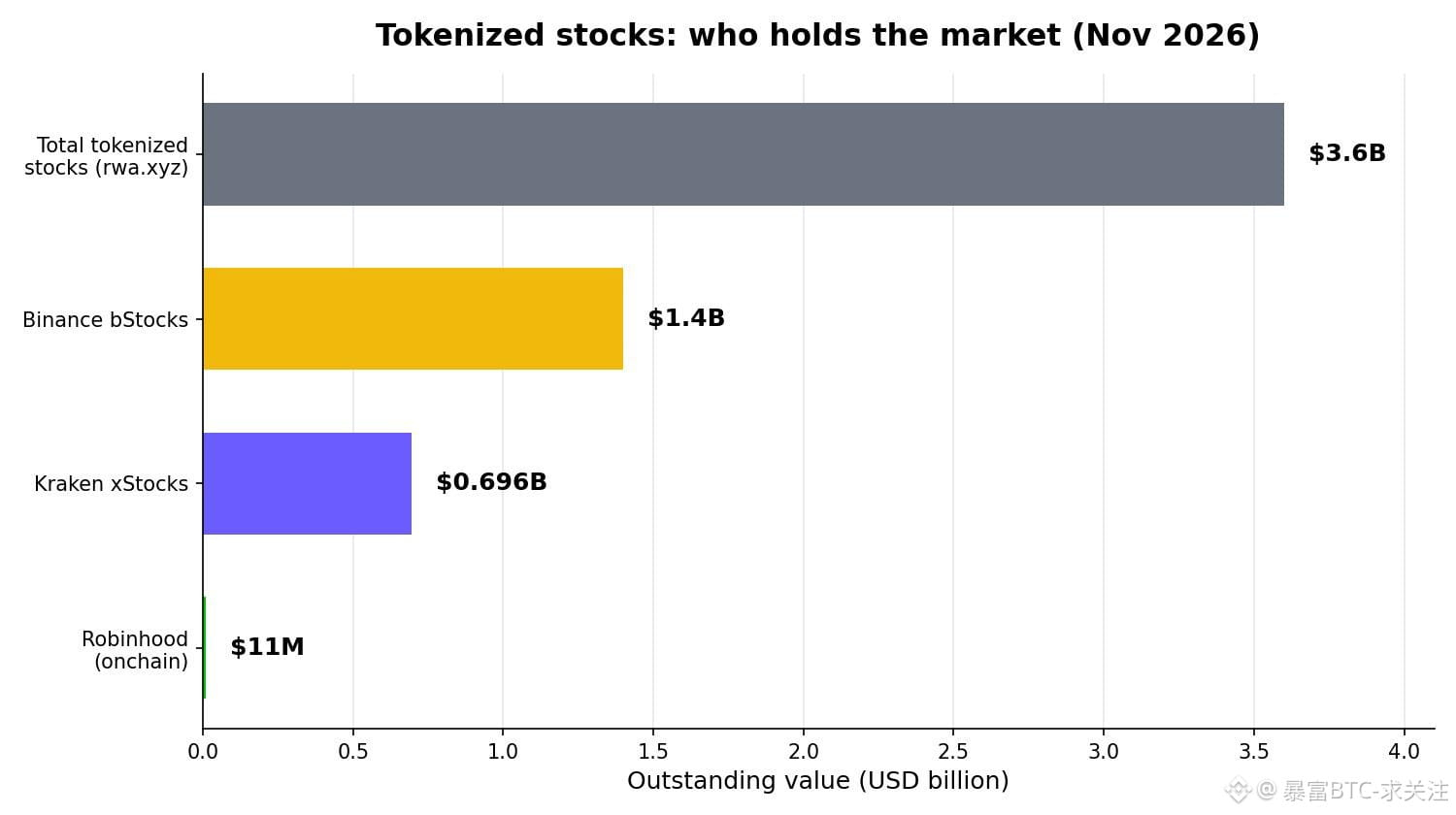
This isn’t starting from scratch. Binance launched its tokenized stocks, bStocks, in June this year, initially offering Nvidia, Tesla, Circle, Micron, and SanDisk. It added five more on October 21, seven on November 18, and another five on November 25, including IBITB, a tokenized version of BlackRock’s Bitcoin ETF; SOXXB, a semiconductor ETF; and ARTYB, an AI technology ETF. There are now 104 products in total. RWA.xyz data from November 3 put the total value at around $1.4 billion, after it had already topped $1 billion in October. The November 25 additions were also included on the list of margin collateral, and the zero-order-fee promotion has been extended to December 31. In other words, the trading and custody rails are already in place; the only missing piece is “issuance”—and that’s the piece He Yi is now adding.
The most interesting footnote came ten days ago. On November 18, Binance Wallet held an xStocks subscription for Anthropic’s IPO: the 500 million USDC allocation was snapped up in a few hours, and the offer closed early. But Binance received only 2,957 tokenized shares, corresponding to subscriptions worth 500.02764 million USDC. On November 19, it had to issue full refunds, distribute the shares it received for free on a pro-rata basis, and airdrop an additional $1 million worth of ANTB. Anthropic listed on Nasdaq that day, with an IPO price of $83 and an opening price of $111.50—a 34% gain in one day. Demand isn’t the problem: $500 million was snapped up in hours. The problem is supply—the exchange could get its hands on fewer than 3,000 shares. What He Yi is aiming to do is turn “allocating shares” into “issuing new shares.”
This isn’t an isolated event. On the same day, June 30, 2025, Kraken’s xStocks and Robinhood’s tokenized U.S. stocks launched: xStocks brought an initial lineup of 60 U.S. stocks and ETFs to Solana, while Robinhood made more than 200 available to European users via Arbitrum. This month, Kraken also announced its acquisition of issuer Backed Finance, and xStocks’ cumulative trading volume has already exceeded $10 billion. According to rwa.xyz, the total value of tokenized stocks across the market was around $3.6 billion as of November 26. The U.S. is also loosening restrictions: on September 17, the SEC issued an innovation exemption allowing compliant platforms to trade tokenized U.S. stocks on-chain; on October 28, the U.S. securities depository DTC launched tokenization services after receiving a no-objection letter from the SEC. From Kuala Lumpur to Bangkok, from Wall Street to Abu Dhabi, players in the on-chain stocks space are filling in the pieces one by one.
I see this in two ways. In the medium to long term, this is real growth: exchanges are becoming places to “issue stocks,” not just places to “sell coins”—bringing the primary-market business on-chain too. Binance already has the rails in place: 104 bStocks, $1.4 billion in assets, margin collateral, and zero fees. Add issuance, and the loop is complete. $BNB is currently around $550, down 2.28% over the past 24 hours, but this is a story about how exchanges are valued, not about today’s candlestick. In the short term, don’t get your hopes up about a timeline: He Yi hasn’t named a regulator, jurisdiction, or launch date, and nothing is set in stone. The Anthropic case has already shown that the bottleneck for distributing IPO shares on-chain isn’t demand—it’s whether the issuer is willing to provide shares. One reminder: bStocks are essentially receipts, not the shares themselves; they carry no voting or dividend rights and are issued only under prospectuses approved by Abu Dhabi Global Market (ADGM). U.S. users are explicitly excluded. A tokenized IPO is not the same as an IPO that has already been approved; if it doesn’t get the green light, it’s just talk. Exchanges may want to become investment banks, but regulators have to say yes first. Binance has shown its hand; the next move is up to the regulators. $BNB