


Quotation
The market has priced someone's departure twice. During the ten days he was gone, Nvidia's market capitalization decreased by $1.15 trillion; on the day he returned, the market capitalization rebounded to $950 billion. No other exchange in the world has quoted a price in trillions of dollars, or even daily. But what's truly worth trillions isn't the person, but the governance structure that allows one person's departure to leverage a trillion dollars.
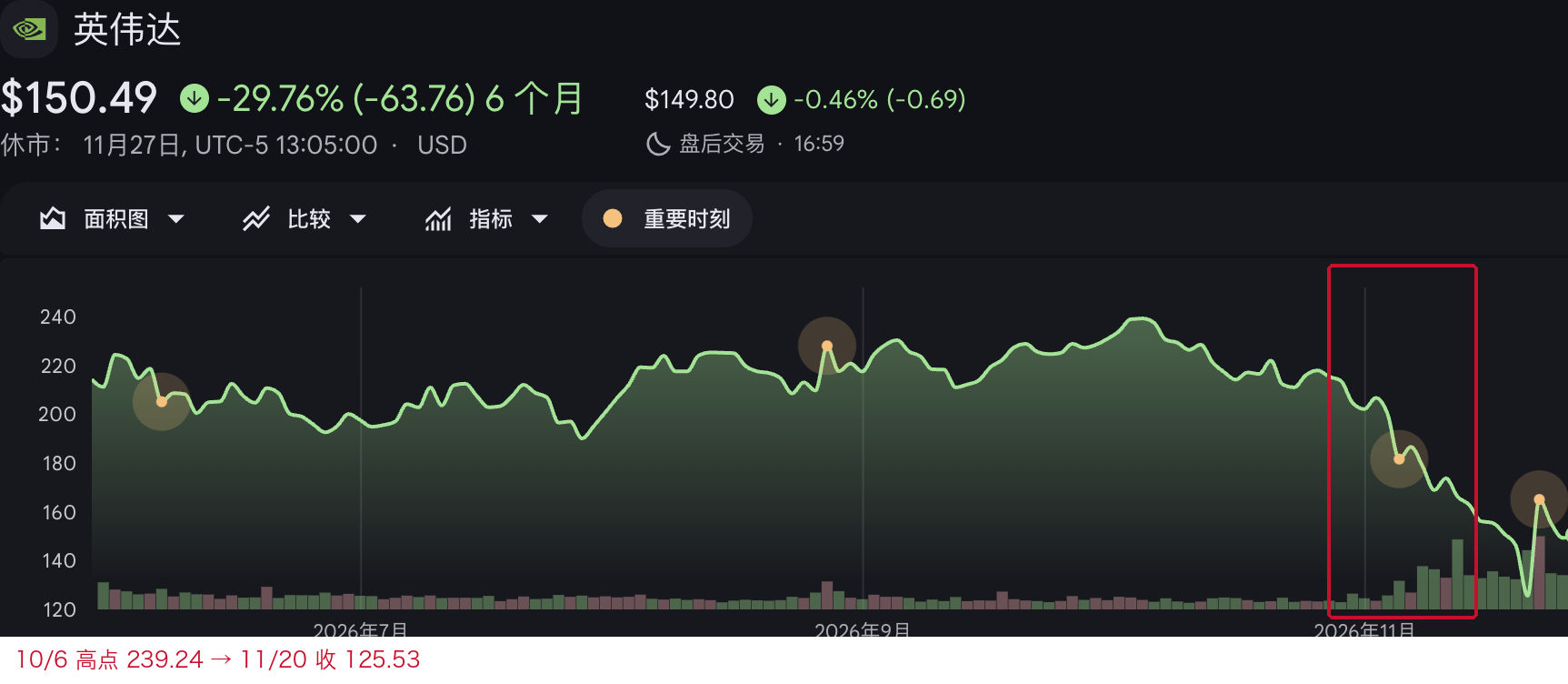
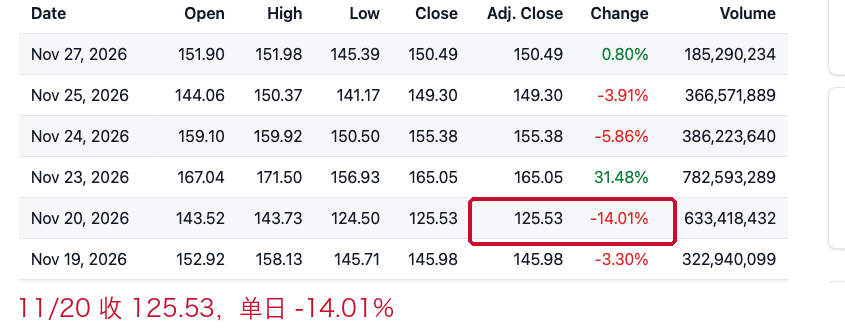
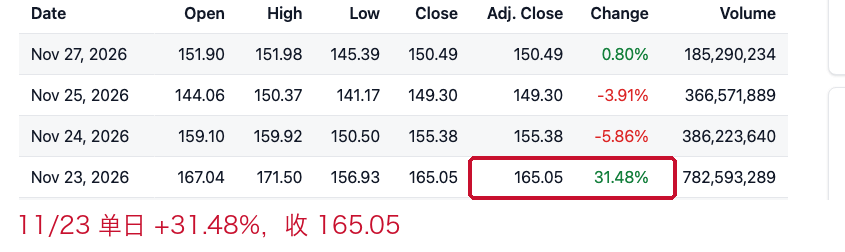
Based on a total share capital of approximately 23.9 billion shares, the prices at four key trading points clearly outline the complete picture of this fluctuation. On November 11, the last full trading day before his resignation, Nvidia's stock closed at $173.73, corresponding to a market capitalization of approximately $4.15 trillion; on November 20, the stock price fell to $125.53, a new 52-week low, corresponding to a market capitalization shrinking to $3.00 trillion; on November 23, the day the reinstatement announcement was released, the stock closed at $165.05, corresponding to a market capitalization rebounding to $3.94 trillion; and as of the close of trading on November 27, the stock price was $150.49, corresponding to a market capitalization of $3.60 trillion.
The market isn't evaluating him; it's pricing an unresolved issue. The market capitalization fluctuation of over a trillion dollars within ten days had no changes in production capacity, orders, or technological routes. The only variable supporting this volatility was the final outcome of the CEO position.
Therefore, this article will analyze these two numbers separately.
Change: A $210 billion shortfall
Selling 1.15 trillion and buying back 950 billion, leaving a difference of 210 billion, this gap is the most valuable part of the whole story.
If the market truly priced assets solely based on "Huang Renxun's personal value," then the market capitalization recovery resulting from his return should be entirely commensurate with the market capitalization loss caused by his departure. However, the actual recovery was $210 billion less than the loss. This $210 billion difference does not represent a discount on his personal abilities, but rather a pricing of the risk associated with "whether he can actually return."
On November 17, Nvidia's board of directors publicly stated that they did not intend to reinstate him, with betting markets giving him less than a 10% chance of re-election. Just six days later, on November 23, the same group of directors unanimously passed a resolution to bring him back. The change of heart within eleven days was not made by secondary market investors, but by Nvidia's board members.
So that $950 billion wasn't bought with capability, but rather with the realization that "a long-standing mystery has finally been solved." A company worth five trillion dollars.
A private life scandal can trigger a trillion dollars, not because the scandal is big, but because a large portion of the company's market value is based on "him still being alive".
On October 6, 2026, Nvidia's stock closed at $239.24, a record high, corresponding to a market capitalization of approximately $5.72 trillion. Supporting this astronomical market capitalization was its rapidly growing performance: quarterly data center revenue reached $107.6 billion, a year-on-year increase of 110%; of which, hyperscale cloud revenue was $60.1 billion, a year-on-year increase of 71%; AI cloud and enterprise revenue was $47.5 billion, a year-on-year increase of 195%; and edge business revenue was $8.2 billion, a year-on-year increase of 42%. The company's inventory reached $39.7 billion, compared to only $21.4 billion a year earlier; in September, the company added $150 billion in share buyback authorizations, bringing the remaining buyback quota to $227.3 billion; and in the quarter, it returned $28.1 billion to shareholders.
In this company's valuation, current profits only account for a portion; a larger proportion comes from the market's expectation of continued high growth in AI capital expenditures over the next few years. And the credibility of this expectation, within the market's default pricing logic, is always endorsed by Jensen Huang alone.
So the reason a single email could wipe out a quarter of a company's market value is because it destroyed that guarantee. A single email, on the day of resignation.
The resignation wasn't a dismissal; it was voluntary. However, the board's choice of words spoke volumes more than the dismissal itself.
On November 8, Huang sent an email to all employees admitting to infidelity to his wife; on November 11, the media revealed a second affair involving a vice president who reported directly to him; the same batch of reports also mentioned a third lead, a woman doing business in Singapore, whom the US suspected had an intelligence background—it must be made clear that this was only suspicion, without any evidence, and the board of directors' investigation ultimately did not reach a conclusion on this matter. This woman was neither accused nor proven to have any problems.
On November 12, Nvidia filed an 8-K with the SEC, announcing that Jensen Huang had resigned as president, CEO, and board member, effective immediately. The board's statement said his "personal conduct was inconsistent with the company's code of conduct, standards, and cultural norms." The company also announced that CFO Colette Kress would serve as interim CEO, Harvey C. Jones would become the company's first chairman of the board, and an independent investigation would be launched. Huang's only public statement was: "I have not met Nvidia's expectations of everyone."
The official document contained not a single word defining the conduct as a violation; it only described the inconsistencies in the situation. The board of directors did not want to make definitive statements that would leave no room for maneuver, nor did it want to leave any ambiguous grounds for accountability.
So from that day on, the object of stock trading was no longer the scandal, but "who will sit in this position next".

Ten days, 1.15 trillion
The market lost 1.15 trillion yuan in ten days. The sharpest drop didn't happen on the day the news broke, but more than a week later.
In the pre-market trading session following the announcement of his resignation on November 12, Nvidia's stock price initially fell by 10%. The real plunge occurred more than a week later, with the stock closing at $125.53 on November 20, a single-day drop of 14.01%, hitting a new 52-week low. From $173.73 on November 11 to $125.53 on November 20, the cumulative decline was 27.74%; if calculated from the all-time high on October 6, the pullback reached 47.5%, and the market capitalization shrank from $4.15 trillion to $3.00 trillion. During this period, employees spontaneously petitioned, demanding that the board release the conclusions of an independent investigation; Musk publicly voiced his support for him at X, arguing that the value of a company should not be determined by one person's private life.
Throughout the week, the entire market was calculating a question no one had ever asked before – how much is Nvidia worth without Jensen Huang? There's no standard answer to this question, and no historical data to refer to, but the closing price of $125.53 indicates that on that day, the market chose the most pessimistic answer.
Therefore, if half of a price is a "guarantee for the future," and that guarantee is removed, the price must be recalculated.
He said he was willing to come back, but the board said no.
The most valuable moment in the unsolved case wasn't the day he resigned, but the day he expressed his willingness to return and the board of directors said they didn't need him.
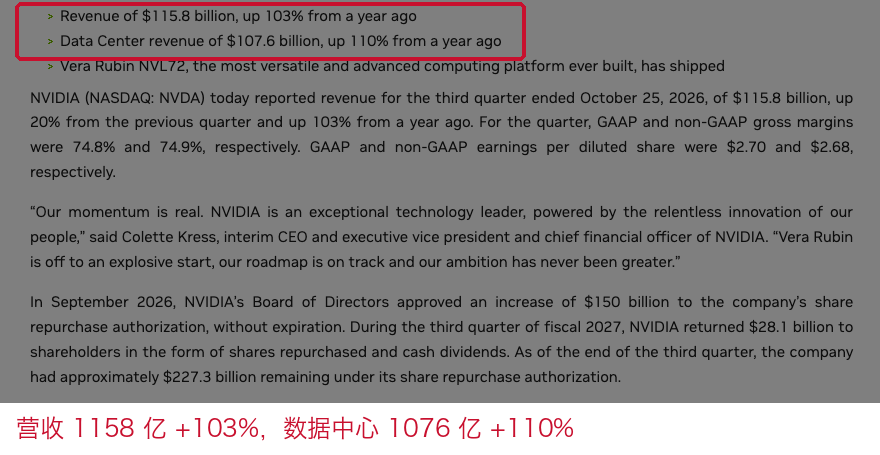
On November 17, Jensen Huang publicly stated that if the board believes his return is in the best interests of shareholders, employees, the company, and the United States, "I will be honored to respond to these calls." Later that day, after the market closed, Nvidia released its earnings report: quarterly revenue of $115.8 billion, a year-over-year increase of 103% and a quarter-over-quarter increase of 20%; data center revenue of $107.6 billion; GAAP gross margin of 74.8%; net income of $65.3 billion; GAAP earnings per share of $2.70; and next quarter revenue guidance of $130 billion plus or minus 3%, explicitly stating that it excludes any revenue from its Chinese data center business.
On the same day the financial report was released, the board made it clear that they did not intend to reinstate him, with the betting market giving him less than a 10% chance of being reinstated. A financial report showing doubled revenue and explicitly excluding Chinese data center revenue from its guidance failed to pull the stock price back from its lows. This clearly demonstrates that the core variable in market pricing at that time was not current performance, but rather who would ultimately sit in the CEO position.
So the results prove that he wasn't needed this quarter, but they don't prove he won't be needed next year.
The day I was reinstated
The reason for the increase of 950 billion yuan on that day had absolutely nothing to do with the company's operations.
On November 23, Nvidia's board of directors unanimously passed a resolution to reinstate Jensen Huang as president and CEO, citing satisfaction with his "frankness and leadership." The statement also included a note saying that after consulting with senior U.S. government officials, it was confirmed that his reinstatement did not pose a national security risk. Trump stated on a television program, "I talked to them, I convinced them," adding, "I closed this deal." Nvidia's stock closed at $165.05 that day, a 31.48% increase, with 574 million shares traded, adding approximately $950 billion to its market capitalization, marking the largest single-day gain since May 2003. One analyst's assessment that day was simply: "Terrible corporate governance."
This assessment isn't a personal attack; it points to a core fact. He was an extremely capable manager, but the market wasn't buying his abilities that day. A company whose market capitalization once exceeded five trillion dollars could have one person's departure determine the rise and fall of nearly a trillion dollars in market value—this decision-making mechanism itself is a systemic risk.
So the 950 billion yuan increase that day was the market paying for "certainty".
Three things on the fourth day.
His return only resolved who made the decisions, not where the money would come from.
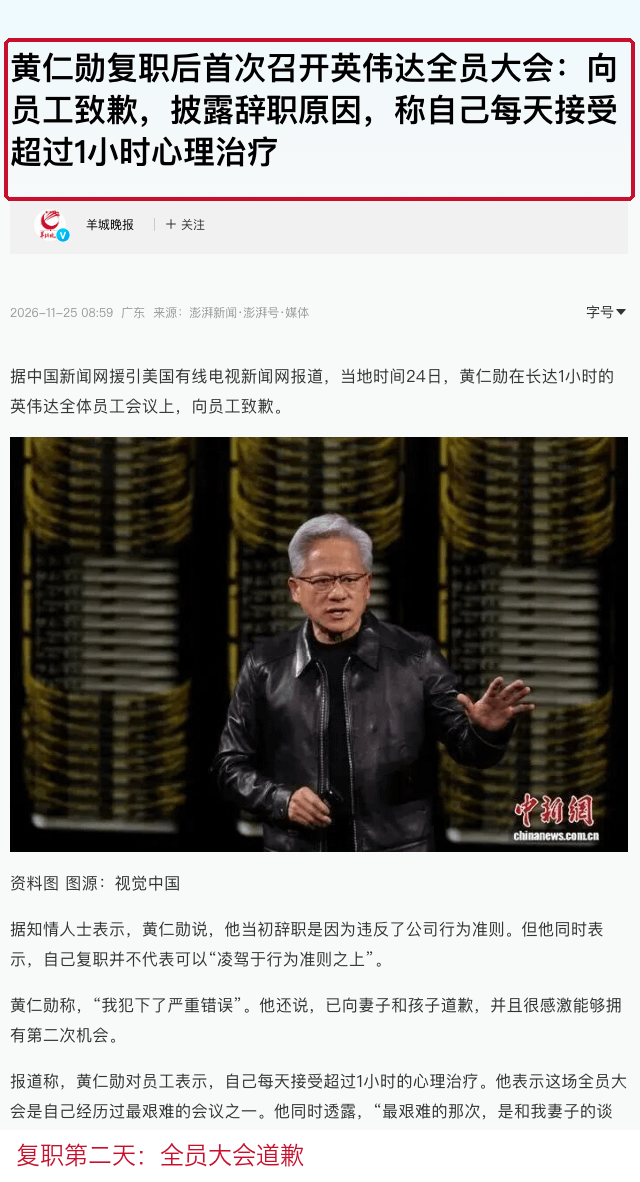
The stock's upward trend following its return to the company didn't last long. On November 24th, the stock price fell 5.86%, followed by a further 3.91% drop on November 25th, closing at $150.49 on November 27th, corresponding to a market capitalization of $3.6 trillion, approximately $350 billion less than the high point on the day of its return. Around the same time, Huang held an all-hands meeting lasting about an hour, where he apologized, saying he had "made some terrible mistakes" and "hurt everyone." He stated that he undergoes more than 90 minutes of psychological therapy daily, denied that Trump had pressured him to return, and stated that the company did not need a succession plan.
The first thing is interest rates. In October, US PCE rose 3.8% year-on-year, and core PCE rose 3.3% year-on-year. The Federal Reserve will hold its policy meeting on December 8th and 9th, releasing its decision and dot plot on December 9th, corresponding to early morning Beijing time on December 10th. The current target range for the federal funds rate is 3.75% to 4.00%. After a 25 basis point rate hike on September 16th, the market has priced in a 97% probability of another rate hike at the October meeting. This matter is irrelevant to him in the Fed's meeting room.
Secondly, the money for AI is borrowed. Data from JPMorgan Chase on November 25th shows that AI-related investment-grade bond issuance reached $368 billion in 2026 and is projected to reach $450 billion in 2027, in addition to $65 billion in leveraged financing; by 2027, total AI capital expenditure across the industry will approach $1.4 trillion. The Federal Reserve's Financial Stability Report released in November shows that as of October, advanced computing-related debt issuance exceeded $680 billion, more than five times the $13 billion issued in 2023. Regarding free cash flow, Amazon's free cash flow over the past twelve months was negative $42.4 billion, Alphabet's single-quarter free cash flow was negative $9.1 billion, and among the four hyperscale cloud vendors, only Microsoft maintained positive free cash flow. This is irrelevant to the cloud vendors' cash flow statements.
The third issue is compliance with Chinese regulations. Simply put, Nvidia chips bypassed US export controls and entered mainland China. On November 27th, Bloomberg reported that a whole cabinet of GB300 NVL72 chips was found in a Shanghai data center. This model is on the US export ban list, and the chip serial numbers can be traced back to Gigabyte. These chips were also used as collateral for a loan of 96 million RMB. The Singaporean company Megaspeed, implicated in this case, was added to the Entity List that same week. From December 1st to 3rd, Jensen Huang and the company's general counsel were scheduled to testify behind closed doors before three House committees and the Senate regarding this matter. Currently, US regulators and media are investigating this issue; there has been no court ruling, and it involves suspected illegal resale. The outcome of this matter is in the hands of regulatory agencies and is not his concern.
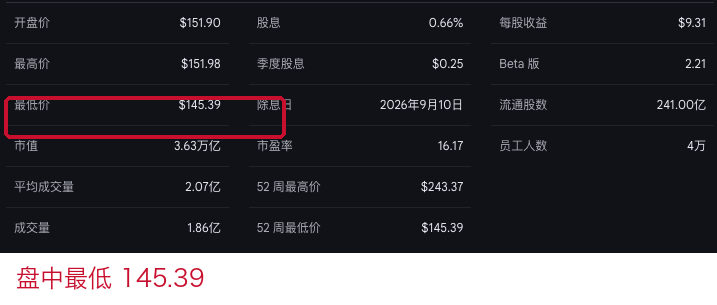
The significance of this lead lies not in the number of chips sold less or the amount of revenue lost, but in the fact that goods have appeared in places they shouldn't be. Revenue risk merely means less profit, affecting valuation; compliance risk, however, could lead to fines, supply disruptions, and being placed on a blacklist, jeopardizing the very foundation of the business. On November 27th, the pre-market stock price rose by 1% to 4.7%, but all gains were wiped out after the opening bell, hitting a low of $145.39 before closing at $150.49, with a total trading volume of 185 million shares. In just half a day of trading, the market initially offered hope, only to retract it just as quickly.
The market gave Nvidia a price tag twice for its decision to stay or leave: during the ten days he was gone, Nvidia's market capitalization dropped by $1.15 trillion; on the day he returned, it rebounded by $950 billion. But what's truly worth trillions isn't the person, but the governance structure that allowed one person's departure to leverage a trillion dollars. On the fourth day after his return, the money started flowing back. The $950 billion increase bought certainty, while the $350 billion decrease showed the market realizing that that certainty wasn't actually tied to him.
Therefore, none of these three issues can be resolved by an apology.
Learn from history
Looking at similar events over the past forty years, personnel have never been the pricing factor; business direction is.
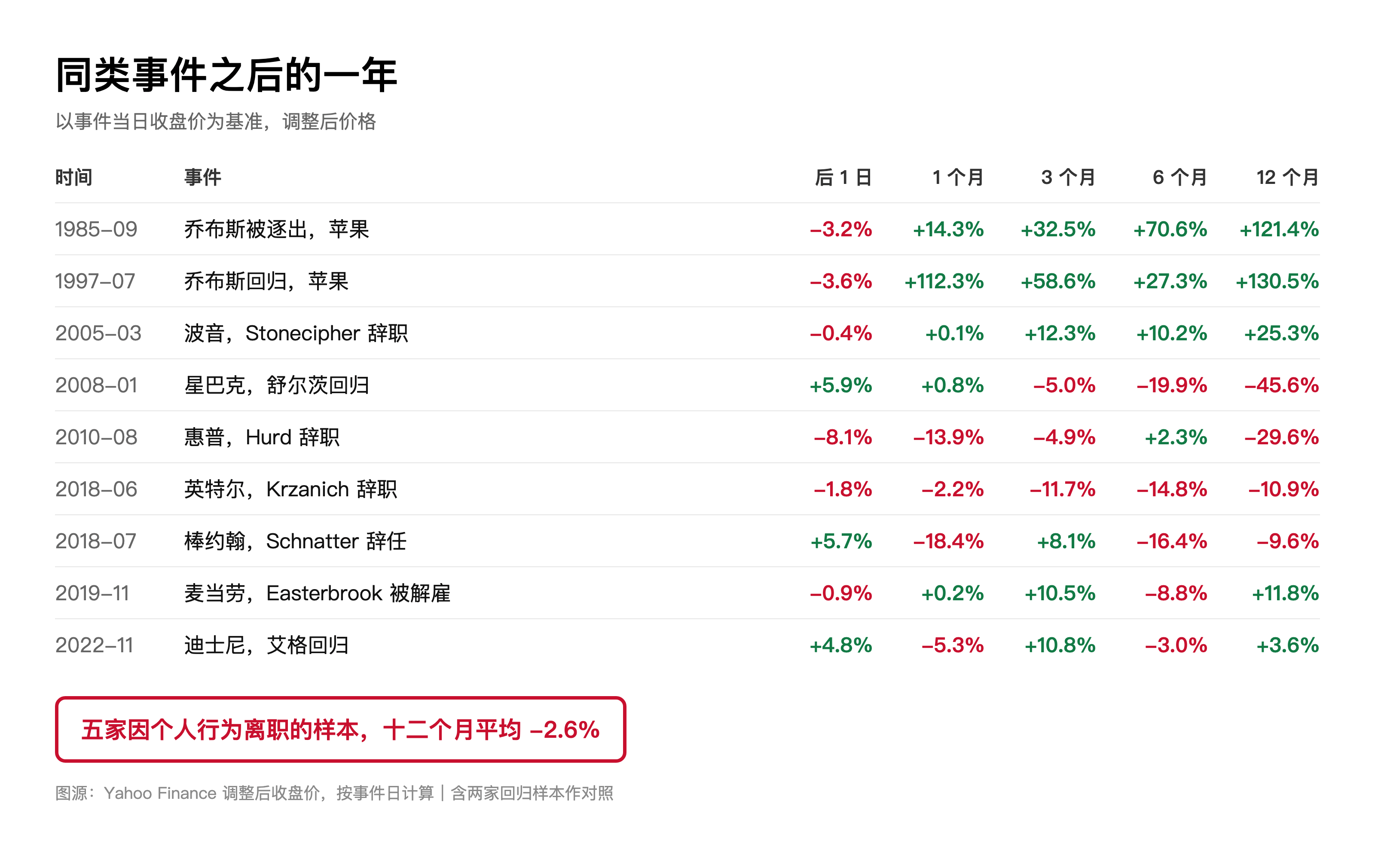
Nine events were analyzed using the same benchmark: the closing price on the day of the event was used as the base to calculate the price changes over five timeframes: 1 day, 1 month, 3 months, 6 months, and 12 months. Complete data is in the table below; here, we will only present three conclusions.
First, the price fluctuations on the day of the event contain almost no information. The day Jobs was ousted from Apple, the stock only fell 3.2%; the day the McDonald's CEO was fired, it fell less than 1%; the day the Boeing CEO resigned due to an office romance, it fell 0.4%; and the day Schultz returned to Starbucks, it rose 5.9%, but a year later it had fallen a cumulative 45.6%. That price line on that day was priced by sentiment, not by the outcome.
Second, there's no single answer after a year; the mean can be misleading. In five out of nine instances, the return was higher than the event date a year later, and lower in four. The average 12-month return was +21.9%, but the median was only +3.6%. The mean was propped up by the two Steve Jobs cases (+121.4% and +130.5%). Remove those two cases, and the average of the remaining seven is -7.9%.
Third, and most closely related to Nvidia: five companies—Boeing, HP, Intel, Papa John's, and McDonald's—that resigned due to personal reasons and never returned, had an average 12-month loss of 2.6%, meaning they worked for nothing. The market doesn't reward replacements; it only rewards the end of suspense.
However, this Nvidia incident has no historical precedent. The fact that someone resigned voluntarily due to personal reasons, only to be unanimously recalled by the same board of directors eleven days later, is unprecedented in the history of a major global technology company.
So history can tell us that personnel events are basically forgotten a year later, but it can't tell us whether this time will be the same—because this time there's an additional layer of structural issues.
Conclusion: The expensive part is the structure.
What's truly worth trillions isn't Huang Jen-hsun, but this structure that allows him to leverage a trillion dollars all by himself.
Eleven days ago, the board publicly stated they had no intention of reinstating him; eleven days later, they unanimously invited him back, citing satisfaction with his "frankness and leadership." The same group of people completely changed their tune within eleven days, offering no new investigation findings or supplementary factual evidence. The value of this decision-making mechanism far outweighs his individual abilities, and it won't disappear simply because of his successful return.
From a fundamental perspective, Nvidia's fourth-quarter revenue guidance is $130 billion, 12% higher than the $115.8 billion in the previous quarter, and explicitly excludes revenue from its China data center business; gross margin guidance is 71% to 72%. Based on full-year earnings per share of $9.67, the share price of $150.49 corresponds to a P/E ratio of 15.6. The median target price given by the 63 analysts covering the stock is $240, the average is $242.43, with a minimum of $130 and a maximum of $425.
The subsequent stock price movement can be roughly categorized into three scenarios. The first is sideways consolidation, with the stock price fluctuating between $150 and $200, with a probability of about 50%. The second is that the Fed's dot plot suggests the end of the rate hike cycle, and looser liquidity pushes the stock price back above $200, testing the historical high of $239.24, with a probability of about 1/4. The third is that new evidence emerges during the congressional hearings, or the revenue from Chinese operations is reassessed, causing the stock price to fall below the previous low of $125.53, targeting $110, with a probability of about 1/5. There are three key points to observe: the Fed's dot plot statement in the early morning of December 10th, whether the four hyperscale cloud vendors can still borrow enough money next year, and whether the serial number of that GB300 cabinet will appear in the testimony during the congressional hearings.
What the market bought that day wasn't a person, but a guarantee; this guarantee was worth $950 billion, but its issuer was a company that had a trillion dollars on its name.